Eric Chevillard - Prehistoric Times
Здесь есть возможность читать онлайн «Eric Chevillard - Prehistoric Times» весь текст электронной книги совершенно бесплатно (целиком полную версию без сокращений). В некоторых случаях можно слушать аудио, скачать через торрент в формате fb2 и присутствует краткое содержание. Год выпуска: 2012, Издательство: Archipelago Books, Жанр: Современная проза, на английском языке. Описание произведения, (предисловие) а так же отзывы посетителей доступны на портале библиотеки ЛибКат.
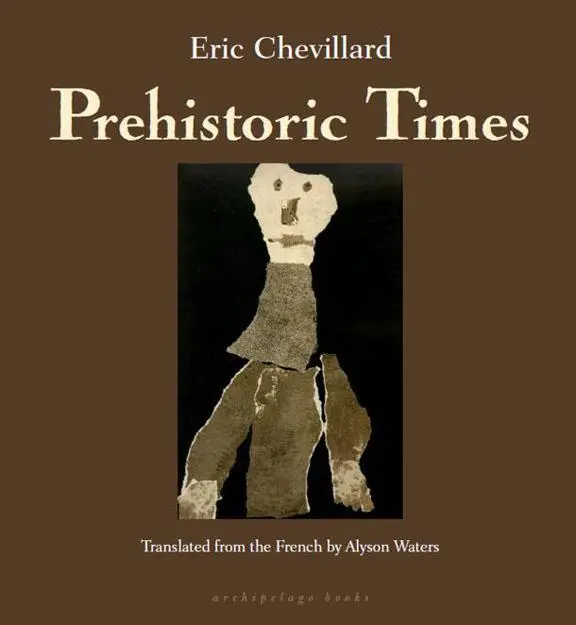
- Название:Prehistoric Times
- Автор:
- Издательство:Archipelago Books
- Жанр:
- Год:2012
- ISBN:нет данных
- Рейтинг книги:5 / 5. Голосов: 1
-
Избранное:Добавить в избранное
- Отзывы:
-
Ваша оценка:
Prehistoric Times: краткое содержание, описание и аннотация
Предлагаем к чтению аннотацию, описание, краткое содержание или предисловие (зависит от того, что написал сам автор книги «Prehistoric Times»). Если вы не нашли необходимую информацию о книге — напишите в комментариях, мы постараемся отыскать её.
Prehistoric Times — читать онлайн бесплатно полную книгу (весь текст) целиком
Ниже представлен текст книги, разбитый по страницам. Система сохранения места последней прочитанной страницы, позволяет с удобством читать онлайн бесплатно книгу «Prehistoric Times», без необходимости каждый раз заново искать на чём Вы остановились. Поставьте закладку, и сможете в любой момент перейти на страницу, на которой закончили чтение.
Интервал:
Закладка:
BIRDS CHANGE names whenever they change habitats, this is why they are at home wherever they go. Their flightiness does considerable harm to the notion of native land. Fortunately there are farmyards, nations are saved by their farmyards. However, this would not be enough. Nations are above all mineral, at one with their soil. Rome when it left home was ultimately defeated by Barbarians and returned to Rome with its she-wolf’s tail between its legs, immobilized for good, petrified, a tourist attraction. The geologic samples that we shall now examine more closely provide a rather accurate picture of the Pales valley, a picture that is, however, retrospective or prophetic, because we have only shards, fragments of rock, a vision of chaos or apocalypse, no matter, it’s the same scene. Every human work as it is constructed also foreshadows what will be, but in reverse, its successive ruins, and each year of our life discreetly celebrates the anniversary of our death: time passed through here, it will go back through here. Inexhaustibly rich in silicates, iron oxides, and manganese, the Pales region, birthplace of painting, is also reputed for its low grain yield, where the hens lay so rarely that storks hatch from their eggs. Art and hunger have thus belonged to one another since the beginning, shaped by the same dreams of abundance and sensual delight. I’m inclined to believe that the first painter discovered ochre’s properties as a colorant while sucking on a stone to stave off hunger. All day long he spat stars. This could very well be how the whole adventure began. The ever mysterious origin of stories interests me more than their always predictable endings; this is why I would make a pathetic storyteller — am I not naively lighting the evening bonfire on the thatched roof of my cottage? — a lousy storyteller concerned only with beginnings, origins, genealogies, etymologies, and continually postponing the start of his story instead of moving beyond, to the rest, to the action, because sooner or later, he must — no matter what ruses are employed or even deployed to delay as long as possible this fatal, inevitable, ineluctable, and terrifying outcome at the end of a sentence, on the edge of the void — conclude.
This way, please. At least, I think so. There are so many directions. But it must be this way, yes, I’d swear to it, but not on my life. This way out, then, straight ahead, then left, dark little hallway, left again after the overhang, watch your head, then right, take the steep path that leads to the upper level, another dark passageway, we grope along and yet we move ahead, we’re getting closer — this half-light in fact is not due to some negligence, make no mistake, nor to a lack of means; it is deliberate, maintained, necessary. Continuous lighting would quickly cause the painters’ colors to fade. Light tends to replace everything it touches. This is why the Pales network has a very specific electrical installation similar to the one used in theaters where daylight — too dated, anachronistic — is also kept out. Intermittent projectors, inspection lamps that seize a mammoth or a bison, but for just an instant, fleetingly, nothing like those rabbits frozen in the beam of a headlight like in aspic, here the visitor has no time to feast his eyes on what he sees: the chosen figures do their little trained-animal act and then night reclaims them. Let’s move along. This way. Not too fast, please. Pay close attention or you might trip on the pebbles littering the next section and that even threaten to obstruct it. But I’m here with you, out in front, I know my job, we’ll make it through.
Graphite, magnetite, limonite, hematite, xanthosiderite, stilpnosiderite, turgite, goethite, lepidocrocite, aeitite, glauconite, laterite, hausmannite, braunite, manganite, I invite hard-up literary hacks to profit free of charge from this little iterative ditty. Even though I am always sorry to have to abandon a line of thought, I cannot exploit each and every one, they would take me too far too fast, some in a zigzag toward the horizon, others in a spiral toward the depths, they would lead me away from my task, this relentless work of mine, I prefer to let them go, they’ll surface here and there no doubt, the most gorgeous crystallizations are often produced a good distance from the main deposit — the way a cold takes root in one’s feet and its big fat red fruit appears in the middle of one’s face — the undersea trajectory of the shark is punctuated at very long intervals by its flashes on the surface, and the hand that was testing the water is surprised to find it pointy, then the shark dives again, its hunger satisfied but its stride unbroken; let us never forget what is hatching in the depths, everything is related so sometimes everything becomes confused, it’s not my fault, the digressions I allow myself — follow me carefully here — are not equivocations or stalling tactics, on the contrary: I accelerate round the curves, I want nothing to escape me, I want to exhaust my subject, explain matters thoroughly, I refuse to be distracted by anything that doesn’t belong — did I open the door to that adorable angel who was writhing in front of it? These digressions go from a point A to a point C, or H, or X, rather than starting at the beginning of the alphabet each time (I’m trying to forget that inane nursery rhyme). This way I gain time, my work goes faster. Besides, we know that people who claim to zip along in a straight line go round and round in the forest, the rescue team will arrive after the crows.
Graphite, magnetite, limonite…exquisite nuggets for the Pales painters who filled their pouches with crude fragments extracted from the soil and built up large reserves of colorants that they stockpiled in one of the cave’s secret alcoves to which only the initiated had access: true artists were as rare then as they are today and the responsibility for decorating the caves fell exclusively to them; a few chance engravings in the recesses doubtless attest to the resentment felt by the talentless amateurs expelled from the main site — their mammoths are schematic and stunted, already resembling our poor little elephants. The collection of samples we possess was reconstructed by Professor Glatt and his team using pigments taken directly from the frescoes. All the shades sliding slowly from black to yellow were known to the painters, who nonetheless never managed to obtain blue, or else they thought it useless to put on another layer beneath a perfect sky, or green, but green was already devouring the entire landscape as far as the eye could see. The natural calcite flows provided the white without too much difficulty; they were left unpainted and were judiciously outlined by the angles and edges of the adjoining colored surfaces, exactly like the level of wine in the bottle measures the emptiness of existence. Sometimes I myself borrow this clever technique from the Paleolithic masters, and the blank space I leave between two passages is a result of the same graphite-saving practice, the same act of nonintervention; I don’t deny the influence, I learned my lesson.
And here’s something else to ponder: a tiger body, engraved midway up the wall in a chamber of the upper gallery, on whose flank we find four deep, parallel stripes with red accents. This was long ago the inspiration for a terse, peremptory study by Professor Opole entitled The Tiger-God of the Men from Pales . It was based on a meticulous analysis of this tiger, reduced symbolically to the pattern of its markings and devoutly placed at the very center of the cave, which got a lot of attention before it was destroyed by Professor Glatt in his counterattack: Drinking Time for Professor Opole . In that article, Glatt irrefutably proves that the alleged tiger stripes were actually made on fresh clay by a bear with one swipe of its claw, and the wall also displays very thin grooves that are traces of fur — the bear’s, without a shadow of a doubt, because women and men at the end of the Paleolithic Era had long not been the hairy primates we now see popularized in colored prints, as if the exuberant proliferation of their pubic fleece should have allowed the disposal of an unsellable stock of Adams and Eves. As for the red incrustations of the four stripes, Professor Glatt attributes them to a natural percolation of iron oxide, subsequent to the bear scratch: chance meddles in everything, and it exists as surely as the origin of the winds; sometimes it changes a rain cloud into a thoroughbred, a sandal, a Dalmatian tripping as it runs, collapsing, and it kills it off, but sometimes its work will last, it engraves a red tiger in stone; think what you will but whenever it happens, I take off my cap to it.
Читать дальшеИнтервал:
Закладка:
Похожие книги на «Prehistoric Times»
Представляем Вашему вниманию похожие книги на «Prehistoric Times» списком для выбора. Мы отобрали схожую по названию и смыслу литературу в надежде предоставить читателям больше вариантов отыскать новые, интересные, ещё непрочитанные произведения.





Обсуждение, отзывы о книге «Prehistoric Times» и просто собственные мнения читателей. Оставьте ваши комментарии, напишите, что Вы думаете о произведении, его смысле или главных героях. Укажите что конкретно понравилось, а что нет, и почему Вы так считаете.