Mircea Cărtărescu - Blinding - Volume 1
Здесь есть возможность читать онлайн «Mircea Cărtărescu - Blinding - Volume 1» весь текст электронной книги совершенно бесплатно (целиком полную версию без сокращений). В некоторых случаях можно слушать аудио, скачать через торрент в формате fb2 и присутствует краткое содержание. Год выпуска: 1996, ISBN: 1996, Издательство: Archipelago, Жанр: Современная проза, на английском языке. Описание произведения, (предисловие) а так же отзывы посетителей доступны на портале библиотеки ЛибКат.
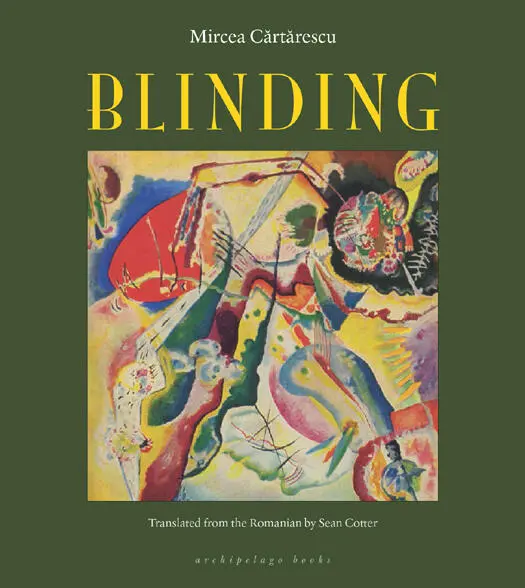
- Название:Blinding: Volume 1
- Автор:
- Издательство:Archipelago
- Жанр:
- Год:1996
- ISBN:9781935744856
- Рейтинг книги:3 / 5. Голосов: 1
-
Избранное:Добавить в избранное
- Отзывы:
-
Ваша оценка:
Blinding: Volume 1: краткое содержание, описание и аннотация
Предлагаем к чтению аннотацию, описание, краткое содержание или предисловие (зависит от того, что написал сам автор книги «Blinding: Volume 1»). Если вы не нашли необходимую информацию о книге — напишите в комментариях, мы постараемся отыскать её.
was one of the most widely heralded literary sensations in contemporary Romania, and a bestseller from the day of its release. Riddled with hidden passageways, mesmerizing tapestries, and whispering butterflies,
takes us on a mystical trip into the protagonist’s childhood, his memories of hospitalization as a teenager, the prehistory of his family, a traveling circus, secret police, zombie armies, American fighter pilots, the underground jazz scene of New Orleans, and the installation of the communist regime. This kaleidoscopic world is both eerily familiar and profoundly new. Readers of
will emerge from this strange pilgrimage shaken, and entirely transformed.
Blinding: Volume 1 — читать онлайн бесплатно полную книгу (весь текст) целиком
Ниже представлен текст книги, разбитый по страницам. Система сохранения места последней прочитанной страницы, позволяет с удобством читать онлайн бесплатно книгу «Blinding: Volume 1», без необходимости каждый раз заново искать на чём Вы остановились. Поставьте закладку, и сможете в любой момент перейти на страницу, на которой закончили чтение.
Интервал:
Закладка:
The day when I went up to the eighth floor for the first time, two things happened to me that were so unusual, I attribute my courage in these moments to my mind’s confusion. I had gone out behind the block at around nine in the morning, when, even though the sun was shining strongly, the air was still cold like water from the faucet. I was alone, so far, in the topsy-turveyness of construction materials, mud, and ditches that made up our play area. Behind the concrete fence and the metal gate, which the girls, playing school, covered with crooked letters in colored chalk, rose the enormous brick palace of the mill, and beside it, like an annex, the flattened building of the Pioneer bread factory, with curved pipes coming out of the walls and going back in on another floor. Its windows were opaque from flour, and it was surrounded constantly by the smell of warm bread. The brick factory was as tall as our block, and on its peak, lost in the clouds, sometimes a red flag fluttered. After I had shaken the levers of an abandoned bulldozer in the block courtyard, I climbed out of the cabin and began to work on a hill of sand full of the traces of children who clambered over it all day. I dug a hole into the wet, red sand, that smelled of snails, in sharp contrast to the dry, dusty layer on top, until I could put my entire arm inside. My nails smarted in the wetness and suddenly they felt actually painful: I’d hit something hard. I lugged out this object that had sat crossways to my tunnel, and when I wiped away the sandy dirt, I caught my breath: it was a large, heavy, shining cowboy pistol, a revolver, with a curved handle that barely fit in my hand and a mirrored nickle barrel. It never crossed my mind to wonder whose it was, or who might have lost it. I’d had, up to then, some ordinary, two-bit water guns, made of soft, pink plastic, from which I would suck the rubber-tasting water. I had hardly ever seen cowboy guns, maybe from rich kids, and none of them compared with my unparalleled revolver. It was all mine. I had found it, and from then on it belonged to me. I climbed back onto the soft vinyl chair in the bulldozer cabin and began to shoot all around into the frozen air. I had goose bumps from the cold, but the sun and the poplar puffs, and the twisted and luxurious vegetation twined around the concrete fence brought me the feeling of a torridly hot summer. Only when I ran along the sewer-pipe ditches, aiming at the first girl who came out to arrange her dolls on a rug in the sun, did I become conscious of the second amazing fact of that morning: I was naked from the waist down. I was wearing just an undershirt that fluttered over my hips, barely covering my behind and “little rooster,” but revealing them when I ran around and shot my pistol. Because the undershirt was a little long, Mamma hadn’t noticed that I’d forgotten to put my underpants on, since she had recently been letting me dress myself.
I felt my entire skin burn with shame. I pulled down my undershirt as far as I could and moved slowly, barely lifting my feet, toward our stairway. I made it into the hallway without anyone seeing me, and I scampered up the stairs. The mosaic steps were ice cold when I put my bare feet on them. The first floors were sinister and dark. One, which was mysterious, where I knew no one and thin pipes ran along the walls and fuse boxes lined up, then two, three, and four were each more familiar … I knew some neighbors who had kids: Romică’s mother, Virgil’s, Cristi’s, and the Chinaman’s … The policeman on four, with such a silly name: Corcodel, had made a monumental door, painted as black as the entry to a crypt. At Mr. Kulineac’s you could always hear Lola barking. Popa, who played soccer for Dinamo, had a daughter with fantastic toys that were brought from abroad, including a doll that pushed a stroller with a little baby … I found our apartment door half open, probably as I had left it. Mamma was doing laundry in the bathroom, and when I opened the door, she had suds up to her elbows and some in her hair. A big cake of laundry soap, green and narrow, tottered on the edge of the sink. I aimed the pistol at her and shouted, and Mamma jumped and started to shout back at me. She wiped her hands on a towel. She was enormous. My neck hurt from looking up at her face, projected somewhere against the ceiling. She told me to take the pistol back immediately to wherever I had found it, and when she saw my bare bottom, she smacked it a few times and found me some shorts. She had barely gotten them over my thighs when I tore myself from her grasp and ran outside again.
I met up with Luci, and then Jean, on the big tank near the concrete wall, across from Stairway 5, a macabre stairway, different from all the others and almost as mysterious as Stairway 1, because it was not in a hallway, but directly behind the block, near the entry to the furniture storeroom. Its gaping mouth, blacker than all the others, was mostly hidden by kitchen sets, hall tables, easy chairs, and windows packed in cardboard, all directly on the asphalt, and sometimes by workers armed with belts and hooks who would heave them into horse-drawn trucks. Jean sometimes would take a horse by the bridle and whisper in its ear: “ţuric!” and the horse would step backwards, knocking over chairs and tables.
On the big tank, stomping as hard as we could to hear the metallic booms amplified in the space underneath, we chatted a while, almost calm. Jean from Seven told us that in Italy mămăligă was called “poopy-lenta,” “so you can run down the street shouting ‘poopylenta, poopy-lenta!’ and nobody will do anything to you,” and Luci, tubby and curly headed, perched on the fence and shouted it too, laughing like crazy at the funny word. After we’d had enough of saying it a hundred ways, we set to exploring, since there were too few of us yet to play anything. I objected with all my might to going into Stairway 5, more sinister for me than a dragon’s cave. When they grabbed me and tried to force me in, I fell on a pile of planks full of nails, and I got scratched a little on the leg. In the end, shaking, I said I would go on the roof if we went up our stairway, mine and Jean’s, since Luci lived on Stairway 3. Jean was a jerk. He had a bad mouth, sang songs, and told dirty jokes. He lived on Seven, he was always dressed poorly, and his mother looked like a beggar. His father drove a tractor for the circus, pulling around caged animals and houses on wheels. But we were all good friends, because we always laughed with him and didn’t try to fight. That day, for the first time, we went in the elevator without a grown-up. Jean stretched himself high on the tips of his toes, and reached to 7. “I can go higher,” he said, and he pushed the red button, which made a buzz so loud that we all screamed. This didn’t stop him. He stretched up to see himself in the mirror, stuck his tongue out, and in the end he pressed the last button, marked “O,” which made the elevator stop in between floors. “I’m telling! I’m telling your mom!” Luci shouted, crazy with fear, while Jean opened the doors so we could see the layer of concrete between the floors. “You’d have been stuck here, man! Toast!” And we believed we really were going to stay in that terrible elevator car, painted green, forever, without our parents or the real world, and they would bury us, the little ones, in an infinite block of ice, in endless fear. My tears had already started when Jean pushed 7 again and the elevator started moving, making its slow way through the concrete universe of the block. Two more metal doors appeared and disappeared, slowly, in the elevator window, until it stopped and we poured onto a foreign landing, so unfamiliar that we could have been anywhere, thousands of kilometers away, above or below, in one place or another. For Jean, however, this was the most ordinary place possible, because it was where he lived. I had the barrel of the pistol stuck in my underpants and covered carefully with my undershirt; I hadn’t shown it to the other boys, since I was afraid they would know whose it was and take it away. Now, more dead than alive with fear, I could feel it there, so warm, it was as if it had become part of my body.
Читать дальшеИнтервал:
Закладка:
Похожие книги на «Blinding: Volume 1»
Представляем Вашему вниманию похожие книги на «Blinding: Volume 1» списком для выбора. Мы отобрали схожую по названию и смыслу литературу в надежде предоставить читателям больше вариантов отыскать новые, интересные, ещё непрочитанные произведения.











Обсуждение, отзывы о книге «Blinding: Volume 1» и просто собственные мнения читателей. Оставьте ваши комментарии, напишите, что Вы думаете о произведении, его смысле или главных героях. Укажите что конкретно понравилось, а что нет, и почему Вы так считаете.