Mircea Cărtărescu - Blinding - Volume 1
Здесь есть возможность читать онлайн «Mircea Cărtărescu - Blinding - Volume 1» весь текст электронной книги совершенно бесплатно (целиком полную версию без сокращений). В некоторых случаях можно слушать аудио, скачать через торрент в формате fb2 и присутствует краткое содержание. Год выпуска: 1996, ISBN: 1996, Издательство: Archipelago, Жанр: Современная проза, на английском языке. Описание произведения, (предисловие) а так же отзывы посетителей доступны на портале библиотеки ЛибКат.
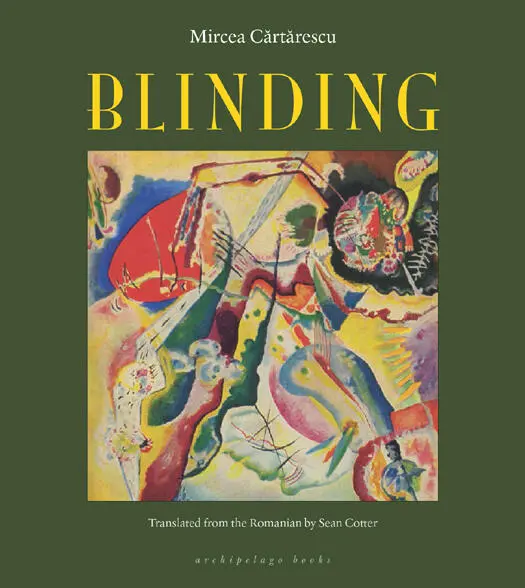
- Название:Blinding: Volume 1
- Автор:
- Издательство:Archipelago
- Жанр:
- Год:1996
- ISBN:9781935744856
- Рейтинг книги:3 / 5. Голосов: 1
-
Избранное:Добавить в избранное
- Отзывы:
-
Ваша оценка:
Blinding: Volume 1: краткое содержание, описание и аннотация
Предлагаем к чтению аннотацию, описание, краткое содержание или предисловие (зависит от того, что написал сам автор книги «Blinding: Volume 1»). Если вы не нашли необходимую информацию о книге — напишите в комментариях, мы постараемся отыскать её.
was one of the most widely heralded literary sensations in contemporary Romania, and a bestseller from the day of its release. Riddled with hidden passageways, mesmerizing tapestries, and whispering butterflies,
takes us on a mystical trip into the protagonist’s childhood, his memories of hospitalization as a teenager, the prehistory of his family, a traveling circus, secret police, zombie armies, American fighter pilots, the underground jazz scene of New Orleans, and the installation of the communist regime. This kaleidoscopic world is both eerily familiar and profoundly new. Readers of
will emerge from this strange pilgrimage shaken, and entirely transformed.
Blinding: Volume 1 — читать онлайн бесплатно полную книгу (весь текст) целиком
Ниже представлен текст книги, разбитый по страницам. Система сохранения места последней прочитанной страницы, позволяет с удобством читать онлайн бесплатно книгу «Blinding: Volume 1», без необходимости каждый раз заново искать на чём Вы остановились. Поставьте закладку, и сможете в любой момент перейти на страницу, на которой закончили чтение.
Интервал:
Закладка:
It is almost six in the evening of a late and suffocating summer … One thousand, nine hundred, eighty-six years ago a prophet came from Judea. After thirty-three years he was crucified, and after another three days he rose and ascended to heaven, not before he promised to return. So far, though, he hasn’t. I attribute this delay to the fact that, as you have seen, I still have perplexing hands. I have not yet been transformed, in the wink of an eye, and I have not yet seen a new earth and new heaven …
19
ISIT in my chair for a little while longer, in my attic with the oval window, on the edge of a galaxy. A quiet grows rosier as evening falls, interwoven with volatile and benign noises: the continuous song of the doves (they often stop on the ledge and peer a round eye into the cave behind my window), toilets flushing in other apartments, the limpid cries of the boys playing soccer between cars parked in front of the block … Now I am writing in the heart of the night. The little lamp on my desk is no brighter than a wick in oil, so it leaves the corners of my room dark, and my bed disappears into a triangle of pitch. The haze of alcohol fills the room, alcohol and sweat. Because in my home, in my bed, for the first time after months and months, someone is here, completely obliterated by the dark. If I push my head and shoulders out of the sphere of yellow light over the desk and accustom my eyes, slowly, to the tenebrous air, I think I can make out a crumpled structure, an engraver’s needle cobweb, a plaque almost unattacked by acid. After a long time, I perceive the phantom-like cloud of a crumpled sheet, veiling and simultaneously unveiling a human form. It all looks like a heavy plaster cast thrown onto the plank bed, a statue that creaks and bows the slats. But Herman is light, a skeleton that the wrapper of his skin can barely hold together, glued tight to his skull and flapping free everywhere else, because his metabolism is a haze of alcohol vapors. “Poor him,” Mamma said twenty years ago, “so young and polite, he tells me ‘kiss the hand’ ten times a day when we pass on the elevator or the stairs — poor kid, look how he ended up, look what drinking will do to a person …” But I, holding her hand, without imagining I would one day know Herman as well as I do myself, looked with fright over my shoulder, toward the entryway, where I could still see the drunk, unnaturally hunched over, silhouetted by the weak light of the yellow and red elevator bulb. His neck was at a right angle to his body, as though one of his cervical vertebra had bent his spinal cord horizontal, and his head, always looking at the ground, was the image of oriental humility. Whenever we met, he scared me, because all drunks scared me, they were strange animals — I heard them sometimes howling and cursing behind the block — and, even though Herman was gentleness itself, when he put his hand on top of my head, I jumped and Mamma pulled me close. He still wouldn’t take his hand off my hair, cut short, with bangs, and, if the elevator was coming from the seventh floor, he might stay like that for more than a minute. During this time he would gaze at us, in the shadow of the stairway, revealing very, very blue eyes beneath his eyebrows, grimacing with the effort of looking straight ahead. His face was handsome and young, intelligent, but his breath, reeking of vodka, made us hold on to each other for the entire time that, crowded in the elevator, it took to reach the fifth floor. When we closed the metal door behind us, with its crack of matte glass, and we stepped onto our calming landing, in front of apartment 20, we breathed deeply a few times, while Mamma unlocked the door and the elevator went another two floors higher, with Herman.
Aside from the customary “kiss the hand, ma’am,” he never opened his mouth, but he smiled at me and absentmindedly patted the top of my head. He always wore the same suit, dark and proper, with a white shirt open at the neck, showing a little of the soft, rosy skin of his chest. He was always drunk, and when we went shopping with Mamma, on Lizeanu, we could usually spot him in the bar, wasting his time with ordinary drunkards, but Herman never trembled. He never rambled when he spoke, and he never left his clothes undone or dirty. He was so different from Mimi and Lumpă’s father, a porcine gypsy, who would come home with a train of musicians playing the violin and accordion, while he howled his favorite song as best he could:
On my mother’s grave, on her grave
If tonight I don’t get you
Naked in your slippers
I hope this slum gets the plague
with his pants around his ankles, smacking the balloon of his hairy paunch! Or the drunk on Stairway 3, an old man in a gray hat who would pull out his little black worm and urinate like a racehorse with a thick jet onto the pillars in the hall, right in the middle of the kids playing in furniture boxes.
The young man lived with an aged peasant mother in a studio on the top floor of the block on Ştefan cel Mare. The elevator only went to the seventh floor, and then you took the stairs to get to his miniscule landing, shared by the apartment’s door, the always-barred metal door to the elevator motor, and the laundry door with a transparent window. The fourth door, for me the most mysterious one by far, led to the rooftop terrace. In fact, that landing (and not only the landing) was connected to concentric mysteries, ever more troubling, ever deeper … I had moved to the block on Ştefan cel Mare when I was five, and the immensity of its stairways, hallways, and floors had given me, for some years, a vast and strange terrain to explore. I went back there many times, in reality and dreams, or better put, within a continuum of reality-hallucination-dream, without ever knowing why the vision of that long block, with eight stairways, with the mosaic of its panoramic window façade, with magical stores on the ground floor: furniture, appliances, TV repair — always filled me with emotion. I could never look at that part of the street with a quiet eye. If I were to take a picture, I am sure it would show something completely different: between the enormous, scarlet castle of the Dâmboviţa mill, with its pediments and crenulations shooting toward the sky, and the sea of roofs and yellow, cubic buildings, pink, or calcio-vecchio cubic buildings of Bucharest beyond the street, there would only be an empty lot, maybe some piles of rusty tram rails, or concrete forms, or purely and simply a yellow pool, refracting the yellow clouds pouring over it … The block, the Police watchtower next to it, the Circus alley and its blue mushroom cap surrounded by poplars whose branches were held in a Renaissance entrelac (and which had grown enormously over the years: summer, from my parents’ apartment balcony, through the snowfall of poplar tufts, the tree growth kept me from seeing anything of the alley, but the tallest dusty pediment of the mill) seemed actually to live only in my mind, sprung pale and ghostly, from an emotional abyss. Everything is strange, because everything is from long ago, and because everything is in that place where you can’t tell dreams from memory, and because these large zones of the world were not, at the time, pulled apart from each other. And to experience the strangeness, to feel an emotion, to be petrified before a fantastical image always means one and the same thing: to regress, to turn around, to descend back into the archaic quick of your mind, to look with the eyes of a human larva, to think something that is not a thought with a brain that is not yet a brain, and which melts into a quick of rending pleasure which we, in growing, leave behind. In countless dreams I entered Stairway 4 of the block on Ştefan cel Mare, the way it was in the first months when we moved there: the hallway full of debris, the metal panel with little letter-box doors on a different wall than it is on today, a mysterious cell, full of magazines and packages, that doesn’t exist anymore — or maybe it never did — and the monumental steps up to the elevator door. Everything is vast, like in a basilica, solemn and frightening. More terrible still is the great white opening of the elevator shaft, before the car was installed. There is no door, just a rectangular opening in a wall. I go up the steps full of stone chips and whitewashed lime, surrounded by a kind of enchantment. I stop in the immense portal and look up the enormous, astounding well, with cable viscera hanging against the walls. The infinite height makes me nauseous, I squat down and feel someone yank me backwards. It is Mamma, who takes me by the hand and we climb the stairs, full of the same debris, sometimes so much that we have to clamber over the gray mounds. In between the landings with apartment doors are others, empty, sinister, with little windows where you can see the mill, and through one door alone, the incinerator. The incinerator already emits a revolting stench, since many families have moved to the block long before the construction was completed. I am more afraid of the empty landings than of those with apartments, even though each door is different there, even though great crates have appeared with cacti or oleanders, and a few grimy pictures are stuck to the walls. If I weren’t with my mother, I would never get home, because it seems certain that the floors continue above and below endlessly. Lost on empty landings, I shout desperately, until I lose my voice, weak with fear and strangeness. We do, in the end, get home. Mamma unlocks the door, twisting the security key in the keyhole that makes the wings of the little pieces inside pull back slowly. Only then does she unlock it with the real key. We enter the vast, empty rooms, and then into the front room. The evening is dark. In the triple window, a blood-colored cloud hangs over the city. Luminous billboards, very far away, flash on and off. In the room the only furniture is a bed and a chair. The walls are unpainted and two black, stunted wires cross the ceiling like spider legs. We don’t yet have electricity. Mamma, young and beautiful, lights a candle and sticks it to a saucer. We don’t have curtains, and the window is splashed with lime. We sit on the bed, embracing, and I melt from love and magic. Along the window only the stripe of clotted blood remains a while, and the rest is night. And the round, weak light of the candle, in prismatic needles, refracts in the window. It is a beautiful and sad quiet. I huddle against my mother’s body, and we watch the stripe of blood slowly disappear …
Читать дальшеИнтервал:
Закладка:
Похожие книги на «Blinding: Volume 1»
Представляем Вашему вниманию похожие книги на «Blinding: Volume 1» списком для выбора. Мы отобрали схожую по названию и смыслу литературу в надежде предоставить читателям больше вариантов отыскать новые, интересные, ещё непрочитанные произведения.











Обсуждение, отзывы о книге «Blinding: Volume 1» и просто собственные мнения читателей. Оставьте ваши комментарии, напишите, что Вы думаете о произведении, его смысле или главных героях. Укажите что конкретно понравилось, а что нет, и почему Вы так считаете.