Mircea Cărtărescu - Blinding - Volume 1
Здесь есть возможность читать онлайн «Mircea Cărtărescu - Blinding - Volume 1» весь текст электронной книги совершенно бесплатно (целиком полную версию без сокращений). В некоторых случаях можно слушать аудио, скачать через торрент в формате fb2 и присутствует краткое содержание. Год выпуска: 1996, ISBN: 1996, Издательство: Archipelago, Жанр: Современная проза, на английском языке. Описание произведения, (предисловие) а так же отзывы посетителей доступны на портале библиотеки ЛибКат.
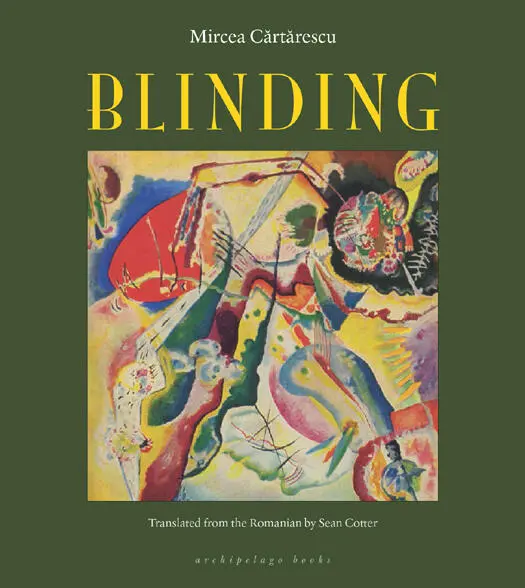
- Название:Blinding: Volume 1
- Автор:
- Издательство:Archipelago
- Жанр:
- Год:1996
- ISBN:9781935744856
- Рейтинг книги:3 / 5. Голосов: 1
-
Избранное:Добавить в избранное
- Отзывы:
-
Ваша оценка:
Blinding: Volume 1: краткое содержание, описание и аннотация
Предлагаем к чтению аннотацию, описание, краткое содержание или предисловие (зависит от того, что написал сам автор книги «Blinding: Volume 1»). Если вы не нашли необходимую информацию о книге — напишите в комментариях, мы постараемся отыскать её.
was one of the most widely heralded literary sensations in contemporary Romania, and a bestseller from the day of its release. Riddled with hidden passageways, mesmerizing tapestries, and whispering butterflies,
takes us on a mystical trip into the protagonist’s childhood, his memories of hospitalization as a teenager, the prehistory of his family, a traveling circus, secret police, zombie armies, American fighter pilots, the underground jazz scene of New Orleans, and the installation of the communist regime. This kaleidoscopic world is both eerily familiar and profoundly new. Readers of
will emerge from this strange pilgrimage shaken, and entirely transformed.
Blinding: Volume 1 — читать онлайн бесплатно полную книгу (весь текст) целиком
Ниже представлен текст книги, разбитый по страницам. Система сохранения места последней прочитанной страницы, позволяет с удобством читать онлайн бесплатно книгу «Blinding: Volume 1», без необходимости каждый раз заново искать на чём Вы остановились. Поставьте закладку, и сможете в любой момент перейти на страницу, на которой закончили чтение.
Интервал:
Закладка:
Then, in the trembling, spherical light of the candle, Mamma rises and projects her colossal shadow onto the ceiling and walls, like in a strange ballet, when the woman of dark flesh, but with clear, hazel eyes like two lakes at dusk, exchanges features, clothes, and internal organs with her own misshapen, anamorphic, palpitating shadow. She opens her hand and in the center of her palm, like in the heart of a brown flower, there is a white plastic elephant, thin and semitransparent in the yellow-dark light. She puts it on the chair and lets it hang its golden coin over the arm, connected by a thread to the elephant’s neck. The coin turns a bit and sparkles, blinking slightly, casting vague sparks onto the floor. Its weight sets the elephant in motion, wobbly at first, leaning on its right leg, then the left, while the coin slowly approaches the ground. Kneeling on one side of the chair and the other, we watch it together, happy and smiling, melting in the luminous night of the half-foreign room. And in the surrounding stillness, lit from behind, extending its shining trunk and misshapen shadow onto the wood of the chair, the elephant scoots forward, minute by minute, with small, dry chuffs, millimeter by millimeter, eternity by eternity, all the way to the edge, where it stops, leaning gently over the abyss. The coin is only a finger-width away from the floor, and it alternates its faces one after another, shifting like the phases of the moon …
Sometimes, two or three months after we had moved to Ştefan cel Mare, Mamma would push the button for six or four by mistake, in the newly installed elevator. We would rise in darkness. The car light bulb was constantly stolen, until they refused to replace it anymore, and, when the car stopped with a clang of a blacksmith’s hammer, we would open the door and happen upon an unknown and frightening world. If we stopped at four, the shock wasn’t so intense, because we recognized that landing from when we used the stairs, but if we came to any floor above ours, my eyes would pop out of their sockets with fear. Those worlds were always silent and abandoned. The air was green, and through its solemn fog I saw terrible images sometimes, over the familiar forms that I had expected. The doors of the apartments on five, each with a familiar detail — the blue plaque on Mr. Manu’s door, the policeman’s silver peephole shaped like a funnel, the brown mat by Săndel’s mother — were superimposed with monstrous, threatening mental inventions: other doors, other paint, other colors on the edges of the fuse box, other mosaics on the floor. The landing was identical to ours and yet completely different, as broadly alike as it was narrowly different in details. It was another universe that howled menacingly, like a glacier, and I was completely lost. Once we even went in the wrong entryway — there were two entries like ours, but they were Stairways 6 and 7, not 3 and 4 — and we were fooled until we took the elevator to the fifth floor and opened the green metal door onto another world, and as we went down the stairs, each landing — some illuminated and full of screeching silence, others sunken in the deepest dark — was strange and frightening, as though we had descended into Hell … I howled like an animal and pulled on my mother’s hand. She also shouted, trying to calm me down, but I was throbbing all over, like a bird’s heart, and I didn’t calm down again until I saw that I was outside, on the street, and I saw the electric poles over the tram tracks, holding their globes of rosy light. Trams and cars passed in the reddened evening, and the illuminated windows of the furniture store showed familiar, calming objects: chairs and couches, desks, lamps and shades …
The eighth floor of our stairway was incomparably more mysterious than the others. I discovered it late: when I went up there for the first time, with Luci and Jean, to go out on the rooftop, more than a year had passed since we had moved to the block. I was a full six years old, and in that concrete colossus, I only knew well our stairs and the hall across the entryway we shared. I would go out behind the block almost every afternoon to play with the other kids, on the worksites where they were still putting in the sewers and electric cables. I had heard about Stairway 1, as though it were a faraway continent I might never explore. Wherever I was, I had to be within my parents’ sight from our fifth floor balcony. They stood together watching me, head by head and their gaze delimited the safe and civilized world, beyond which I would be swallowed by the void. The universe at that time consisted of the three rooms in our home and a few annexes, extended like spider legs, with an ambiguity all the greater for their distance. There was a first zone, semi-real, where I could move by myself, more or less safely, after which followed the city streets, which my parents created by walking between real and foreign places. Only my mother and father, between whom I walked through fortresses and basilicas, depots and castles of water scraping clouds like flames on yellow heavens, only my gigantic masters and friends, clasping my fingers in their great, warm hands, talking quietly over my head and pulling me through round piaţas with fabulous statues in the center, could pacify the endless dominions of chaos. Like a reflex arc, like the engram of memory, like the melting of marble steps under millions of feet, some streets, the ones we took more often, solidified, they gained a consistency, they were colored in familiar shades, detaching from the unreal gray that surrounded them. The tram toward Dudeşti-Cioplea, where Aunt Sica lived (Vasilica, my mother’s sister), was the only one painted red, and above it was the only fragment of blue sky in Bucharest. Climbing on board, I liked to sit behind the driver, to see how the control with the metal ball clattered, and to watch the sky through the thick, violet glass of the sunshade. The ball on the control lever was brass, polished by the rubbing palm of the driver, and its curve gathered, in concentrated colors ten times more intense than in the thin air outside, all of the neighborhoods we passed and all of the wooden interior of the tram car, with wooden chairs and wooden handles that knocked against the vinyl roof. I saw the driver’s face there, too, and if I got closer, my own face, just my eyes and nose, smiling in dull wonder. Equally solid, and a little less strange — although still, so odd! — was the way to my godparents’ place, on Maica Domnului, where a different tram took us only a few stations, after which we had to turn down a slummy street, always full of mud, with fences painted dementedly in pink and blue and green, to reach, at the end of an endless road, the house shaped like a ship. Above this new neural pathway the sky had a completely different form: it was a sheet of scented liquid, with vast coral reefs, and sea lilies rocking in the currents of spring, filtering the frozen air through gills that looked like feathers, and schools of fish glinting in the sun and changing their direction suddenly, all at once, at a twitch in the clouds …
The eighth floor was a zone of abstraction, unsuitable for life. There, on the crown of the block, the air was probably so rarified that no normal human being could survive. It was an adventure already to walk the stairs to the sixth floor. The seventh was almost inaccessible, but the elevator, the living and moving soul of the block, would dare go that far, like an outpost reaching deep into Mato Grosso. The landings were, if not identical, at least of the same kind as those I knew. On the eighth landing — and how many rumors, legends and myths did we kids tell each other, about this far-off land! — everything changed. There was, first of all, the door to the rooftop. Our parents must have told us hundreds of times: “Never go out on the roof! That’s not allowed!” even before they had the tiniest idea of what this rooftop was like. We didn’t even dare to imagine it. In place of an image in our minds was a green light of fear. The bigger kids had been on the rooftop, and this gave them prestige and self-assurance. They told us about the narrow door with the leaded window, going outside, and seeing the entire city beyond the concrete balustrade, and how, if you leaned over, you could also see the street like the bottom of a well, with its miniscule trams and cars … The elevator housing was also on the eighth floor, and they talked about its thundering motor, starting and stopping. In the washroom just “stupid stuff” happened (and you couldn’t get another word out of them about it). Finally, on the eighth floor, like a watchman at the border of another world, lived Herman.
Читать дальшеИнтервал:
Закладка:
Похожие книги на «Blinding: Volume 1»
Представляем Вашему вниманию похожие книги на «Blinding: Volume 1» списком для выбора. Мы отобрали схожую по названию и смыслу литературу в надежде предоставить читателям больше вариантов отыскать новые, интересные, ещё непрочитанные произведения.











Обсуждение, отзывы о книге «Blinding: Volume 1» и просто собственные мнения читателей. Оставьте ваши комментарии, напишите, что Вы думаете о произведении, его смысле или главных героях. Укажите что конкретно понравилось, а что нет, и почему Вы так считаете.