Ranko Marinkovic - Cyclops
Здесь есть возможность читать онлайн «Ranko Marinkovic - Cyclops» весь текст электронной книги совершенно бесплатно (целиком полную версию без сокращений). В некоторых случаях можно слушать аудио, скачать через торрент в формате fb2 и присутствует краткое содержание. Год выпуска: 2010, Издательство: Yale University Press, Жанр: Современная проза, на английском языке. Описание произведения, (предисловие) а так же отзывы посетителей доступны на портале библиотеки ЛибКат.
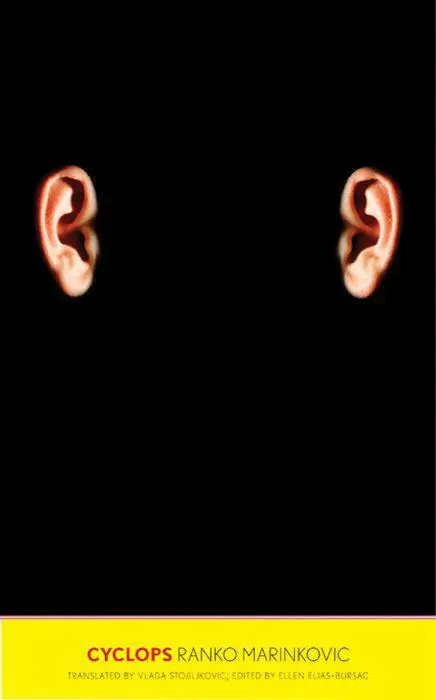
- Название:Cyclops
- Автор:
- Издательство:Yale University Press
- Жанр:
- Год:2010
- ISBN:нет данных
- Рейтинг книги:3 / 5. Голосов: 1
-
Избранное:Добавить в избранное
- Отзывы:
-
Ваша оценка:
Cyclops: краткое содержание, описание и аннотация
Предлагаем к чтению аннотацию, описание, краткое содержание или предисловие (зависит от того, что написал сам автор книги «Cyclops»). Если вы не нашли необходимую информацию о книге — напишите в комментариях, мы постараемся отыскать её.
, Croatian writer Ranko Marinkovic recounts the adventures of young theater critic Melkior Tresic, an archetypal antihero who decides to starve himself to avoid fighting in the front lines of World War II. As he wanders the streets of Zagreb in a near-hallucinatory state of paranoia and malnourishment, Melkior encounters a colorful circus of characters — fortune-tellers, shamans, actors, prostitutes, bohemians, and café intellectuals — all living in a fragile dream of a society about to be changed forever.
A seminal work of postwar Eastern European literature,
reveals a little-known perspective on World War II from within the former Yugoslavia, one that has never before been available to an English-speaking audience. Vlada Stojiljkovic's able translation, improved by Ellen Elias-Bursac's insightful editing, preserves the striking brilliance of this riotously funny and densely allusive text. Along Melkior’s journey
satirizes both the delusions of the righteous military officials who feed the national bloodlust as well as the wayward intellectuals who believe themselves to be above the unpleasant realities of international conflict. Through Stojiljkovic's clear-eyed translation, Melkior’s peregrinations reveal how history happens and how the individual consciousness is swept up in the tide of political events, and this is accomplished in a mode that will resonate with readers of Charles Simic, Aleksandr Hemon, and Kundera.
Cyclops — читать онлайн бесплатно полную книгу (весь текст) целиком
Ниже представлен текст книги, разбитый по страницам. Система сохранения места последней прочитанной страницы, позволяет с удобством читать онлайн бесплатно книгу «Cyclops», без необходимости каждый раз заново искать на чём Вы остановились. Поставьте закладку, и сможете в любой момент перейти на страницу, на которой закончили чтение.
Интервал:
Закладка:
In front of you, see, is a female body, a rustling one, with the broad cheeks of a saint on an icon. Her eyes are mournfully surprised and she has a regulation voice as if it had been laid down in the Minaeon:
“Are you the one from Neurology?” Nurse Olga was saying with a wooden face. “Come with me, this way,” and she set off down the corridor in the opposite direction from Room Seven.
Melkior had a feeling of being defeated in battle, on his way to a place of exile. The dirty, smelly prisoner of war, long unshaven, had been hiding out for days among lunatics … Numbskull “found me out.” Perhaps he arranged my transfer with the Major. I’ve got my life ahead of me!
He sneered bitterly at his momentum. Oh where have they hidden her? Her presence will rustle any moment now around this corner, where the corridor bent with a fresh little hope. He stopped at a few doors: he thought he heard her voice in there in the cacophony of rasping, coughing, hawking, and spitting, he peeked through doors left ajar, but she was nowhere to be seen. She was nowhere to be found anymore.
“We’ll put you in here … for now,” said the white icon.
Two long rows of battered white beds with a lot of haggard pale faces above the army blankets. A rotten reek encountered his olfactory sense as the local worldview. Now to readapt. To tame this general smell, too, make it his own, familiar … he almost said “belief.” Struggle for survival through olfactory adaptation. And he lay down immediately, the sooner to make the dirty rags reveal themselves to him, to exchange touch and warmth with them, to establish a close relationship. Melkior was settling in to live there, his whole life was ahead of him, man!
He shaved and bathed. I don’t smell bad anymore, so where are you?
He took a tour of the entire ward … but she was nowhere to be found. Downstairs in the examination room now sat Nurse Olga, accompanying the Major on his rounds was Nurse Olga, temperatures were taken by the grave and austere Nurse Olga. And She is no longer here. In the air fade the locks of her hair, on the floor, in the dust of my pining, her footprint is no longer there. … He spoke automatically, but with the piety of a past, imagined happiness, which he believed in to the tears. I have closed the window the more to be alone, with you to be alone … and he watched himself meanwhile invent that poetic window, yet nevertheless closed it with a vast sorrow, as if nailing himself shut, and a torrent of weeping broke through the constricted throat. Getting dark. Those are black shadows drinking my tears … and Melkior dissolved into soundless sobs in the twilight of the hospital room.
He is saying Can you hear me? in an ugly voice, but the little girl doesn’t seem to hear. She is standing in the middle of a deserted street staring straight ahead, meekly and somehow patiently, as if she trusts nothing but silence.
She is standing still like a big expensive doll with deep-set dark eyes. An arrow is embedded in her small plump back, all the way through, from one shoulder to the other, with a small caesura in the middle where it crosses the dimple in her back. The girl is standing slightly hunched, the better, presumably, to adapt her stance to the steel fibula that has pierced her back; her arms hang down her sides and her head is thrust forward in a kind of humility.
“Hey? Can you hear me?” he shouts, in fear this time, for he is thinking the little girl needs urgent care. But what is to be done? Still she is silent and motionless. He doesn’t know whether he ought to touch her at all. Is she dead?
“Please tell me: does it hurt?”
“It hur … urts,” he barely hears the little voice, frightened but somehow sustained and multiplied in echoes sounding from several directions simultaneously, as if a children’s choir has sung it in canon. … It is only then that he looks around, his gaze sweeping the breadth of the streets. There are seven or eight more little girls, equally transfixed with arrows, equally motionless and silent and slightly hunched, with their heads thrust forward. And they are all staring straight ahead humbly, as if patiently expecting something. … Or … perhaps they expect nothing any more, having already surrendered to a horrible enchantment, motionless, pierced, abandoned like dolls after a mad, cruel game.
He tries to find out who has done it and why, and why little girls, but there is nobody to be seen. He sets off in search of someone, to call for help, for it is appalling to see the little girls standing there, staring humbly ahead with arrows in their small, innocent flesh. How strange, he thinks, there’s not a drop of blood on them anywhere! And their wounds are not serious or fatal, as if this was done deliberately, so they could live, and they are alive and I could almost say healthy, they could move, pull the arrows out of their bodies and run back home to their Mamas. … Why are they standing still like that? This frightens him and he sets off down the streets in search of someone. But there is nobody to be seen anywhere in town. The town is empty.
The Alligator! flashes the most terrible thought of all.
“That’s right,” the Melancholic confirms from somewhere, invisible, “he passed through here this morning.”
“This morning? And what time is it now?”
“Night. But the Sun stood still to light his way. He’s a son of the Sun, being a victor. All victors are sons of the Sun.”
“So those little girls have been standing there like this since this morning?”
“Hee, hee, the little dolls … stayed behind.” That is Rover’s animal smell, it is by his smell that Melkior knows him. “The Tartar archers passed through, everybody ran off, they shot the little dolls, hee, hee … and left.” Shot and left … he repeats, but cannot understand why Rover is laughing like that, almost lasciviously. The poor little innocent ones … But he has no time to feel sorry. He hurries back: they must be helped as soon as possible. The arrows must be plucked from those small bodies, the little girls must be freed from the terrible reptile’s thrall and returned to life. And then I’ll tell them an amusing adventure story for children to entertain them. … Running back, he is singing the Paternoster … but when he reaches the street again the little girls are gone. From an old dilapidated house where living redbrick flesh is exposed under the crumbling front he hears the unruly laughter of women. The women are standing at the windows in various stages of undress, some of them quite naked, and laughing at him, tipping him winks and beckoning him upstairs. Draped over the windowsills are bedclothes put out to air: white sheets; amber, blue, and scarlet silk eiderdowns; large white pillows trimmed with lacework; foamy, transparent, insubstantial negligees; lain-in, slightly rumpled pajamas that have retained the outlines and fragrances of those female bodies. … Lust’s props with living naked laughing flesh sway luxuriously above his head.
“The little girls … Where are they?” he asks, and hears repeated salvos of their laughter.
“It hur-urts, hee-hee-hee,” the window women laugh cantabile , in canon. Above them, high up, coming out from the top floor, the coloratura laughter of a birdlike voice stands out by dint of its penetrating trills. She is beautiful, the most beautiful of them all. She has plumped out her lovely full bosom on the sill like two ruddy peaches and is performing her laughter with a kind of manic perseverance.
The laughter has been planted there by ATMAN as bait to the passenger through the deserted town. And she has been given the birdlike warble as a sign of his particular benevolence. She is Head Mermaid, the Honorable Mother in this house of sin for Tartar archers, the victors.
Читать дальшеИнтервал:
Закладка:
Похожие книги на «Cyclops»
Представляем Вашему вниманию похожие книги на «Cyclops» списком для выбора. Мы отобрали схожую по названию и смыслу литературу в надежде предоставить читателям больше вариантов отыскать новые, интересные, ещё непрочитанные произведения.









Обсуждение, отзывы о книге «Cyclops» и просто собственные мнения читателей. Оставьте ваши комментарии, напишите, что Вы думаете о произведении, его смысле или главных героях. Укажите что конкретно понравилось, а что нет, и почему Вы так считаете.