Ranko Marinkovic - Cyclops
Здесь есть возможность читать онлайн «Ranko Marinkovic - Cyclops» весь текст электронной книги совершенно бесплатно (целиком полную версию без сокращений). В некоторых случаях можно слушать аудио, скачать через торрент в формате fb2 и присутствует краткое содержание. Год выпуска: 2010, Издательство: Yale University Press, Жанр: Современная проза, на английском языке. Описание произведения, (предисловие) а так же отзывы посетителей доступны на портале библиотеки ЛибКат.
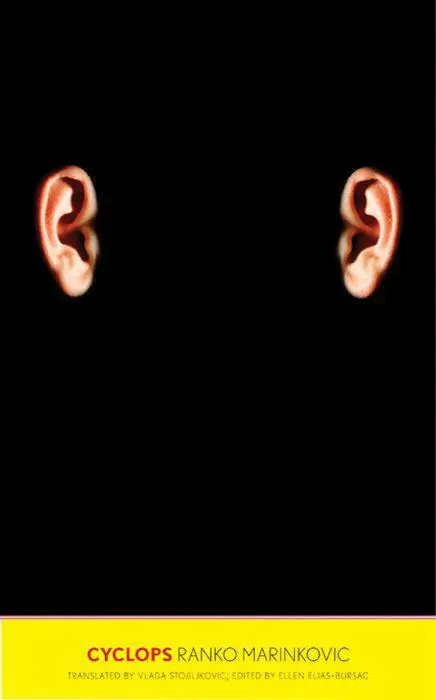
- Название:Cyclops
- Автор:
- Издательство:Yale University Press
- Жанр:
- Год:2010
- ISBN:нет данных
- Рейтинг книги:3 / 5. Голосов: 1
-
Избранное:Добавить в избранное
- Отзывы:
-
Ваша оценка:
Cyclops: краткое содержание, описание и аннотация
Предлагаем к чтению аннотацию, описание, краткое содержание или предисловие (зависит от того, что написал сам автор книги «Cyclops»). Если вы не нашли необходимую информацию о книге — напишите в комментариях, мы постараемся отыскать её.
, Croatian writer Ranko Marinkovic recounts the adventures of young theater critic Melkior Tresic, an archetypal antihero who decides to starve himself to avoid fighting in the front lines of World War II. As he wanders the streets of Zagreb in a near-hallucinatory state of paranoia and malnourishment, Melkior encounters a colorful circus of characters — fortune-tellers, shamans, actors, prostitutes, bohemians, and café intellectuals — all living in a fragile dream of a society about to be changed forever.
A seminal work of postwar Eastern European literature,
reveals a little-known perspective on World War II from within the former Yugoslavia, one that has never before been available to an English-speaking audience. Vlada Stojiljkovic's able translation, improved by Ellen Elias-Bursac's insightful editing, preserves the striking brilliance of this riotously funny and densely allusive text. Along Melkior’s journey
satirizes both the delusions of the righteous military officials who feed the national bloodlust as well as the wayward intellectuals who believe themselves to be above the unpleasant realities of international conflict. Through Stojiljkovic's clear-eyed translation, Melkior’s peregrinations reveal how history happens and how the individual consciousness is swept up in the tide of political events, and this is accomplished in a mode that will resonate with readers of Charles Simic, Aleksandr Hemon, and Kundera.
Cyclops — читать онлайн бесплатно полную книгу (весь текст) целиком
Ниже представлен текст книги, разбитый по страницам. Система сохранения места последней прочитанной страницы, позволяет с удобством читать онлайн бесплатно книгу «Cyclops», без необходимости каждый раз заново искать на чём Вы остановились. Поставьте закладку, и сможете в любой момент перейти на страницу, на которой закончили чтение.
Интервал:
Закладка:
“All right, but how do they make five?”
“The madmen?” smiled the Melancholic in commiseration. “They take twice two fingers of the same hand, and since they’re all connected with each other they bring the fifth — the little finger — along … so as not to leave him alone. Hence the misconception.”
“You majored in math — but what do you do in life?”
“I’m a traveler. I pick hawthorn berries.”
“And count them?”
“How did you know?”
“Something tells me …”
“Something tells you my foot. You must’ve read it in the papers. They wrote about me.”
“So how do you ‘get them to come together’ when you count?”
“In my pocket. I have a hard time of it. Up to a billion. Want me to count your head hairs? I’ve counted his,” he gestured at Rover. “Know how I do it? I divide his head in sectors … I had a pencil, but the Tartars took it … and then I work by sectors, easy as pie. Only I didn’t finish — he wouldn’t sit still.”
“How will you do me if you haven’t got a pencil?”
“There’s another method — plucking. Only ten hairs a day. But you’ll have to wait until it has grown back in. What is it they say — don’t let grass grow under your …” All of a sudden, as if he had remembered something, he caught Melkior by the elbow and whispered in confidence: “See those windows across the way? Take a good look: three stories, five windows each. Tonight I’ll show you something I’m quite keen on. Now hush, pretend you don’t know me.” He went off “craftily” and, walking up to his bed, suddenly raised his arms high above his head, crying out: “On Ombrellion, the barren mountain, spake he!” then lay down and closed his eyes.
Time had begun to peck at him. The day was now endlessly long, the third day among the insane. The Melancholic had taken him briefly back to the world of living words, then thrown him back into silent solitude again. Aroused by the sound of a human voice, his hearing now found the deaf silence more difficult to bear than during the previous two days. The Melancholic had left him with the fifteen windows across the way and a promise for tonight … But tonight was a long way off. Outside and up high, the day was still shining in the sky among tattered clouds, and above him (to make things worse) floated the sun in a glory of autumn blue. He hated the sun in the square of the sky and the clouds and the light and everything that made up the day. He was yearning for words, words to the hungry ear! Any words, any kind of words, just as long as it was the sound of a human voice!
He tried to listen to himself. But what should he say? Romans, friends, countrymen … But what if they responded? Polyphemus the Cyclops, the beast … No, he could not enunciate that either. Then it came to him in a flash merely to say Parallelikins , as if it were a name. Melkior said it aloud.
The Lord Chamberlain leapt up, cut to the quick. It was as if he had been awaiting that very word to get his terrible excitement going. Has someone dared utter it? was what his astounded look meant. Using a finger he sicced Rover on Melkior. Rover was off like a shot. He turned around with catlike speed and, hands outstretched, scampered toward Melkior.
“I am Rover, the eldest of five,” he snarled at him.
Melkior remembered the Melancholic’s trick of … He hastily tore two buttons off his striped robe and repeated his words:
“Don’t do that, Rover — I’ll give you these two four-rupee pieces …”
“Hah, two buttons!” leered Rover derisively. “Get them sewn on your own! Surrender!”
“All right, I surrender — here,” Melkior put his hands up. What’s this? They won’t accept their own currency any more? “I surrender, Rover, take me prisoner.”
“What’ve you got? Gimme a ten spot!” Rover stood facing him, short but broad-shouldered.
“Haven’t got a ten spot — the Tartars took it,” Melkior made another attempt to make some headway using the formulas of this weird world. But it suddenly appeared as if none of that worked any longer. Even the Melancholic laughed:
“Heh, how can there be any Tartars here?”
“Well, you said yourself they took away your …”
“I only said it … tan-gen-tially,” specified the Melancholic and set up an ugly cackle, which Rover took up in a modified, animal version. Even the Lord Chamberlain laughed, a dignified and dry laugh.
Why, they are genuinely insane! thought Melkior, taking offense, now they’re mocking me in the bargain. He went across to the Melancholic and sat down on his bed. The man used his foot to warn him to get off. This offended Melkior further; he now wanted to clear things up at all costs.
“Very well, I’ll say it to you from here. You mentioned Tartars twice, and now you’re laughing? Are you laughing at your own madness then? Unless you meant ‘doctors’ when you said ‘Tartars.’”
“Since when do doctors have anything to do with Tartars?” laughed the Melancholic derisively. “I may be mad, but I’m not daft. Listen,” he spoke to the other two, “doctors and Tartars — do they have anything to do with each other?”
All three were laughing at Melkior.
What’s this supposed to mean, he thought in embarrassment, madmen laughing at me? And he was already prepared to think it was all just a con game played by disbelieving malingering clowns, a test to see whether his presence was not a trap devised by the army authorities, but their laughter suddenly stopped and all three pricked their ears in fright at a strange sound from the corridor.
Indeed, even Melkior could hear a kind of distant mournful wail, like the howling of a sick dog. Melkior tried to approach the door, to peek through the keyhole or at least put his ear to it — what was it that had frightened them so much? — but Rover blocked his way in a soundless leap and gave him a terrified look telling him to stop.
“Hssst, don’t move,” whispered the Melancholic, quaking.
“Why not?” Melkior whispered himself, without realizing it.
“Wolf,” whispered Rover inaudibly, between his palms. “He’s hungry.”
“A wolf … here? If there are no Tartars, there are no wolves either,” Melkior defied them.
“There is one … in Number Sixteen,” the Melancholic implored him to believe. “We also thought at first … But later on I saw it: all black and warty. The tail … the teeth …!” he shivered like a man in a fever. Using his index finger he confidentially invited Melkior to come closer, and whispered in his ear: “You’re right, there can’t be a wolf in here — he made it up, the primitive. The only animals he’s ever heard of are wolves and bears. He’s never heard about alligators, so … never mind the moron. It’s an alligator in Number Sixteen,” whispered the Melancholic in an even lower voice, “a dreadful one, huge, nine meters long, needs ten beds to sleep on, I saw it with my own eyes …” Now what was heard was a terrible roar. “Aha! Can you hear it?”
“But what’s it doing in here?” asked Melkior in feigned confidence.
“Hah, ‘what?’ There’s one in every town. A secret weapon. They crunch everything with their teeth, not even a tank can hurt them.”
The Melancholic was speaking with the certainty of a man in the know. A silly kind of joy came to life inside Melkior: a momentary, quaint illusion derived from a mad story. A flash of hope. Against Polyphemus the cannibal there rose the dreaded Alligator. Samson, Achilles, the Golem, the national giant, crushing everything underfoot, invincible! … And his imagination began narrating to Melkior The Great Victory —an epic at the Central Military Hospital Neurology Department — fiddling all day long to the vengeful joy of the defenseless.
Читать дальшеИнтервал:
Закладка:
Похожие книги на «Cyclops»
Представляем Вашему вниманию похожие книги на «Cyclops» списком для выбора. Мы отобрали схожую по названию и смыслу литературу в надежде предоставить читателям больше вариантов отыскать новые, интересные, ещё непрочитанные произведения.









Обсуждение, отзывы о книге «Cyclops» и просто собственные мнения читателей. Оставьте ваши комментарии, напишите, что Вы думаете о произведении, его смысле или главных героях. Укажите что конкретно понравилось, а что нет, и почему Вы так считаете.