Walker Percy - The Thanatos Syndrome
Здесь есть возможность читать онлайн «Walker Percy - The Thanatos Syndrome» весь текст электронной книги совершенно бесплатно (целиком полную версию без сокращений). В некоторых случаях можно слушать аудио, скачать через торрент в формате fb2 и присутствует краткое содержание. Год выпуска: 2011, Издательство: Open Road Media, Жанр: Современная проза, на английском языке. Описание произведения, (предисловие) а так же отзывы посетителей доступны на портале библиотеки ЛибКат.
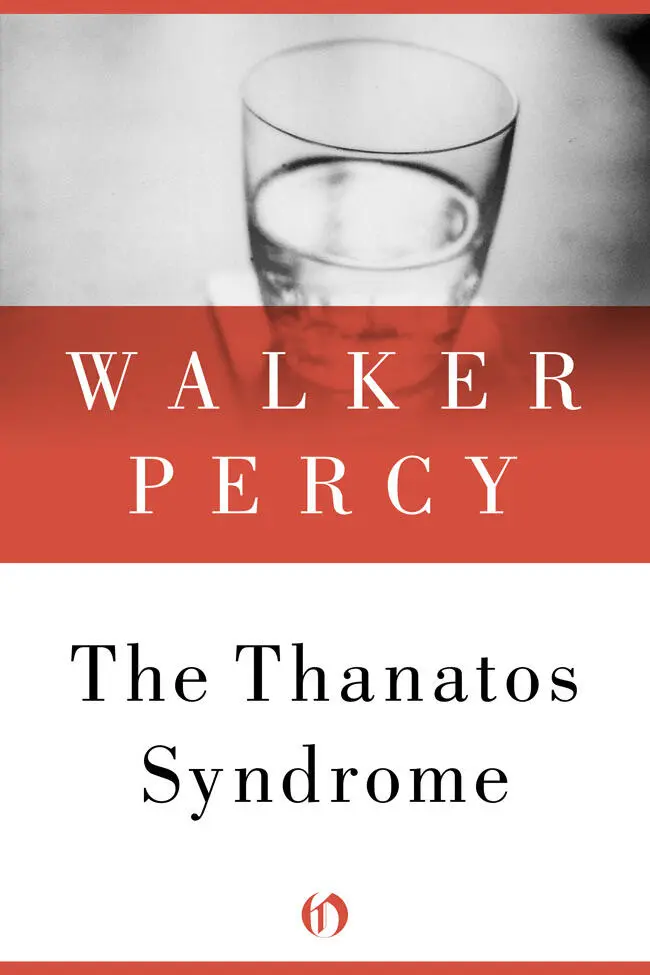
- Название:The Thanatos Syndrome
- Автор:
- Издательство:Open Road Media
- Жанр:
- Год:2011
- ISBN:нет данных
- Рейтинг книги:3 / 5. Голосов: 1
-
Избранное:Добавить в избранное
- Отзывы:
-
Ваша оценка:
The Thanatos Syndrome: краткое содержание, описание и аннотация
Предлагаем к чтению аннотацию, описание, краткое содержание или предисловие (зависит от того, что написал сам автор книги «The Thanatos Syndrome»). Если вы не нашли необходимую информацию о книге — напишите в комментариях, мы постараемся отыскать её.
Dr. Tom More returns to his parish in Louisiana determined to live a simpler life. Fresh out of prison after getting caught selling uppers to truck drivers, he wants nothing more than to live “a small life.” But when everyone in town begins acting strangely — from losing their sexual inhibitions to speaking only in blunt, truncated sentences — More, with help from his cousin Lucy Lipscomb, takes it upon himself to reveal what and who is responsible. Their investigation leads them to the highest seats of power, where they discover that a government conspiracy is poised to rob its citizens of their selves, their free will, and ultimately their humanity.
The Thanatos Syndrome — читать онлайн бесплатно полную книгу (весь текст) целиком
Ниже представлен текст книги, разбитый по страницам. Система сохранения места последней прочитанной страницы, позволяет с удобством читать онлайн бесплатно книгу «The Thanatos Syndrome», без необходимости каждый раз заново искать на чём Вы остановились. Поставьте закладку, и сможете в любой момент перейти на страницу, на которой закончили чтение.
Интервал:
Закладка:
“I know, I know. So what?”
“The name is Ellie Culbertson, Tom.”
“He’s dead.’
“Ellie, Tom. Not Ely.”
“I see. So what?”
“That’s what Van Dorn calls Ellen, isn’t it, as a compliment to her bridge playing. You’ve told me yourself. She’s his Ellie Culbertson.”
“Yes, but—”
“Dear,” she says, taking my arm. “People don’t use their real names for this test.”
“True, but you still don’t know who this is.”
“Honey, George Cutrer told me.” Her voice is sorrowful.
“Who in the fuck is he to know?”
“Honey, he’s chief of ob-gyn. And he has to tell me. I’m the epidemiologist, remember?”
“Who else did he tell?”
“No one. I swear.”
“Let’s see the date. Where’s the date?” I can’t seem to read the date.
She’s beside me, reading past my shoulder in the slit of light.
“The date was six weeks ago.”
“How do you know it wasn’t me?”
She has another slip. She’s the good intern. “Here. Six months ago she was negative. Six months ago you were in prison in Alabama. Six weeks ago she’s positive. Six weeks ago you were still in prison in Alabama. Now, unless they allow conjugal visits in federal prisons—”
“That was uncalled for.”
“You’re right. Jesus, I’m sorry.”
“Good night.”
She plucks my sleeve.
“Do you hold it against me?”
“No.” I don’t.
“I feel rotten. But you see that I had to tell you. I’m sorry. I know you feel rotten too.”
“I don’t.” I don’t. I don’t feel anything. “Good night.”
“If there is anything at all you need. Anything.”
“Thanks. I think I’ll have a drink and go to bed.”
“I’ll get you one. You go on upstairs. I’ll bring you one.”
I remember where it’s always been kept. In the sideboard in the dining room.
“Thanks.”
She folds my hand on the capsules. “I’ll get you a drink to chase them.”
I don’t move.
“Tom—”
“Yes?”
“You see, I had no way of knowing whether you and Ellen— that is, since you got back — and I don’t intend to ask.”
“Good.”
“I think I’ll go on up. You remember where—”
“Yes, in the sideboard. I remember.”
“One more thing, Tom.” She’s half turned away.
“Yes?”
“I’ve taken two too.”
“Two too,” I repeat.
“There’s nothing wrong with me, Tom. Do you understand?”
“Yes,” I say, not understanding.
“Are you all right?”
“I’m fine.”
“So I’ll say good night.”
“All right.”
She gives me a kiss on the mouth, eyes open, searching mine.
3. I HAVE A FEW drinks standing at the sideboard in the dim dark of the dining room. There is a single gleam from the hall chandelier on the polished table. It’s been twenty years since I stood here. Yet I remember exactly where the decanter is, an expensive silver-and-crystal affair, and the child’s silver cup Uncle Rylan used for a jigger, and that he filled it, the decanter, with a cheap bourbon named Two Natural. It’s the same bourbon and twenty years haven’t helped it. Several times I fill the cup, keeping a thumb at the rim to feel the cup fill. I stand in the dark.
Uncle Rylan would stand at the sideboard making a toddy for Miss Bett, first stirring sugar into three fingers of water. The silver spoon made a tinkling sound against the crystal. The stirring went on much longer than was required to dissolve the sugar. There was always talk of politics during the stirring.
Even here with the freshly polished furniture there is the old smell of the house, of scoured wood and bird dogs.
It is not bad standing in the dark drinking.
There is this to be said for drinking. It frees one from the necessities of time, like: now it is time to sit down, stand up. One would as soon do one thing as another.
Time passes, but one need not tell oneself: take heed, time is passing.
Lucy finds me either standing at the sideboard or sitting at the table.
“Are you all right?”
“Sure.”
She is wearing a heavy belted terry-cloth robe as short as a car coat. Her hair is wet.
She turns on the light and looks up at me. I’m not sitting. I’m still standing at the sideboard.
“You are all right, aren’t you? I can tell.”
“Sure.”
She looks at the decanter but she does not ask me: did you drink all that?
“Well?” she asks after a moment.
“Well what?”
“Wouldn’t you like to go to bed?”
“Sure.”
I take another drink from Uncle Rylan’s child’s cup. It was the sugar of the toddy which made this lousy bourbon tolerable.
“I’ll tell you what,” she says, looking down at me. I’m sitting.
“What?”
“I’ll help you up.”
“All right.”
I used to come here as a child for Christmas parties and blackberry hunts and later for the dove shoots at the opening of the season every November. It was a famous dove hunt.
The tinkle of spoon against glass was the occasion of a certain kind of talk. The talk was of bad news, even of approaching disaster — what Roosevelt was doing at Yalta, what Truman was doing at Potsdam, what Kennedy was doing at Oxford (Mississippi) — but there was a conviviality and a certain pleasure to be taken in the doom talk. As a child I associated the pleasure of doom with the tinkle of silver against crystal.
“I know how you feel,” says Lucy. “Did you ever know how I always felt about you?”
“No.”
She’s wrong. I don’t feel anything but the bird-dog reek of memory.
“I’ll tell you what,” says Lucy.
“What?”
“Put your arm around my shoulders.” She puts my arm around her shoulders. “Put your weight on me. I’m a strong girl.”
“All right.” She is a strong girl.
“God, you’re heavy.”
“Then I’ll not put my weight on you,” I say, not putting my weight on her.
She laughs. “Come on. Up the stairs.”
They, the English Lipscombs, must have spoken exactly the same way, with the same doomed conviviality and the same steady tinkle of silver against crystal, when the Americans came down the river two hundred years ago in 1796 and up the river with Silver Spoons Butler in 1862.
In the bedroom Lucy says, “Do you need any help?”
“No, I’m fine.”
“You are, aren’t you?” She smiles, absently spits on her thumb, smooths my eyebrows. “But I’ll help you anyhow.”
“All right.”
“What’s the matter?” asks Lucy.
“Nothing.”
“You look uncomfortable.”
“It’s this collar. No doubt it’s the newness.”
We had to take pins out of the pajamas. “Maybe another pin.”
“Tch. My word. It’s the stupid price tag. Hold still.”
“All right.”
The mattress is new and hard but not uncomfortable. It used to be a feather bed. The bottom sheet is fitted and snapped on tight as a drum. The top sheet harbors trapped cold air. But the patchwork quilt is old and warm. The pillow slip is new, but the pillow is old and goose down.
The silence and darkness and smell of the house is like a presence.
“You’re okay,” says Lucy.
“Yes.”
“You seem all right but somewhat — distant.”
“I’m not distant.”
“You’re not even drunk.”
“That’s true.”
“You’re shivering.”
“I’m fine.”
“I think I’ll stay here for a while, if you don’t mind.”
“All right.”
In Freiburg they have feather beds too. But instead of a quilt comforter, they have something like a bolster, a long narrow pillow to cover the gap on top. I wake early in the morning to the sound of church bells, not like the solemn tolling of our church bells, but a high-pitched crystalline sound, eine Klingel, yes, almost a tinkling.
Читать дальшеИнтервал:
Закладка:
Похожие книги на «The Thanatos Syndrome»
Представляем Вашему вниманию похожие книги на «The Thanatos Syndrome» списком для выбора. Мы отобрали схожую по названию и смыслу литературу в надежде предоставить читателям больше вариантов отыскать новые, интересные, ещё непрочитанные произведения.










Обсуждение, отзывы о книге «The Thanatos Syndrome» и просто собственные мнения читателей. Оставьте ваши комментарии, напишите, что Вы думаете о произведении, его смысле или главных героях. Укажите что конкретно понравилось, а что нет, и почему Вы так считаете.