Walker Percy - The Thanatos Syndrome
Здесь есть возможность читать онлайн «Walker Percy - The Thanatos Syndrome» весь текст электронной книги совершенно бесплатно (целиком полную версию без сокращений). В некоторых случаях можно слушать аудио, скачать через торрент в формате fb2 и присутствует краткое содержание. Год выпуска: 2011, Издательство: Open Road Media, Жанр: Современная проза, на английском языке. Описание произведения, (предисловие) а так же отзывы посетителей доступны на портале библиотеки ЛибКат.
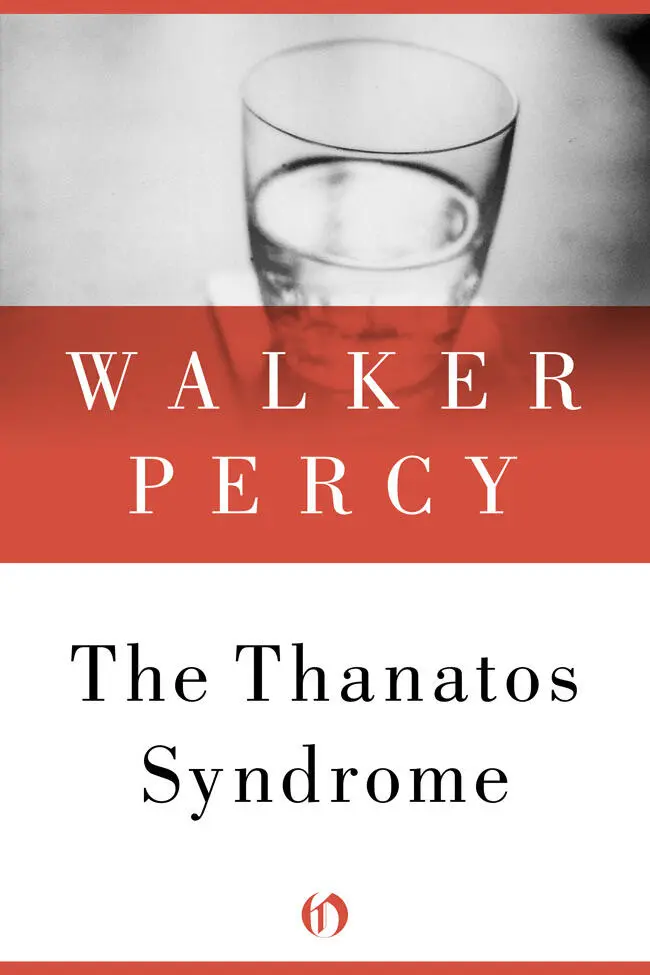
- Название:The Thanatos Syndrome
- Автор:
- Издательство:Open Road Media
- Жанр:
- Год:2011
- ISBN:нет данных
- Рейтинг книги:3 / 5. Голосов: 1
-
Избранное:Добавить в избранное
- Отзывы:
-
Ваша оценка:
The Thanatos Syndrome: краткое содержание, описание и аннотация
Предлагаем к чтению аннотацию, описание, краткое содержание или предисловие (зависит от того, что написал сам автор книги «The Thanatos Syndrome»). Если вы не нашли необходимую информацию о книге — напишите в комментариях, мы постараемся отыскать её.
Dr. Tom More returns to his parish in Louisiana determined to live a simpler life. Fresh out of prison after getting caught selling uppers to truck drivers, he wants nothing more than to live “a small life.” But when everyone in town begins acting strangely — from losing their sexual inhibitions to speaking only in blunt, truncated sentences — More, with help from his cousin Lucy Lipscomb, takes it upon himself to reveal what and who is responsible. Their investigation leads them to the highest seats of power, where they discover that a government conspiracy is poised to rob its citizens of their selves, their free will, and ultimately their humanity.
The Thanatos Syndrome — читать онлайн бесплатно полную книгу (весь текст) целиком
Ниже представлен текст книги, разбитый по страницам. Система сохранения места последней прочитанной страницы, позволяет с удобством читать онлайн бесплатно книгу «The Thanatos Syndrome», без необходимости каждый раз заново искать на чём Вы остановились. Поставьте закладку, и сможете в любой момент перейти на страницу, на которой закончили чтение.
Интервал:
Закладка:
“Me too.”
“What? You don’t look much like Christina.”
“Aren’t you glad?”
“—now a complete turnaround: a voluptuous Duchess of Alba pigging out on Whitman’s Sampler, goes berserk, shoots half her thoroughbreds, perhaps fooling around with groom—”
“I got it!” She takes my arm in both hands, eyes bright. “Let’s run her! No, wait. Oh shoot. Their little terminal would be down. No, wait. They would have to report to Baton Rouge, wouldn’t they? Let’s try the mainframe again.”
“Just ask for sodium. It’s the active ion.”
Long colloquy, nixes, queries, Sn errors; then: okay, access; then: Na-24—18mmg.
“What do you know.” I am gazing at the screen. Again there’s a tingle under my Bean collar. There’s more. There’s the heavy, secret, lidded, almost sexual excitement of the scientific hit — like the chemist Kekule looking for the benzene ring and dreaming of six snakes eating one another’s tails — like: I’ve got you, benzene, I’m closing in on you.
Lucy feels the same excitement. She pulls up close, round-eyed. Her exultation gives her leave. She can say things, ask things she couldn’t ordinarily.
“We’ve got something big, Tom,” she says, pulling close.
“I know.”
“I’m sorry about Ellen,” she says, still holding my arm, flushed with six emotions, happy enough to afford sorrow.
“Thanks.”
“What are you going to do about—” She stops, eyes searching my face.
“About what?”
“About Ellen and—? About Ellen and — your life.”
I don’t say anything.
Another searching look, hands still on my arm, then a squeeze and a brisk yank at my sleeve, a brushing off. She lights up a cigarette, plucks a tobacco grain from her tongue.
“Let’s do another one, Tom.”
“All right. Donna S—. That’s Donna Stubbs. Fat girl.Molested by father. A romantic at heart, expected a certain someone—”
“Me too.”
“—did well in therapy, took up aerobic dancing, lost weight, dated, but when I saw her last week, she exhibited an unusual erotic response.”
“Unusual?” asks Lucy, hands on the keyboard. “How?”
“I told you about her. Presenting rearward — like estrus behavior in a pongid.”
“How would you know?”
“She also had the peculiar language response I told you about. Mention a place name, like her hometown Cut Off, and they seem to consult a map in their heads, a graphic like your computer here. They seem to look over my head as if they were following a cursor on a map.”
“Did you say Cut Off?”
“She’s gone back to Cut Off. I know she saw a doctor there and went to a hospital with symptoms of hypertension.”
“Hm,” I give her Donna’s number. “No hospital in Cut Off.”
“Try Golden Meadow.”
She found Donna in Golden Meadow: Na-24—12.
“Wow,” says Lucy.
“Right.”
“Give me another one.”
“Let’s try Frank Macon. You know him. Janitor at Highland Park, should be on employees’ health records. Old friend, ambivalent black, love-hate, we understood each other, very funny and wise about hunting dogs. Now talks like Bryant Gumbel: Have a nice day.”
“Number? Okay, easy. Got him.”
Frank: Na-24—7.
“Jesus.”
“Right.”
“Give me another one.”
“Let’s try Enrique Busch. Ex-Salvadoran. Married into one of the fourteen families. Probably involved in the death squads. Ferociously anti-Communist and anti-clerical. Now has only two interests: golf and getting his daughter into Gamma sorority.”
“I’ll take the death squads.”
“You can probably find him at East Feliciana Proctology Clinic. He has intractable large bowel complaints.”
“No wonder.”
She gets him.
Enrique: negative! Nominal! Normal!
Lucy looks at me. “What does that mean?” She’s more excited than I am.
I shrug. “Presumably that it’s normal, not a toxic reaction, for a rich Hispanic removed to this country to progress from death squads to golf and sororities.”
“What does that mean?”
“It means, Lucy, that we’ve got an epidemiological element here and that it’s up your alley and that I want to find it.”
“I know! I know!” Excited, she grabs me, with both hands again, then grabs Hal the computer. “We have to find a pattern. A vector. Another one?”
“Well, here’s Ella Murdoch Smith’s number. Classmate at East Feliciana High, diehard segregationist in the old days, yet intelligent, Ayn Rand type, left town when schools were integrated so her children wouldn’t be ruined, went to Outer Banks of Carolina, lived in a shack, taught school, educated her children, wrote poetry about spindrift and the winter beach. Returned last year, rages and Ayn Rand ideology gone, got menial cleaning job right here at Mitsy, came to me complaining of plots of fellow employees against her, particularly one Fat Alice. My impression: paranoia, until I talked to her supervisor and found out Fat Alice was a robot. My impression: though Fat Alice was programmed to ‘speak,’ Ella couldn’t tell that she was not human. She was responding to Fat Alice’s speech like another robot. No more poems about spindrift.”
Ella rolls out like a rug on the screen: Na-24—21, C-137—121.
“Are you writing these down?” I ask her.
“Honey, I’m doing better than that. I got them taped right here. If we get enough, we can run them through and see if we can come up with a vector, a commonality.”
“How many do we need?”
“The more the better. I’ll tell you what.” She grabs me and gives me a jerk.
“What?”
“Give me a few more, then I’ve got an idea. Tom, we’re missing something. It’s under our noses and we’re missing it!”
“Yeah.”
“Well, let’s see.” I’m looking at my list. “Well, there’s Kev and Debbie. Father Kev Kevin, ex-Jesuit, and Sister Thérèse, ex-Maryknoller, now Debbie Boudreaux. Both radicalized, joined Guatemalan guerrillas, Debbie radical feminist, used to talk about dialoguing, then began to talk tough, about having balls, cojones — now both retired to a sort of commune retreat house in pine trees, marital problems: Kev accusing Debbie of being into Wicca and having out-of-body experiences with a local guru which are not exactly out of body, Debbie accusing Kev of becoming overly active as participant therapist in a gay encounter group—”
“That’s enough. How do we get a handle on them?”
“Try American Society of Psychotherapists.”
“Got you. Give me the numbers. Okay. Okay. Got them.”
Kev: zero. Normal!
Debbie: zero. Normal!
Lucy: “I’m confused. Talk about flakes. What do you make of them?”
“One of three things. One, they’re acting like normal married couples. Two, they’re pathological, but the pathogen is not heavy sodium.”
“Three?”
“Father Smith would say the pathogen is demonic.”
“Demonic. I see. What do you say?”
“I say let’s run some more.”
We run a dozen more. We’ve got three negatives, the rest positive.
Lucy turns off all machines. Lights stop blinking. There are no sounds but the hum of lights. A screech owl’s whimpers. It is three o’clock.
“I’m going to bed,” I say. “Let’s sleep on it.”
“Wait wait wait.”
“All right.”
“I’ve got an idea.”
“Okay.”
“Do you know where these people live?”
“Sure.”
“Okay. I’m going to give you a graphic, a map. Let’s see how many we can locate. Maybe we can get a pattern.”
“Let’s do it tomorrow.”
“It’ll only take a second. Watch this.”
She pops in a cassette and there’s old Louisiana herself, a satellite view, color-coded, with blue lakes and bayous, silver towns and cities, rust-red for plowed fields, greens for trees — and the great coiling snake of the Mississippi.
Читать дальшеИнтервал:
Закладка:
Похожие книги на «The Thanatos Syndrome»
Представляем Вашему вниманию похожие книги на «The Thanatos Syndrome» списком для выбора. Мы отобрали схожую по названию и смыслу литературу в надежде предоставить читателям больше вариантов отыскать новые, интересные, ещё непрочитанные произведения.








Обсуждение, отзывы о книге «The Thanatos Syndrome» и просто собственные мнения читателей. Оставьте ваши комментарии, напишите, что Вы думаете о произведении, его смысле или главных героях. Укажите что конкретно понравилось, а что нет, и почему Вы так считаете.