Walker Percy - The Thanatos Syndrome
Здесь есть возможность читать онлайн «Walker Percy - The Thanatos Syndrome» весь текст электронной книги совершенно бесплатно (целиком полную версию без сокращений). В некоторых случаях можно слушать аудио, скачать через торрент в формате fb2 и присутствует краткое содержание. Год выпуска: 2011, Издательство: Open Road Media, Жанр: Современная проза, на английском языке. Описание произведения, (предисловие) а так же отзывы посетителей доступны на портале библиотеки ЛибКат.
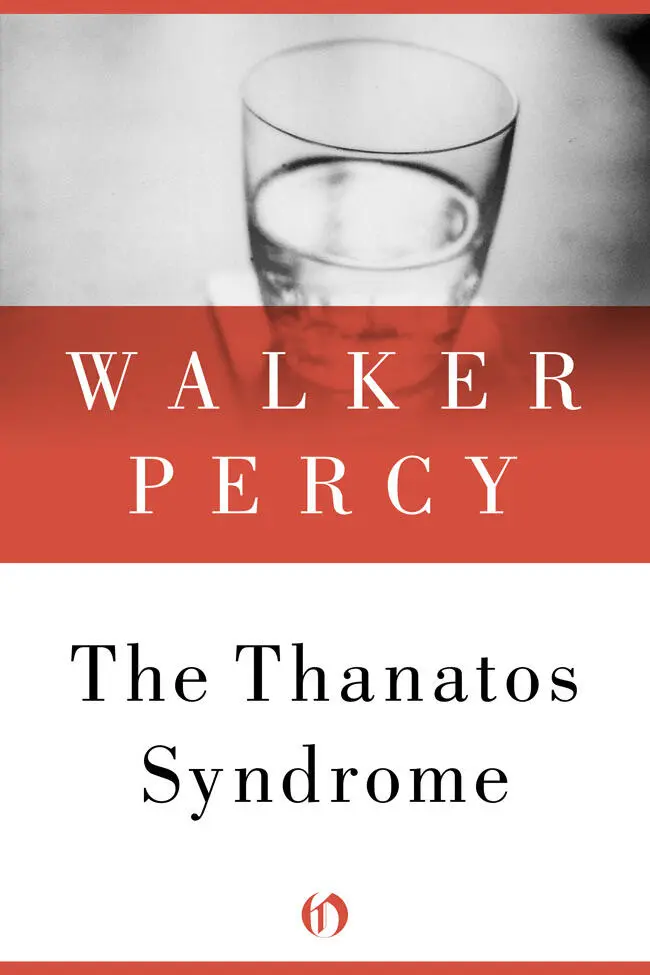
- Название:The Thanatos Syndrome
- Автор:
- Издательство:Open Road Media
- Жанр:
- Год:2011
- ISBN:нет данных
- Рейтинг книги:3 / 5. Голосов: 1
-
Избранное:Добавить в избранное
- Отзывы:
-
Ваша оценка:
The Thanatos Syndrome: краткое содержание, описание и аннотация
Предлагаем к чтению аннотацию, описание, краткое содержание или предисловие (зависит от того, что написал сам автор книги «The Thanatos Syndrome»). Если вы не нашли необходимую информацию о книге — напишите в комментариях, мы постараемся отыскать её.
Dr. Tom More returns to his parish in Louisiana determined to live a simpler life. Fresh out of prison after getting caught selling uppers to truck drivers, he wants nothing more than to live “a small life.” But when everyone in town begins acting strangely — from losing their sexual inhibitions to speaking only in blunt, truncated sentences — More, with help from his cousin Lucy Lipscomb, takes it upon himself to reveal what and who is responsible. Their investigation leads them to the highest seats of power, where they discover that a government conspiracy is poised to rob its citizens of their selves, their free will, and ultimately their humanity.
The Thanatos Syndrome — читать онлайн бесплатно полную книгу (весь текст) целиком
Ниже представлен текст книги, разбитый по страницам. Система сохранения места последней прочитанной страницы, позволяет с удобством читать онлайн бесплатно книгу «The Thanatos Syndrome», без необходимости каждый раз заново искать на чём Вы остановились. Поставьте закладку, и сможете в любой момент перейти на страницу, на которой закончили чтение.
Интервал:
Закладка:
“Everything. All networks. To CDC in Atlanta, NIH in D.C., Bureau of the Census, State Department of Health in Baton Rouge, AT & T, GM, Joe Blow, you name it.”
“I see.”
The fluorescent light is unsuitable. I wish we were having a drink on the gallery.
“I think we have a lead.”
“What’s that?”
Lucy pushes a button. The room goes dusk dark.
“Well,” I say.
“We have to wait for our eyes. We have to read the screens.”
“All right.”
She has both hands on my arm. “You want to know something?”
“Yes.”
“I think you’re on to something.”
“I see.”
“And I think we have a lead.”
“Good.”
“Okay. Let’s boot up.”
“Okay. What’s the lead?”
“Correct me, but aren’t the symptoms you describe in your syndrome similar to the findings in your paper about the heavy-sodium accident at Tulane years ago?”
“Somewhat. I’ve thought of that, but—”
“Do you think your syndrome could be a form of heavy-sodium intoxication?”
“It had occurred to me, but there’s been no accident, no yellow cloud—”
“Did you know that thing over there”—she nods toward Grand Mer—“has a sodium reactor?”
“Sure, but there’s been no accident.”
“They call it an incident. Or an event. Or an unusual occurrence. An incident is worse than an event.”
“But there’s been no event.”
She smiles. “How do you know?”
“I don’t.”
“Would you like to find out?” We’re side by side on a piano bench. She settles herself, straightens her back, touches fingers to keys like a concert pianist getting to work.
“Sure.” I am pleased she remembers my paper, my last scientific article written perhaps ten years ago.
“Something occurs to me.” Now she’s settled back again, tapping fingernail to tooth. “Did you know that when Grand Mer was licensed, the EPA required as a condition of licensure the monitoring of blood levels of heavy sodium in both Feliciana Parish and Pointe Coupée across the river?”
“How would they go about that?”
She shrugs. “Whenever a routine blood workup was ordered in a hospital, heavy sodium and chloride levels were checked as routinely as blood sugar or NPN.”
“So?”
“So I’m wondering if they still do it.”
“I wouldn’t know. I haven’t ordered much lab work lately.”
“Let’s find out.”
“All right.”
“Come over here by me now.”
“I’m by you. Is that a terminal?”
“Yes. Now then—” She consults a little book, punches keys on the keyboard, punches other keys on a small black box, humming a tune, musing and busy. She reminds me of a chatelaine, the ole miss of Pantherburn. Red lights begin to blink on the black box.
The screen lights up with an arcane readout: LADPTPBH and a flashing question mark.
“Do you know what that is?” she asks me.
“Louisiana Department of Public Health?”
“Right, I use ’em all the time. Now”—humming—“let me get the access and user codes.”
“Aren’t they closed now?”
“They don’t close, dummy. I’m not talking to people. I’m talking to their data bank.” She’s hitting more keys. The bank must be pleased, lights up with a merry flashing ACCESSED.
“You’re in?”
“We’re in. Now to ask the question. What’s the question?”
“We want the mean plasma level of heavy sodium of hospital admissions in Feliciana Parish, say, for this year.”
“Well expressed, well—” she muses, hitting keys.
The computer utters a sour bleat, flashes SNERROR.
“What does that mean? That is, doesn’t know or won’t tell?”
“It means we asked a dumb question.”
“I feel like I flunked a test.”
“That particular bank has a personality.”
“Like Hal.”
“No no. It’s on our side. Hm. Tom, what did we do wrong?”
“How did you write heavy sodium?”
“As heavy sodium.”
“Try Na-24.”
“That’s the atomic weight?”
“Yes.”
“Smart.” She hits keys. The thing is pleased, flashes a smiling ACCESS ACCESS ACCESS, then, as if it were thinking things over, waits a second and reads out: 6 mmg., meaning 6 micrograms. The symbol is really 6 µ but I figure this was not practical typographically. We gaze at it blinking. “Jesus,” I say.
Lucy looks at me. “What does that mean?”
“Six micrograms. That is very little, but any is too much. I suppose it means the mean value of heavy-sodium levels in all hospital blood workups, including positives and negatives.”
“Is it too high?”
“Any number would be too high.”
“But that’s very little, isn’t it?”
“Yes, but too much.” I feel a prickling under the collar of my new Bean shirt. I look at her musing. “What else can we ask?”
“We can ask any terminal any question. It’s just a matter of framing the question.”
“Well?” She looks at me, hands on keyboard. She’s shifted now, from chatelaine to girl-Friday secretary, Della Street waiting for Perry to make up his mind.
“What we need is a control.”
“Right.” She waits, smiling.
“Let’s do yours and mine. Have you had a complete physical lately?”
“Sure. I had to get one to get this job.”
“You got it at Fedville?”
“Right. How about you?”
“Me too.”
“At Fedville?”
“Yes.”
“When was that?”
“When I was arrested by the feds.”
“Of course. I wanted to come see you.”
“It was not a good time. Can you talk to Fedville now?”
“Sure. I’m on intimate terms with their mainframe. Let’s see. Yours would be about two years ago, right?”
“Right.”
“Two years. What a waste.”
“Waste of what?”
“Give me your SS number.”
I give it. “Can we get individual readings?”
“We can get anything we ask for. I have Class One clearance.”
More black book, more punching out the big keyboard, little box, more queries, accesses, OKS. The thing doesn’t even pause to think it over this time. Back come the answers. I have the feeling the thing is sitting pleased, waiting to be patted.
LL NA24—O C137—O
TM NA24—O C137—O
We gaze and blink some more.
“Does that mean what I think it means?” Lucy asks me.
“It means you and I are negative, zero levels of heavy sodium and chloride.”
“I don’t get it,” says Lucy at last. “We both live here.”
I look at her. “Have you heard anything about an accident over there? Or an incident? Or event?”
“Not a word.”
“Would you hear if there had been one?”
“I don’t know. But I live next to the damn thing. So if anybody got sick, it would be me, wouldn’t it?”
“One would think so. If, that is, it—” I fall silent. “You’re feeling all right, aren’t you?”
She cocks an eye. “Wouldn’t you have to test me to find out?”
“Test you for what?”
“Presenting rearward. Think about that.”
“That’s true,” I say, thinking about that.
“Okay,” she says, not smiling, but eyes round and risible. “How many patients in your series?”
“Maybe twenty or so.”
“How many were hospitalized or had blood work?”
“Maybe half a dozen.”
“Do you know who and where?”
“Sure.”
“Let’s try a couple.”
“Okay. How about Mickey LaFaye? Here’s her SS number. But her workup was done at the local hospital.”
“No problem. They have a terminal and I’ve got their number. Now, she’s the one who—”
“New England lady, married Durel LaFaye — you know him — high roller — ended up as a starveling Christina with free-floating anxiety, panic, unnamed longing—”
Читать дальшеИнтервал:
Закладка:
Похожие книги на «The Thanatos Syndrome»
Представляем Вашему вниманию похожие книги на «The Thanatos Syndrome» списком для выбора. Мы отобрали схожую по названию и смыслу литературу в надежде предоставить читателям больше вариантов отыскать новые, интересные, ещё непрочитанные произведения.








Обсуждение, отзывы о книге «The Thanatos Syndrome» и просто собственные мнения читателей. Оставьте ваши комментарии, напишите, что Вы думаете о произведении, его смысле или главных героях. Укажите что конкретно понравилось, а что нет, и почему Вы так считаете.