Norman Rush - Mortals
Здесь есть возможность читать онлайн «Norman Rush - Mortals» весь текст электронной книги совершенно бесплатно (целиком полную версию без сокращений). В некоторых случаях можно слушать аудио, скачать через торрент в формате fb2 и присутствует краткое содержание. Год выпуска: 2003, ISBN: 2003, Издательство: Vintage Books, Жанр: Современная проза, на английском языке. Описание произведения, (предисловие) а так же отзывы посетителей доступны на портале библиотеки ЛибКат.
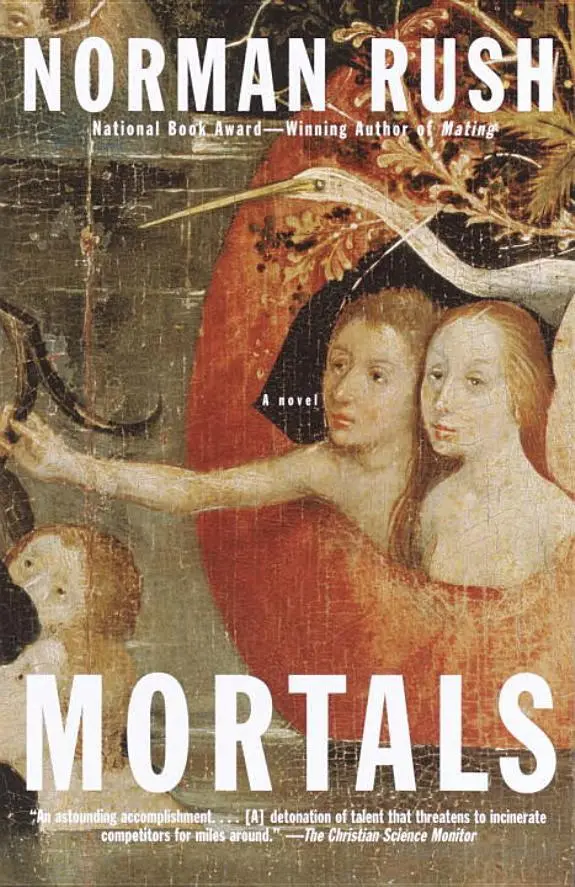
- Название:Mortals
- Автор:
- Издательство:Vintage Books
- Жанр:
- Год:2003
- ISBN:9780307789365
- Рейтинг книги:3 / 5. Голосов: 1
-
Избранное:Добавить в избранное
- Отзывы:
-
Ваша оценка:
Mortals: краткое содержание, описание и аннотация
Предлагаем к чтению аннотацию, описание, краткое содержание или предисловие (зависит от того, что написал сам автор книги «Mortals»). Если вы не нашли необходимую информацию о книге — напишите в комментариях, мы постараемся отыскать её.
As a spy, the compulsively literate Ray ought to have no trouble confirming his suspicions. But there’s the distraction of actual spying. Most of all, there’s the problem of love, which Norman Rush anatomizes in all its hopeless splendor in a novel that would have delighted Milton, Nabokov, and Graham Greene.
Mortals — читать онлайн бесплатно полную книгу (весь текст) целиком
Ниже представлен текст книги, разбитый по страницам. Система сохранения места последней прочитанной страницы, позволяет с удобством читать онлайн бесплатно книгу «Mortals», без необходимости каждый раз заново искать на чём Вы остановились. Поставьте закладку, и сможете в любой момент перейти на страницу, на которой закончили чтение.
Интервал:
Закладка:
The venue was a classroom normally used for nurse training, one of two modules in a flimsy annex to the administrative block at the Princess Marina Hospital. They were in a long, narrow, windowless room with pea-green walls. There were seats, student desk-armchairs, for sixty. As was standard for government space, the room was scrupulously clean, the floors were gleaming, the blackboards scrubbed, a scent of lemon soap was in the air. On the wall above the blackboard were two framed portraits, the obligatory photograph of the current president, Masire, and beside it, to the right of it, interestingly enough, an unofficial portrait, obviously cut out of a magazine, of the deceased founder of the country, its first president, Sir Seretse Khama. Masire’s photo was hanging crookedly, but not Khama’s. It could mean something. When Masire’s likeness had appeared on the currency there had been a shortlived movement to turn in the new bills for the older ones bearing Khama’s likeness. He himself had overheard a woman on line ahead of him at Barclays explaining to the teller that she preferred the old pula because the new pula carried the picture of a jackal and she would not be happy to have such pictures in her purse. It had had to do with tribal feeling, Masire not being a Mongwato. It was a typically Tswana sort of protest, in its mildness. It was what he was used to. Now everything was changing around him, for the worse, for the worse, and he was to blame, he was to blame, not for all of it, for some of it, he was. Woe, he thought. He controlled himself.
The room was lit by a train of large hanging lamps containing very dim lightbulbs, inverted milkglass pyramids serving incidentally as receptacles for the remains of dead insects. The pyramids were open at the top and each one held a black load taking up, he estimated, about a fifth of the lamp interior. It was remarkable. The character of the light delivered was affected. It was remarkable, like everything.
They had their choice of seats. There were a few attendees, women, Indian and Batswana, in the back rows. Iris wanted to sit at the front so she could see everything, which was fine because the room would fill, if it filled, from the back forward, and they would have some time to talk freely. He had something to tell her that he was trying not to think about.
They took seats in the second row directly in front of the lectern. A small table and a chair had been set to the left of the lectern, and a chrome steel utility cart had been pushed up against it on the right. The cart bore a display of bouquets obviously recycled from the hospital wards. The centerpiece was a protea in a pot, drooping in a gold foil calyx. A gooseneck microphone was mounted on the lectern, needlessly, considering the dimensions of the room.
“These chairs always make me want to write,” he said. He made writing motions.
“Then we should get you one.”
He left it there. He was going to decline to pick up the invitation to reopen the question of the glorious, or at least better than this, life he was going to lead someday post-agency. She wanted him to go back to poetry, be what he had tried and failed definitively to be. That was what she seemed to want. She had all his ancient efforts somewhere in her files and boxes, her archives. She wanted a vocation for him that she liked better. He understood it. He wouldn’t mind living a life closer to what she might consider ideal. For the Denoons it had worked out rather oddly and bitterly, it had to be said, although they were living a life that by Iris’s standards had at least started out ideally. They were full-time against injustice wherever they could find it, and they had been lucky enough to find supporters who were living less than ideal lives and who were delighted to pay them for their efforts. So Nelson Denoon had founded a city of women in the heart of the Kalahari, where women ran the show and were ennobled and so on and where they inherited, as against the standard Tswana pattern, and all he had to say was bully for all concerned. Who wouldn’t love to found an actual city, given the opportunity and the resources, running according to one’s own notions and preferences? What human luck to be able to do that, found the most celebrated development project of the 1980s, place it in the hands of the beneficiaries, derive a splendid mate out of it, and go hand in hand off to some new venue of injustice, trailing clouds of glory, go to India, as they had done, India, constituting a buffet of injustices for them, a perfect place to go, castes, bonded labor, purdah or other woman’s problems, all of that. Iris adored them because they were wearing out their souls in the service of man. And she wanted to wear out her soul in the service of man, if it could be arranged, before it was too late, and she wanted him to do the same, if only obliquely, by for example writing poetry, an improving thing to do, something she could accept. He was being unfair.
He said, “You didn’t bring your book for him to sign.” She owned a copy of Denoon’s Development as the Death of Villages .
“That’s not why I’m here,” she said.
“I know.”
“I have her book, too.”
“I know.”
“I’d be embarrassed.”
“I understand that.”
Iris wondered aloud why the meeting was being held in such an inadequate setting and he told her that the Denoons were in bad odor with goromente for reasons not entirely clear to him. The government had put certain obstacles in their path. For example, they had been given a stingy, five-day-only visa. She wanted to know why. She was under the impression that the women’s colony he had established was a success, something the government was proud of.
“Well, yes, a success, but it’s a success as a German plantation. That’s what it’s turned into, in effect. It’s true that a sort of female elite runs it for the Germans, but it’s not the same place it was. Grapple plant grows wild in the Kalahari and the Germans were buying all they could get to put in some aphrodisiac concoction. The biggest health food chain in Europe got involved. There was a boom. And then a collapse in all the growing areas except the one around Tsau. It’s a tuber and you have to leave half of it in the ground if you want it to regenerate, which is the way Denoon had taught the women at Tsau to proceed. The other foragers had just ripped the whole thing out of the ground. Anyway, so the Germans moved in on Tsau, gave them contracts … and paid plenty because devil’s claw, which is the other thing they call it, had gotten so scarce. Now it’s like gold. So Tsau is a little like a company town on the order of Hershey, Pennsylvania. The women are doing quite well. Some of them are married to Germans who’ve settled there. There’s a long waiting list to get in, and the female-line inheritance deal Denoon got the government to allow is a big draw, but it hasn’t spread anywhere else and it’s breaking down informally at Tsau. It’s very gentrified, compared to what it was. And the Denoons are unhappy with the way things have turned out and they are letting everyone know how they feel. So they won’t be making a visit to Tsau on this trip.”
She said, “Hm. That’s sad. But why is the government being so unfriendly to them?”
“Well, goromente is perfectly happy with the way Tsau is going. So that’s one thing. But it’s not mainly that. I think it’s because of what happened in India. Botswana wants to keep the Indian community here happy. They’re well off and they have a lot of influence. And the Denoons made trouble in India. They’re persona non grata there. They got kicked out of Poona. So—”
“Yes, and kicked out when he was still convalescing. After what happened. And he’s still convalescing. I think it’s a scandal.” She looked at him. “You’re a cornucopia of information on almost any subject I raise, Ray. That’s lucky for me. I’m serious.”
Читать дальшеИнтервал:
Закладка:
Похожие книги на «Mortals»
Представляем Вашему вниманию похожие книги на «Mortals» списком для выбора. Мы отобрали схожую по названию и смыслу литературу в надежде предоставить читателям больше вариантов отыскать новые, интересные, ещё непрочитанные произведения.






Обсуждение, отзывы о книге «Mortals» и просто собственные мнения читателей. Оставьте ваши комментарии, напишите, что Вы думаете о произведении, его смысле или главных героях. Укажите что конкретно понравилось, а что нет, и почему Вы так считаете.