Norman Rush - Mortals
Здесь есть возможность читать онлайн «Norman Rush - Mortals» весь текст электронной книги совершенно бесплатно (целиком полную версию без сокращений). В некоторых случаях можно слушать аудио, скачать через торрент в формате fb2 и присутствует краткое содержание. Год выпуска: 2003, ISBN: 2003, Издательство: Vintage Books, Жанр: Современная проза, на английском языке. Описание произведения, (предисловие) а так же отзывы посетителей доступны на портале библиотеки ЛибКат.
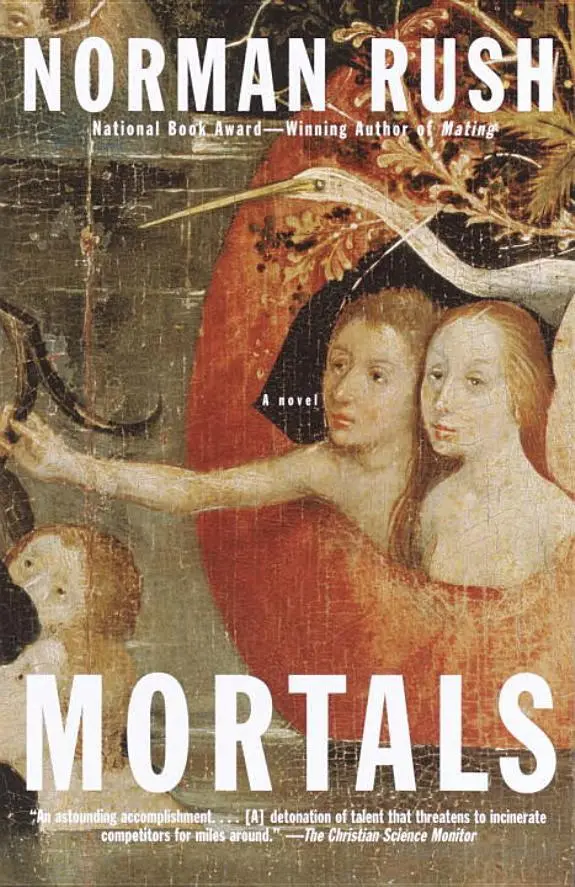
- Название:Mortals
- Автор:
- Издательство:Vintage Books
- Жанр:
- Год:2003
- ISBN:9780307789365
- Рейтинг книги:3 / 5. Голосов: 1
-
Избранное:Добавить в избранное
- Отзывы:
-
Ваша оценка:
Mortals: краткое содержание, описание и аннотация
Предлагаем к чтению аннотацию, описание, краткое содержание или предисловие (зависит от того, что написал сам автор книги «Mortals»). Если вы не нашли необходимую информацию о книге — напишите в комментариях, мы постараемся отыскать её.
As a spy, the compulsively literate Ray ought to have no trouble confirming his suspicions. But there’s the distraction of actual spying. Most of all, there’s the problem of love, which Norman Rush anatomizes in all its hopeless splendor in a novel that would have delighted Milton, Nabokov, and Graham Greene.
Mortals — читать онлайн бесплатно полную книгу (весь текст) целиком
Ниже представлен текст книги, разбитый по страницам. Система сохранения места последней прочитанной страницы, позволяет с удобством читать онлайн бесплатно книгу «Mortals», без необходимости каждый раз заново искать на чём Вы остановились. Поставьте закладку, и сможете в любой момент перейти на страницу, на которой закончили чтение.
Интервал:
Закладка:
Ray thought, Man how he hates America! There were apparently no redeeming features! What had America done to deserve his hatred, other than destroy the gay-hating Nazis and the Russians who until recent years had thrown gays into prison? And hadn’t it been the great god of Russian literature Gorky who’d said homosexuality was a product of fascism? Rex hated America, but how could he explain a guy running for the presidency and pledging to legalize homosexuals in the military? Of course Bush was going to crush him, but still.
He didn’t want to read more. He wanted Iris to prance into the room naked. She might.
This last item he was supposed to read was startling. It wasn’t clear what it was. Was it a dedication?
Partly it was. It was a series of statements printed in turquoise ink, waveringly, drunkenly lettered, on a sheet of vellum. There was no heading.
I present this to the great friend of my life, Iris, my great friend, this assemblage of truths and secrets to peruse.
O my coevals! The secrets of a people are revealed in individual asides. Our lies reveal the deepest truths about us.
Please , Ray thought. This man was supposed to be the nemesis of the cliché.
In jests we show our deepest sorrow. All the secrets I possess are here, somewhere. You must juxtapose. Wake up and smell the offal!
The thing was signed ungracefully, atypically, which reminded him of something odd in his own history. His signature had been rather stiff and careful up to the time of their father’s death. And then he had begun signing his name more loosely and in fact in a form very much like their father’s. He hadn’t thought much about it.
Well, he was surprised. Unless this was a draft of something better, he was very surprised. But it seemed not to be a draft. It seemed to be a demonstration of Rex’s gnomic and aphoristic aspirations going mad on the page. They were feeble.
Ray felt he was on the point of being dragged into collaborating with someone seeking the lowest form of literary immortality as established and pioneered by the annoying James Joyce, who thought it would be such a good idea to create puzzle palaces for thousands of specialists to wander around in forever, using his genius to fabricate and drop clues and conundrums, or conundra, that would turn the body of his work into an everlasting object of academic interest and industry. That had been Joyce’s crap idea of immortality, endless lines of clerks, really, clerks fondling his clues and getting tenure out of doing it, hives of clerks working to reconstruct the so playful so antic so smart mind of James Joyce. There was enough natural mystery to go around and enough social mystery as well, and mystery was his enemy. Of course Dubliners was great, and Portrait was, unless the concluding sentence was a trick and joke intended to let you know you had identified with a protagonist who was in fact an intellectual peacock and a fool, but his great work had been prior to all the puzzlemaking, for which fuck him.
He sat there.
Iris was in the doorway, naked, virtually, with a gauzy green stole around her neck and hanging down over her breasts and leaving her beautiful lower self exposed, to his joy. But she looked unhappy.
“What do you think?” she asked.
“What do you mean?”
“What I mean is, don’t you see the decline I see?”
“Yes, his penmanship, unless he was just in a hurry to throw together this preface or whatever it is.”
“But Ray, not only in his handwriting. There’s a loss of clarity.”
“You could be right.”
“I am and you know I am.”
She was back at the luggage again, bent over delightfully to him and then squatting, searching for something, more evidence. She had it. She presented him with a snapshot, a Polaroid, of Rex. It was dated February 1990 and it didn’t tell him anything. It was his fat brother, unsmiling, wearing a beret.
“This doesn’t add anything,” he said. He studied the photograph.
“There’s something pitiful, Ray.”
“I don’t know. He doesn’t like his teeth. He always had to be begged to smile when anyone was trying to take pictures.”
Ray was having a definite event. It was inward but it was also visual and felt like an image coming forward through his head and through his eyes and out vaguely, out into the air between his eyes and the photo of Rex. It was the image of a minor character from his boyhood, Crawford, a contractor their father had hired to build an addition to their house and who had become a recurrent presence with them over the years, when something needed to be done or redone. His father had made him redo a flooring project. Was Crawford his first name or his second name? Ray couldn’t remember. Rex looked like the dark, heavy Crawford, the heavy but preening Crawford. This could be a picture of Crawford. Ray had always been uncomfortable around Crawford, for no reason that he could remember, for no reason that he would have been able to name at the time. Crawford had never been a handsome dog, and in his forties, whatever charm he’d had was gone, or almost, although he strutted around like a peacock. He had gone around with the collar of his windbreaker permanently turned up, a sure sign of vanity in that period of time. Ray felt peculiar and light. His brother was a cuckoo, or cuckoo’s egg. He was sure of it. He couldn’t tell this to Iris. He had no proof at all.
“You’re pale,” Iris said.
He didn’t answer. Someday he would talk to Iris about this, but not now. He couldn’t. She would think he was trying to slide around and away from what he knew she was going to come out with now, her conclusion. It was remarkable. He wondered if he had known this about Rex but without letting himself know it, a kind of thing that could happen. It was true. It was absolutely the case. He must have known, without knowing what he knew. He felt so peculiar.
“You’re pale,” Iris said again.
“No I’m not,” he said.
“You are. You think what I think. I think your brother is ill, Ray. That’s what’s happening.”
“HIV, you think.”
“It’s the first thing you think of.”
“Well, in the Polaroid he’s still pretty heavy …”
“No he’s much heavier in some earlier ones I have, much.”
“Well.”
“It can affect the nervous system. I think that must be the explanation. I mean, God help him. I think it is the explanation.”
“Well, we don’t really know, do we?” This was terrible, all of it. She could be right. Or she could be wrong.
“Something is required,” she said.
He knew it.
23. The Denoons
Ray and Iris were there early. Ray doubted that much of a crowd would turn up for the celebrated couple, the Denoons. Tricks had been played, not by the agency so far as he knew, but by others, the government. There had been last-minute cancellations of the venue and even, briefly, a false venue and date carried on Radio Botswana. It wasn’t impossible that the agency had been involved. These two would be certifiable radicals in Boyle’s view. All Ray knew was that he hadn’t heard anything. And while he was thinking about the matter, he decided to make an inward pledge never to engage in petty obstruction campaigns in the future, in his onward life. He knew how to evade getting involved in certain categories of business, as things stood, and he would just add another category to the list. That’s that, he thought.
He was very eager to have a look at Denoon and his wife in the flesh. They had an interesting history, not only in Botswana. And of course Iris knew something about them, enough to make her adore them. They were social heroes, both of them.
Iris was very fixed up. He wondered if she expected Morel to attend. There was nothing he could do.
Читать дальшеИнтервал:
Закладка:
Похожие книги на «Mortals»
Представляем Вашему вниманию похожие книги на «Mortals» списком для выбора. Мы отобрали схожую по названию и смыслу литературу в надежде предоставить читателям больше вариантов отыскать новые, интересные, ещё непрочитанные произведения.


Обсуждение, отзывы о книге «Mortals» и просто собственные мнения читателей. Оставьте ваши комментарии, напишите, что Вы думаете о произведении, его смысле или главных героях. Укажите что конкретно понравилось, а что нет, и почему Вы так считаете.