Norman Rush - Mortals
Здесь есть возможность читать онлайн «Norman Rush - Mortals» весь текст электронной книги совершенно бесплатно (целиком полную версию без сокращений). В некоторых случаях можно слушать аудио, скачать через торрент в формате fb2 и присутствует краткое содержание. Год выпуска: 2003, ISBN: 2003, Издательство: Vintage Books, Жанр: Современная проза, на английском языке. Описание произведения, (предисловие) а так же отзывы посетителей доступны на портале библиотеки ЛибКат.
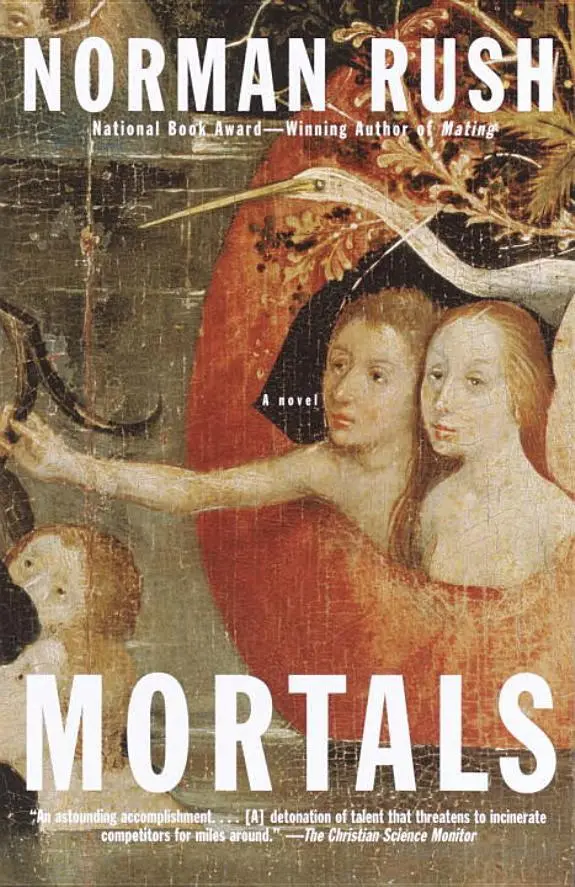
- Название:Mortals
- Автор:
- Издательство:Vintage Books
- Жанр:
- Год:2003
- ISBN:9780307789365
- Рейтинг книги:3 / 5. Голосов: 1
-
Избранное:Добавить в избранное
- Отзывы:
-
Ваша оценка:
Mortals: краткое содержание, описание и аннотация
Предлагаем к чтению аннотацию, описание, краткое содержание или предисловие (зависит от того, что написал сам автор книги «Mortals»). Если вы не нашли необходимую информацию о книге — напишите в комментариях, мы постараемся отыскать её.
As a spy, the compulsively literate Ray ought to have no trouble confirming his suspicions. But there’s the distraction of actual spying. Most of all, there’s the problem of love, which Norman Rush anatomizes in all its hopeless splendor in a novel that would have delighted Milton, Nabokov, and Graham Greene.
Mortals — читать онлайн бесплатно полную книгу (весь текст) целиком
Ниже представлен текст книги, разбитый по страницам. Система сохранения места последней прочитанной страницы, позволяет с удобством читать онлайн бесплатно книгу «Mortals», без необходимости каждый раз заново искать на чём Вы остановились. Поставьте закладку, и сможете в любой момент перейти на страницу, на которой закончили чтение.
Интервал:
Закладка:
Ray had photocopied the entire twenty-page article. And he had made a separate presentation sheet consisting of excerpts, highlighted, because he knew Boyle would never read the original piece. Ray was doing this out of principle. It would be against his best interest if Boyle paid attention, because of the scheme he had going with Pony. But if Boyle decided to forget Kerekang, Ray would send Pony for a couple of visits to Morel without authorization. Ray would have what he wanted, Morel au naturel, talking the talk.
Of course there was an unusable aspect of Marlo that might endear him to Boyle if he ever looked into it. The great expanded guild system Marlo had proposed was for everybody but Jews. It wasn’t that Marlo had been anti-Semitic, but he had been a man of his time. Boyle had no excuse for his own attitudes and he had no idea how much Ray knew about them thanks to the beloved Marion Resnick. Boyle was Jew-fixated. He blamed the Jew Kissinger for leading Nixon to break the wall around China, which had led them to go capitalist enough to become an enormous economic as well as military threat. The idea was that they should have been left alone to doldrum along with their inefficient communist system. Boyle was an ultra. Ray thought, If you’re politically insane, things will leak out no matter who you are: and Marion can’t be blamed for talking about Boyle. Boyle hated the African National Congress not because blacks were going to come to power through it but because Jews, some of the greatest stars of the ANC, were, and of course communism was the invention of a Jew and Jews had been prominent in getting it going in Russia, and Lenin was a Jew, or half-Jew … That was Boyle. He had to live with him.
The waiting he was being put through was deliberate. He decided to read through his exhibit, sampling it.
“If the guilds were to play an important part in Germany’s future they would have to stand for more than simply the selfish demands of their class … the road back was closed; the future demanded more than nostalgia; it would not accept mere selfishness … the guildsmen were aware of the need for a more general appeal and a wider vision; that they were was largely due to the efforts of one Karl Marlo — the social theorist of the German guild movement during the years of revolution.”
Learn something new every day was Resnick’s line. Socrates, when he was about to drink the hemlock, made everybody in the room shut up so he could hear the end of a song, new to him, being sung in the street. Ray knew the name of the singer, if he could remember it … Stesichorus.
“Marlo was not a guildsman; he was a chemistry teacher in a trade school in Kassel, Kurhessen.” He had been a technician, like Kerekang.
“Marlo’s native province was a land of small villages surrounded by carefully cultivated fields and inhabited by peasants and the master tailors, smiths, bakers, carpenters, and shoemakers of the guilds, who, with their journeymen and apprentices, formed a comprehensive guild system as yet undisturbed by free enterprise and still protected by ancient monopolies and a determined insistence on prerogatives and precedent. It was here that Marlo carried on his social research and here that he found an ‘organization of labor’ whose principles he hoped to see embodied in an economic order which would protect Germany from the ravages of the Industrial Revolution.”
And here was Marlo himself speaking despairingly. “Nothing remains for even the most intelligent to do, but to surrender his social independence and put himself in the service of the capital-rich entrepreneurs, and leave to them the greater part of the fruit of his labor.” Ray could see clearly why Marlo appealed to Kerekang.
Here was the core of it. “Industrial and agricultural enterprises would be limited to a certain number of workers, and each merchandising firm would be given a monopoly over a part of the national market … Those who amass more capital than is needed for their enterprise will be able to lend it to those who lack the money but not the competence to exploit their share of the national market. The state must keep interest rates low, and must also assure to each citizen ‘a sphere of activity’ equivalent to his abilities. Would not, Marlo asked, such a state be able to ward off the wild struggle for markets and capital, the destructive competition, and the dangerous concentration of wealth and power in the hands of a few which have transformed modern societies into vast arenas in which occur chaotic struggles for survival?… Every citizen will be expected to contribute to health, old age, and life insurance programs …”
It sounded to Ray like Sweden in the fifties. And the outcome for Marlo was that his advanced ideas had enraged the liberal revolutionaries who wanted to break the guilds, and the socialists who wanted to vest ownership of everything in the state, and he had been tried for treason when the reactionaries came back to power after the crushing of the revolution.
Ray thought, Outcomes are funny: Imagine that somehow Marlo and this renovated guild system had won out in Germany, what might have been next? Well, for one thing, no German Marxism burgeoning up enough to drive the ruling classes crazy and no ruling classes putting Lenin on a train to Russia and no Russian Revolution and no Stalin and no Red Army carrying fire and blood and doom to what was left of the crazy old regime, thank you very much: We outsmart ourselves! … How can I possibly get this across? We destroy moderates at our own peril, something like that: He won’t get it, he’s Boyle.
When it came to Kerekang’s political life in Britain, reading it correctly took only the smallest amount of sophistication and goodwill. Kerekang had never taken out physical membership in anything. He had been sampling this and that in the nonparty left, over there. He was a pilgrim. There was no evidence of anything more. Yes, at the very beginning of his time in the U.K. he had fellow-traveled with a couple of Trotskyist sectlets or groupustules, Boyle’s tweaking of the standard derogatory term for miniature left groups, groupuscules, but Kerekang had clearly found them wanting. He had rejected them and gone elsewhere, which ought to count in his favor. He had been a sympathizer with something called the Commonwealth Party, now defunct, a precursor to the Green Party. The man was a seeker, and where he had come out was, if looked at without jaundice, innocuous. But Boyle was Boyle. He remained Boyle. What was wrong with him? What was wrong with the world?
It occurred to Ray that a prime reason people want power is so they can say no, have that pleasure, exercise the power to prohibit. It was how some people made the world simpler, people who hated the confusion of the world. It was primitive.
The buzzer sounded, the red light flashed, he rose up wearily.
20. He Didn’t Like What He Was Suspecting
With Iris gone Ray could eat anything he wanted, and he had planned a transgressive meal for himself for tonight, which, now that he was sitting down to it, he didn’t have much appetite for. He had to get past Boyle’s No , Boyle’s brevity with him on top of it, Boyle’s expression when he had examined Ray’s case for making Morel a POI and his attempt to show what effort it was taking to keep disbelief from turning into a horse laugh.
He had a fine clod of fried steak before him, with baked potato and salad, flageolets dressed with oil and vinegar, a salad by British standards only. It was a thick steak, silverside. Cliffs of beef, he thought. The garnish of sautéed garlic and onions was less thoroughly caramelized than he liked. Iris would have done them perfectly. As a cook, his weakness was impatience. He was doing his own cooking. Dimakatso had offered to take over, but she was a rotten cook and he would have had to praise everything.
Читать дальшеИнтервал:
Закладка:
Похожие книги на «Mortals»
Представляем Вашему вниманию похожие книги на «Mortals» списком для выбора. Мы отобрали схожую по названию и смыслу литературу в надежде предоставить читателям больше вариантов отыскать новые, интересные, ещё непрочитанные произведения.





Обсуждение, отзывы о книге «Mortals» и просто собственные мнения читателей. Оставьте ваши комментарии, напишите, что Вы думаете о произведении, его смысле или главных героях. Укажите что конкретно понравилось, а что нет, и почему Вы так считаете.