Norman Rush - Mortals
Здесь есть возможность читать онлайн «Norman Rush - Mortals» весь текст электронной книги совершенно бесплатно (целиком полную версию без сокращений). В некоторых случаях можно слушать аудио, скачать через торрент в формате fb2 и присутствует краткое содержание. Год выпуска: 2003, ISBN: 2003, Издательство: Vintage Books, Жанр: Современная проза, на английском языке. Описание произведения, (предисловие) а так же отзывы посетителей доступны на портале библиотеки ЛибКат.
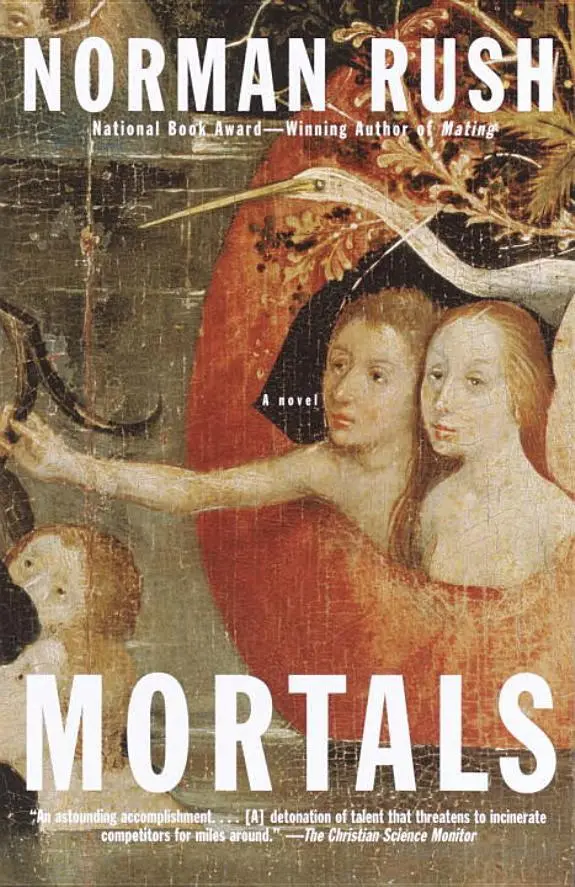
- Название:Mortals
- Автор:
- Издательство:Vintage Books
- Жанр:
- Год:2003
- ISBN:9780307789365
- Рейтинг книги:3 / 5. Голосов: 1
-
Избранное:Добавить в избранное
- Отзывы:
-
Ваша оценка:
Mortals: краткое содержание, описание и аннотация
Предлагаем к чтению аннотацию, описание, краткое содержание или предисловие (зависит от того, что написал сам автор книги «Mortals»). Если вы не нашли необходимую информацию о книге — напишите в комментариях, мы постараемся отыскать её.
As a spy, the compulsively literate Ray ought to have no trouble confirming his suspicions. But there’s the distraction of actual spying. Most of all, there’s the problem of love, which Norman Rush anatomizes in all its hopeless splendor in a novel that would have delighted Milton, Nabokov, and Graham Greene.
Mortals — читать онлайн бесплатно полную книгу (весь текст) целиком
Ниже представлен текст книги, разбитый по страницам. Система сохранения места последней прочитанной страницы, позволяет с удобством читать онлайн бесплатно книгу «Mortals», без необходимости каждый раз заново искать на чём Вы остановились. Поставьте закладку, и сможете в любой момент перейти на страницу, на которой закончили чтение.
Интервал:
Закладка:
He had surprised Pony. The breeze was up again. They danced to a new position on the other side of the pen.
Ray said, “Of course, I can find someone else if you say no. I think I can.”
“No, rra, that will be just all right,” Pony said. He waited for Ray to press the money on him.
They left, hurrying. Pony was ashamed. Ray loved him for it.
19. Two Pieces of Intelligence
Ray had two pieces of intelligence for Boyle, one that Boyle would want but that Ray was not going to give him, and one that Boyle ought to want but wouldn’t and that Ray was going to try to force on him. Both pieces of information had come to Ray via sheer luck, with the assistance in one case of another force he distrusted, intuition. And both pieces of information had left him shaken. He had something critical on Kerekang, an extension and confirmation of what he had already concluded, but new.
It was doubtless the suggestion of guidedness in human affairs that luck and intuition stood for that he hated. There was no design, no occult design. Odd conjunctions not even rising to the status of coincidence also annoyed him, like the odd fact that the previous chief of station had been a collector of ancient Roman whorehouse tokens and the present one was secretly notorious within the agency for his practice of founding high-end whorehouses as part of his collection regime wherever he was posted.
What Boyle would not get out of him was that he knew where Dwight Wemberg was. He couldn’t believe the way he had come to know this fact. Something had told him to go over to the university library to see if he could find the complete original copy of the International Review of Social History , Volume One, Number Six, from which the palm-copier sample reading that was in his file had been taken and used to impugn Kerekang, who had made the mistake of abandoning his reading long enough to go and empty his bladder. At the side of Ray’s mind had been the shadow of an intention to see, at the same time, if he could look up any of Marianne Wormser’s early papers on Milton, to reassure himself that he had been right that she was unpromising. So he had gone there, following his whim or whatever it should be called. He had never gotten to Wormser.
Boyle had agreed to see him, in the consular office, this time. Ray was in one of the holding cubicles, in a box, essentially, in a tan wood-veneer-over-chipboard box, sitting in an Eames chair, with the fine hum of the fluorescent lighting for entertainment. When Boyle was ready for him a buzzer on the door would sound and a red light set in the wall would begin flashing, a light concealing a CCTV minicam and an audio ear. The miking of these cubicles had always struck Ray as pointless. The surveillance in the cubicles was being imposed on people who had already passed through two metal detectors, so what could anyone possibly be expected to detect?
For the record he was there on school business, carrying his permanently pending file of names to be proposed for Phelps-Stokes fellowships. It was time to redo the file. Some of the candidates on it were dead. That file and the exhibit he had especially prepared for Boyle on the Kerekang matter were contained in the red rope portfolio on his lap, and he noticed, now, that his palms were sweating enough to leave marks on the portfolio. He dried his hands in his pockets, irritated at himself, because the sweat marks were just the kind of small thing Boyle might pick up on. The fact was that Kerekang was not a communist, not a socialist, not a follower of Karl Marx. He was a follower, if that was the word, of someone else altogether, Karl Marlo, a thinker of a different kidney completely. Ray had the proof in his hands.
My life is taking forever, he thought. At the university library he had found bound volumes of the International Review of Social History in the stacks, but only from 1980 onward. The card catalog entry was partly illegible, but seemed to say that the earlier years of the journal were in one of the storage areas. He knew the library and was known there. He had made his way to the box rooms, as the storage rooms were called. In the first one he entered, he’d found what he’d come for. The box room was in chaos, with slopes of vandalized, hurt, and deaccessioned books reaching from the overburdened worktable surfaces to the edges of the room. He had had to walk on books to get to the wall shelving, where, displayed at eye level, he found the back issues, unbound, of the International Review of Social History . The lot was tagged as scheduled for microfilming, but the order was dated May 1981. Nothing was happening with these periodicals, he’d decided. He’d slipped the number he wanted into the waistband of his bush shorts, under his shirt.
At that point, he had found Wemberg’s hiding place. A smell, a faint rankness, had arrested his attention. On three sides, the space between the top of the main worktable and the floor had been walled with stacked books, the walling partially masked by the drifts and dumps of spilled books lying against it. On the fourth side, the space was closed with a sheet of cardboard, which he shifted to the side. He’d had to strike matches to see inside the cave. He had cursed the Lion matches for the flimsy, sputtering, unreliable product they were. Inside the cave he had found a pallet, a sakkie containing soiled clothing, a water bottle, and a framed photograph of Alice Wemberg. On impulse he’d taken all the bills he had in his wallet, about fifty pula, and tucked them under the frame of the photograph, obscuring Alice Wemberg’s face so that Wemberg, in his distraction, wouldn’t miss seeing the money. Then Ray had left. Thinking now about Wemberg was upsetting him, again. There was nothing he could do for the man without too much danger to himself. He felt for Wemberg. He identified with him, another poor bastard going mad over a beloved woman. With Iris away, he was feeling more of a bond with Wemberg than before. He was worried that leaving the money had been stupid, that it might startle and unnerve Wemberg and lead him to abandon his hideout, which was a sensible hideout, well located because that end of the library building faced rough, blank bushveld, so that Wemberg would be able to duck in and out without being observed, especially at night. He had to turn his thoughts away from this. There was nothing he could do.
Boyle was taking his time, per usual. Ray took out his exhibit and shuffled through it. If he did say so himself, it was conclusive against the idea that Kerekang was any kind of socialist or revolutionary. The whole misreading had begun with the sloppy job of copying the article’s title, slashing across it to yield
Karl Mar
Socialism
Revolution of 1848
when the correct full title was “Karl Marlo, Guild Socialism, and the Revolution of 1848.” In Marxian terms, Karl Marlo had been a reactionary. He had been a defender of the guilds. He had been an opponent of industrialism. He had wanted the extension of the guild system, with its masters and apprentices and its slow, merit-based upward mobility and employment stability.
The whole thing was interesting. And Marlo had hated the liberals, who were for the industrial system, more than anything, which ought to recommend him to the liberal-hating Boyle, except that the historical context was so wildly different. What Kerekang wanted in Botswana was something like what Marlo had wanted. He had been influenced by Marlo and by an American named Borsodi. He wanted households to raise their own food and have fruit trees and raise small stock and sell any surplus on the open market. What was so terrible about that? There was a cosmic joke going on here. The reason Marlo had hated liberals was because they wanted to open everything up to the market, which he knew would mean doom for the guilds, and he had been right. Kerekang was an individualist, rightly judged. He wanted every family to be allocated an equal plot and house and access to water and he had schemes for raising a variety of agricultural products and taking the surplus for sale, which would sustain the family. You would have a base and you couldn’t be turned out into the street, like the homeless, but you could do wage work on the side, to the degree you chose. It was yeoman democracy, more than anything. It was Jeffersonian. It was innocent.
Читать дальшеИнтервал:
Закладка:
Похожие книги на «Mortals»
Представляем Вашему вниманию похожие книги на «Mortals» списком для выбора. Мы отобрали схожую по названию и смыслу литературу в надежде предоставить читателям больше вариантов отыскать новые, интересные, ещё непрочитанные произведения.






Обсуждение, отзывы о книге «Mortals» и просто собственные мнения читателей. Оставьте ваши комментарии, напишите, что Вы думаете о произведении, его смысле или главных героях. Укажите что конкретно понравилось, а что нет, и почему Вы так считаете.