Norman Rush - Mortals
Здесь есть возможность читать онлайн «Norman Rush - Mortals» весь текст электронной книги совершенно бесплатно (целиком полную версию без сокращений). В некоторых случаях можно слушать аудио, скачать через торрент в формате fb2 и присутствует краткое содержание. Год выпуска: 2003, ISBN: 2003, Издательство: Vintage Books, Жанр: Современная проза, на английском языке. Описание произведения, (предисловие) а так же отзывы посетителей доступны на портале библиотеки ЛибКат.
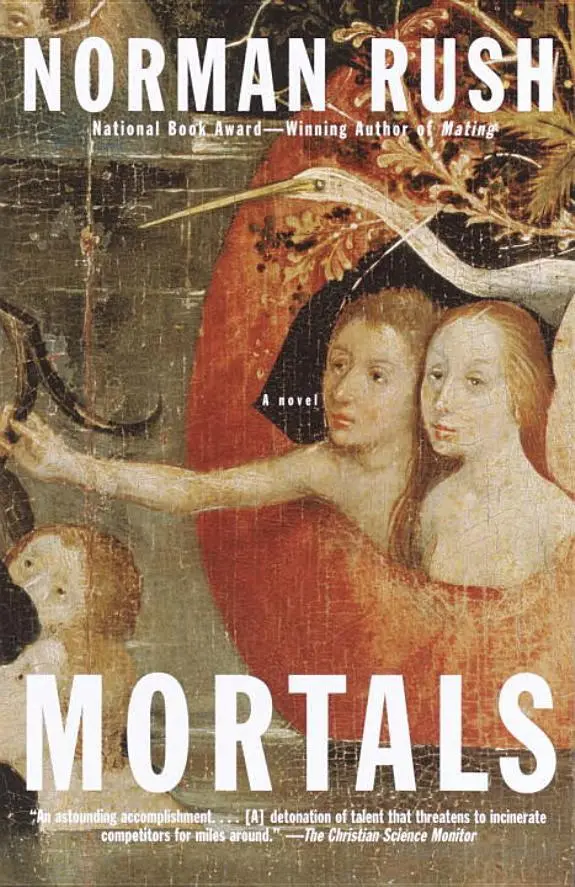
- Название:Mortals
- Автор:
- Издательство:Vintage Books
- Жанр:
- Год:2003
- ISBN:9780307789365
- Рейтинг книги:3 / 5. Голосов: 1
-
Избранное:Добавить в избранное
- Отзывы:
-
Ваша оценка:
Mortals: краткое содержание, описание и аннотация
Предлагаем к чтению аннотацию, описание, краткое содержание или предисловие (зависит от того, что написал сам автор книги «Mortals»). Если вы не нашли необходимую информацию о книге — напишите в комментариях, мы постараемся отыскать её.
As a spy, the compulsively literate Ray ought to have no trouble confirming his suspicions. But there’s the distraction of actual spying. Most of all, there’s the problem of love, which Norman Rush anatomizes in all its hopeless splendor in a novel that would have delighted Milton, Nabokov, and Graham Greene.
Mortals — читать онлайн бесплатно полную книгу (весь текст) целиком
Ниже представлен текст книги, разбитый по страницам. Система сохранения места последней прочитанной страницы, позволяет с удобством читать онлайн бесплатно книгу «Mortals», без необходимости каждый раз заново искать на чём Вы остановились. Поставьте закладку, и сможете в любой момент перейти на страницу, на которой закончили чтение.
Интервал:
Закладка:
They had gotten him out of that tent not a moment too soon. The canvas was impregnated with insecticide and the fumes had been making him feel sick. Also, some solid creature in the soil under the tent floor had been trying to get into the tent, eat its way in. So it had been good to get out.
He had to compose himself as well as he could for the serious interrogation he knew was coming. Technically, all he was required to supply would be his name, rank, and serial number. This was a war zone, so the Geneva Convention applied, he would say. The difficulty was that he had no rank and no number other than his Social Security number, which they could have if they wanted it. Frame of mind was what was critical for interrogation. He had to be calm.
He was going to be calm. He should be able to be. He was fairly sure he knew where he was being taken. So there were unlikely to be surprises in that respect. It was the logical place, and if he had it right this little period of conveyal, which was not a word, conveyance was what he meant, would be over in less than an hour, at these speeds. He was all right. He was riding on events. Aside from the jolting he was taking, he didn’t mind the feeling. It was the polar opposite of entrepreneurship. There were drivers and passengers in the world, more of the latter than the former. And in his obscure and secret way he had been among the drivers. Whether or not Iris or anyone had ever fully appreciated it, he had lived a consequential life of more or less permanent effort, exertion, listening and matching and watching and putting two and two together. So he didn’t mind the feeling of reposing on events. It felt all right. Who was it, someone important in Africa, Livingstone, who had described relaxing into a sort of bliss when the jaws of a lion closed on his leg? And then the lion hadn’t eaten him. And if he remembered correctly it was because when he went limp he appeared dead to the lion and lions abhor carrion. He didn’t know if he was making that up. He forgot why the great man hadn’t been eaten.
There was a vehicle closely following. He knew the sound of its engine by heart. It was the Cruiser. And that was favorable because it meant that it was still conceivable that they would dismiss him, tell him to drive off. With the Cruiser available, that could happen, that should calm him.
They were changing direction, which fit with his notion of their destination. He had three tasks, to sum up. First, to remain calm. Second, to retain what he could about anyone who laid a hand on him or anyone else so he could give evidence against them, not that it would ever happen. These bastards were finished in this part of Africa anyway. He wondered if they knew it. This was their last roundup. Mandela was coming. Mandela was going to rule and these bastards would have to get out. Nobody would have them except warlords and other scum farther north. But that was number two, to be ready to testify. And his third task was to get hold of Strange News again. He could do it. He would consider violence to get it. No he wouldn’t. But he would get it.
It made sense that the koevoet command center would be set up at Ngami Bird Lodge. That was the way they were headed. There was a lurid tale connected to Ngami Bird Lodge. It had failed. It was bankrupt. The facility was shuttered and empty but not derelict. It was in litigation. But the infrastructure was intact, the generators, food stores, and so on. And, ah yes, it had a landing strip.
It was famously grandiose. Iris had wanted to see it, the mock-Moorish buildings, the rock gardens done by a famous landscape artist, date palms, chalets so-called, a zoo, if he remembered correctly. It had been built on the edge of a famous pan where flocks of birds came and the migrating wildebeests and the others. And then the drought had come. The pan had dried up. There was no birdwatching to be done. Pink marble facing had been trucked in from South Africa for the main building, he remembered.
There was more to the story. His knowledge of it was a cartoon, though. An English lord, the last of a noble lineage, had blown his patrimony on Ngami Bird Lodge and on a celebrity tart, a Coloured lounge singer supposedly then the toast of the Cape Town demimonde. He had brought her into the Kalahari to be the lodge’s chatelaine. Then he had proceeded to drink himself into irrelevance as the project failed. There were remarkable things about the woman, the main one being that she had had devil horns strategically tattooed on her lower belly so that they appeared to be emerging from the top of her pubic escutcheon, had been the story. English eccentricity had come into it too. The earl had commissioned the creation of something called a sand fountain, a monumental device and the only one of its kind in the world. It had never been constructed. Aside from the drought, the lodge had been affected by the accelerating collapse of apartheid. The idea had been to create a mini-rival to Sun City that ethical tourists and gamblers and birdwatchers could visit in good conscience. But apartheid had faltered spectacularly. There had been a shooting, the earl was having a prolonged recovery somewhere in Dorset, and the woman had escaped justice and gone back to singing in bars in South Africa.
So, finally, he would get to visit Ngami Bird Lodge. Unfortunately he was going to be blindfolded during his visit. But that was life.
30. Tomorrow It Would Be Combat
He was where he had predicted to himself he would be, on the grounds of the Sand Castle, that being the original name for what became Ngami Bird Lodge. It had been abandoned when one of the backers of the project had pointed out the negative associations the name carried.
His home, for the time being, was a storage room twenty by twenty laterally by eight or so feet floor to ceiling. He was obligated to think about escape possibilities, even though he had just arrived, and he was sorry to have to say that the possibilities looked dim. The zinc panels forming the ceiling were laid over gum tree pole joists and securely fastened to the joists via wire lashings run through perforations in the metal. This was a solid structure. The walls were cement block. He had stamped on the softwood planking of the floor. It was chewed up and featured a display of standing splinters here and there, but it was in good shape. The planking had been pressed directly into the concrete footing. Clearly, heavy equipment had been stored in this space. There were oil and grease stains in the flooring.
It’s roomy, at least, he thought.
The place was windowless but a pittance of light came in through nine vent slots irregularly distributed along the tops of the walls. It would be possible to push an arm through, assuming he could get up that high. He had managed to get a look into the one over the double doors to the shed by climbing up the cross braces on the inside of the doors while hanging on to a ringbolt set into the lintel. He had just gotten his eyes level with the opening, discovering that crushed wads of fine-mesh screening had been jammed into the slot to discourage ingress by animals and the heavier, more ungainly insects. So now he knew that much. There were hooks and other ringbolts screwed into the walls at shoulder level in no particular pattern.
His furnishings were basic, limited to a red plastic bucket lacking a lid or cover of any sort, and his pallet, a twin-size canvas sack filled with chopped maize husks. In fact there were three more pallets, so it was possible that he should be expecting company. He wouldn’t mind company. No blanket had been provided, but the pallets were wide and could, he supposed, be doubled over if it got cold. He would see. He understood why it was that his captors didn’t want him to have a blanket. They were afraid he might do something untoward with it.
Читать дальшеИнтервал:
Закладка:
Похожие книги на «Mortals»
Представляем Вашему вниманию похожие книги на «Mortals» списком для выбора. Мы отобрали схожую по названию и смыслу литературу в надежде предоставить читателям больше вариантов отыскать новые, интересные, ещё непрочитанные произведения.





Обсуждение, отзывы о книге «Mortals» и просто собственные мнения читателей. Оставьте ваши комментарии, напишите, что Вы думаете о произведении, его смысле или главных героях. Укажите что конкретно понравилось, а что нет, и почему Вы так считаете.