Norman Rush - Mortals
Здесь есть возможность читать онлайн «Norman Rush - Mortals» весь текст электронной книги совершенно бесплатно (целиком полную версию без сокращений). В некоторых случаях можно слушать аудио, скачать через торрент в формате fb2 и присутствует краткое содержание. Год выпуска: 2003, ISBN: 2003, Издательство: Vintage Books, Жанр: Современная проза, на английском языке. Описание произведения, (предисловие) а так же отзывы посетителей доступны на портале библиотеки ЛибКат.
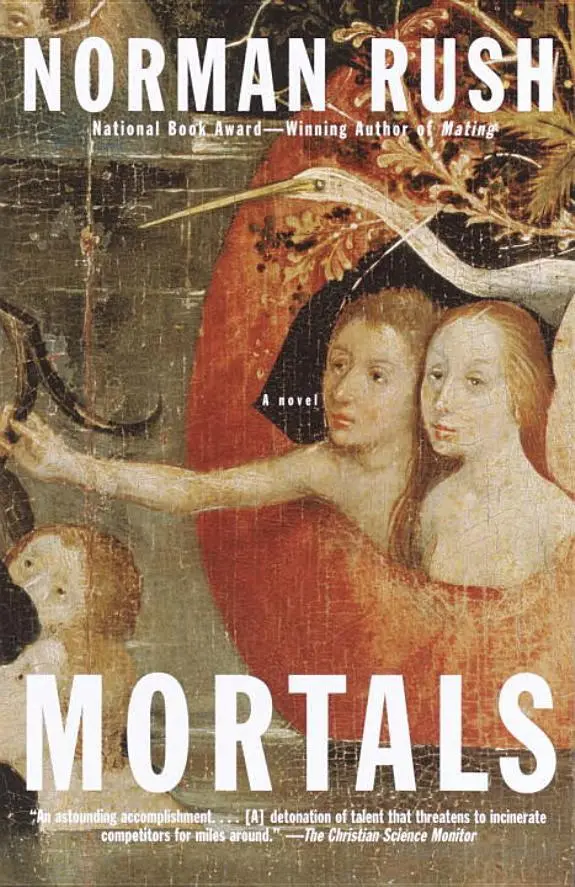
- Название:Mortals
- Автор:
- Издательство:Vintage Books
- Жанр:
- Год:2003
- ISBN:9780307789365
- Рейтинг книги:3 / 5. Голосов: 1
-
Избранное:Добавить в избранное
- Отзывы:
-
Ваша оценка:
Mortals: краткое содержание, описание и аннотация
Предлагаем к чтению аннотацию, описание, краткое содержание или предисловие (зависит от того, что написал сам автор книги «Mortals»). Если вы не нашли необходимую информацию о книге — напишите в комментариях, мы постараемся отыскать её.
As a spy, the compulsively literate Ray ought to have no trouble confirming his suspicions. But there’s the distraction of actual spying. Most of all, there’s the problem of love, which Norman Rush anatomizes in all its hopeless splendor in a novel that would have delighted Milton, Nabokov, and Graham Greene.
Mortals — читать онлайн бесплатно полную книгу (весь текст) целиком
Ниже представлен текст книги, разбитый по страницам. Система сохранения места последней прочитанной страницы, позволяет с удобством читать онлайн бесплатно книгу «Mortals», без необходимости каждый раз заново искать на чём Вы остановились. Поставьте закладку, и сможете в любой момент перейти на страницу, на которой закончили чтение.
Интервал:
Закладка:
He bit into a cracker. He had learned things from Keletso he needed to remember. Driving at night, if you felt sleepy, a good thing to do was to take an apple and make yourself eat the entire thing, chew it slowly, down to the bitter seeds. It would keep you awake. He might need to.
He estimated that he had covered twenty of the fifty kilometers between Nokaneng and the next even smaller and more negligible hamlet, Gumare, which he would transit hoping to reach Etsha by nightfall. The road surface was passable, a little grittier, the grit consisting of bits of ancient shells from the time when all this had been deep underwater. He knew about the shell bits from someone in Gaborone, a geologist.
He would overnight in Etsha and the next day creep along Route 14 and somehow find the spur road that led off to Toromole, the Jerusalem of ISA, the site of Ichokela Bokhutlon or what was left of it. He liked Endure to the End as a motto or name for something. It was a good motto for what he was doing. And when he got there he might find nothing or he might find a mound of ashes. He thought, The past is a bucket of ashes but so is the near future sometimes. The past is a bucket of fishhooks, would be more like it. His mind was tending to aphorism because he was dipping into Strange News from time to time, during stops to pee or stretch, and he was extending his breaks for the purpose of meeting his obligation to finish reading his brother’s last will and testament. It was important for him to get through Strange News and it had been right of Rex to struggle to get it to him. He seemed to be saying to him something like I hope you like this better than you liked me. It was something like that. He could endure that, liking his brother’s best efforts. Rex was supplying entertainment, in this solitude he was being propelled through, or dragged through.
There was something wrong ahead. He had just come around a sharp curve and there was something black in the straight stretch of road directly ahead. The road was sinuous above Nokaneng because it moved over to follow the irregular perimeter of the floodplain of the Okavango River, snaking its way around salients of saw grass and reeds, beds of dry reeds, patches of elephant grass. The road straightened out and then curved east just beyond the black thing in the road. He wondered when the last time was that floodwater had come this far inland. It had been many years. These days the Okavango River was a shriveled thing. When the wind went through the grasses and reeds it made a sound more like clattering than something normal and sibilant.
There was a person in the road. And something was doing in the field of elephant grass. The grass was very high. Something about the texture of the scene was wrong. There could be tents or netting half showing. He would know soon enough.
The figure in the road was a man, just one, a black man standing blocking the way with his arms held out at his sides like Christ on the cross. He was certain that that was what he was seeing, but of course in Botswana you could see in the middle distance or on the skyline what was clearly a bush twitch and strut away, becoming an ostrich. But the imitation of Christ he was seeing was a man. He looked civilian enough. Ray needed to get closer. This assignment had been hard on his eyesight, the constant brightness had. His sunglasses were dark as night. He thought his night vision was a little worse than it had been when he started out. It had been helpful to have Keletso handle night driving. And now his distance vision was seeming a little lacking. Glasses were coming in the next segment of his life. He had gotten Iris when his face had been naked and unencumbered. Even so, he had always been amazed that someone so much beyond his reach had wanted him. In the future any search to be made for a new companion would be undertaken by a bespectacled man, not that that should make a giant difference. But still it was interesting. The design of glasses had improved. Iris always said that when the subject of his possibly needing glasses came up. He would get the best glasses he could. But how would he know which ones were the best? He would figure it out. Morel was a little younger, of course, but as he remembered it, Morel needed reading glasses. We all need glasses, ultimately, he thought, feeling stupid. Because obviously what he was doing was trying to tally up ways, however trivial, in which he was the better man than Gunga Din. It was as though he was preparing for an event, a debate or argument that would decide who Iris would cleave to on the basis of one of them getting a higher score in enumerated qualities.
There was still time to stop, reverse, and turn back to Nokaneng, if he acted immediately. He had been driving with great circumspection and deliberation, out of consideration for his knee. Reversing and swinging around and getting the hell out of there would demand some vigorous moves. And it would conflict with what he thought of as his Trajectory. It would truncate everything. He would discover one of three things, up ahead, or of four things. One would be that this was lifti lifti, a random hitchhiker, innocent. One would be that the person blocking the road was goromente, legitimate. Another was that the man was one of the counterinsurgency specialists from koevoet over in SouthWest. They were killers. He knew that they were present and operating against his friend Kerekang and Kerekang’s friends. And he knew in his bones that Boyle was involved with bringing these teams on board. It would be their job to do the cupping. Mercenaries were scum. They would be setting up cups where they were the only power. Of course the final discovery possible would be that this would be someone from ISA he could communicate with and who would get him to Kerekang. The odds on that were small. But that was what he wanted more than life because he had advice for Kerekang. He was full of important advice. It was keeping him awake at night. He drove forward, at a crawl. You are in the rapids, he thought.
The man in the road wasn’t police, not in any kind of uniform, which might mean he was a hitchhiker. He did look civilian. He was wearing cargo pants, sandals and not boots, a workshirt whose sleeves had been torn off at the shoulder, revealing arms on the huge side, intimidatingly huge arms, in fact. Let me call you Nemesis, Ray thought.
Nemesis was trying to look amiable. He was smiling broadly. And he was doing something clever. He was wearing a baseball cap with the bill pulled sharply down. His big smile was in evidence but the rest of his face was innocently, supposedly, obscure. He was showing himself to be demonstrably unarmed, his hands empty. But he did have a bandanna loosely tied around his neck. If things got critical, it could be pulled up. Mercenaries hated to have their faces seen.
Ray came to a halt. The tone of the encounter was changing already. Ray was receiving peremptory beckoning signals from his nemesis. This was the cup, the edge of the cup.
There was definitely an encampment off in the saw grass. He could make out the tops of tents. There were vehicles under camouflage netting, olive drab bakkies and a jeep. They had selected a good spot to bivouac. The saw grass was thick and the elephant grass was very high. You had to be on top of them to know anyone was there.
The question was whether they would want to take him for questioning or send him back to Nokaneng, kick him out.
The smiling man approached. He was a young fellow. He was keeping his head down, making a show of studying something on the ground. He came to the driver’s side and motioned to Ray that it should be cranked open. Ray hesitated, until he noted in the rearview mirror that a bakkie had come from nowhere and edged into the road behind him, closing it. Ray opened the window.
Читать дальшеИнтервал:
Закладка:
Похожие книги на «Mortals»
Представляем Вашему вниманию похожие книги на «Mortals» списком для выбора. Мы отобрали схожую по названию и смыслу литературу в надежде предоставить читателям больше вариантов отыскать новые, интересные, ещё непрочитанные произведения.



Обсуждение, отзывы о книге «Mortals» и просто собственные мнения читателей. Оставьте ваши комментарии, напишите, что Вы думаете о произведении, его смысле или главных героях. Укажите что конкретно понравилось, а что нет, и почему Вы так считаете.