Norman Rush - Mating
Здесь есть возможность читать онлайн «Norman Rush - Mating» весь текст электронной книги совершенно бесплатно (целиком полную версию без сокращений). В некоторых случаях можно слушать аудио, скачать через торрент в формате fb2 и присутствует краткое содержание. Жанр: Современная проза, на английском языке. Описание произведения, (предисловие) а так же отзывы посетителей доступны на портале библиотеки ЛибКат.
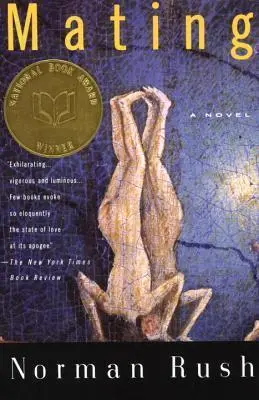
- Название:Mating
- Автор:
- Жанр:
- Год:неизвестен
- ISBN:нет данных
- Рейтинг книги:4 / 5. Голосов: 1
-
Избранное:Добавить в избранное
- Отзывы:
-
Ваша оценка:
Mating: краткое содержание, описание и аннотация
Предлагаем к чтению аннотацию, описание, краткое содержание или предисловие (зависит от того, что написал сам автор книги «Mating»). Если вы не нашли необходимую информацию о книге — напишите в комментариях, мы постараемся отыскать её.
Mating — читать онлайн бесплатно полную книгу (весь текст) целиком
Ниже представлен текст книги, разбитый по страницам. Система сохранения места последней прочитанной страницы, позволяет с удобством читать онлайн бесплатно книгу «Mating», без необходимости каждый раз заново искать на чём Вы остановились. Поставьте закладку, и сможете в любой момент перейти на страницу, на которой закончили чтение.
Интервал:
Закладка:
On the second day the terrain changed. There were long dips and rises. I let the boys graze liberally anytime they seemed inclined. Around noon I had my first phenomenological oddity, having to do with light. It came suddenly. There was a surplus of light. I felt I was getting too much light, despite the fact that I was wearing sunglasses that were practically black. The sky was cloudless. An irrational sign or proof that there was too much light was that I thought I could detect a barely visible flicker in the sky just above the horizon. I tried to push this whole subject out of my consciousness, but it persisted. I thought it might be low blood sugar speaking, so I ate some raisins. Peculiar ideation about light continued.
My sunglasses began to feel heavy and irritating. They were preventing something significant from happening. I developed the conviction that they were keeping me from seeing the real colors of the Kalahari and that this was hazardous for me. I would be in danger unless I recharged my sense of the real colors of things by taking my glasses off at some regular interval. I yielded to this notion, mainly in order to exhaust it, but each time I pushed my glasses up onto my forehead I had a stronger sense of some suppressed vibration going on in the landscape which I would be able to see clearly if I looked more intently and for a longer period the next time. This is brain chemistry, I said, and squatted down and hung my head between my knees. I got up, pulled the visor of my kepi down tight, put my glasses back on, and thought about the hunchbacks of Kang.
I was then all right for twenty minutes, until the mania came back reformulated as the proposition that if I actually got rid of my sunglasses, and only if, I would be able to see the true and fundamental color of nature. I was to understand that what we perceive as beautiful individual colors are only corruptions and distortions of the true color of reality, which is ravishing and ultimate and apprehensible only in extremely rare circumstances. This was not a question of hallucination. It was analogous to dream knowledge, but different. I knew that for some reason at some deep level I was doing this to myself. But still I was tempted to act. I said aloud things like This is about self-injury, This is about self-worth, What are we to ourselves? and other pop-psych trash. The experience was strange in every way. Was I trying to get myself to turn around and go back to Kang before it was too late, because navigating in the Kalahari without sunglasses is one thing for Bushmen who have presumably been adapting their vision to a surplus of light for millennia and another thing for a lakhoa already in a state of anxiety? On any trip like mine there’s a point of no return. So was this some ideational response to the fact, which I was already having to fight to repress, that I was over my head? Had my brilliant unconscious chosen the one thing that if discarded would virtually disable me for making the long trip to Tsau but be manageable for a quick retreat back to Kang and safety? I think what broke the grip of this mania on me was firstly just hearing my own voice, whatever it was saying, and, secondly, remembering reading about someone who had been lost in the Kalahari and survived it reporting that he had had to get past a point when he experienced the desert as an organism or totality trying to get him to become part of it, as in surrender to it. This would make my sunglasses mania an analog of the feeling people lost in the Arctic get that they would be more comfortable if they took off their caps and mittens. The mania left, also suddenly, and we went on uneventfully.
That night I did everything right. I wore myself out collecting enough wood for a ring fire, got us all set up inside it, went into my tent, and closed my eyes, and immediately there were lions in the neighborhood. There may have been only one. I heard a roar like no other sound on earth. I felt it in my atoms. This is my reward for taking precautions, was my first thought.
I made myself emerge. I peered around. My boys were standing pressed together and shaking pathetically. I looked for glints from lion eyes out in the dark but saw nothing. Everything I did I managed to do with one hand on the flap of my tent.
Again I went through my lion lore. Lions roar only after they’ve eaten, for example. The paradox is that ultimately I slept better that night than I had the night before. I fell asleep clutching my bush knife.
In the morning I found it hard to eat. There was terror in me. I could die in this place, it was clear.
I dawdled breaking camp because I wanted to give any lions there were a head start at getting torpid. Lions are torpid during the day, was a key part of my lore package.
Music
Anyone who thinks crossing the Kalahari by yourself is boring is deluded. It’s like being self-employed in a marginal enterprise: there’s always something you should be doing if your little business is going to survive. For example, you should always be lashing a stick around ahead of you through the thicker grass to warn snakes to get back. But this isn’t enough, because there are adders, who pay no attention to noise and just flatten themselves when they hear you coming, the better for you to step on them: so you have to be persistent about watching where you walk. Then you have to be careful not to walk directly under tree limbs without looking keenly to see if there are mambas or boomslangs aloft. You also have to keep resetting your level of vigilance, because your forearm muscles, the extensors in particular, begin to burn, the lashing motion being one you’re totally unaccustomed to. In addition to which there is the sun to be careful about. I was keeping myself smeared with something I bought for three pula at Botschem that was supposed to be a strong sunscreen, but I was turning red in strips and patches anyway. And you have to be watchful for ticks. In only one way was I in luck, and that was in regard to dehydration. This was mid-April, that is to say mid-autumn, and perfect walking weather. In summer you could expect to lose about three pounds of water in a day of walking in the full sun.
You do need mental self-management, though, as I’d already partially learned, to get through solitudes like the Kalahari successfully. Fear itself is not enough to fully sustain and occupy you. On the whole I think I did well, which would have amazed certain lightweight women at the American embassy whose name for me, I learned much later, was Party Lights, based on their interpretation of my way of life — lifestyle to them, no doubt — in Gabs.
I was nervous and so were my animals, postlion. I stumbled on singing as a means of calming them down. I was singing for myself, initially, and then noticed that it seemed to help the boys too, especially Mmo. This is ridiculous, but they seemed to prefer complete songs to fragments of songs strung together with humming. I discovered how few songs I knew in full and how few songs of the ones I did know I knew more than one verse of. I think I must have a more complete sense of my total song inventory than anyone else has of theirs, except for professional singers. I know roughly which songs I know only the choruses of. I know which songs I know but discovered I couldn’t stand to sing in the desert, You Are My Sunshine being a prime example of a song I loathed suddenly to which I had never had any objection previously. And there are other songs you have sung only halfheartedly in the past which in the desert suddenly give you peace and seem indispensable, like Die Gedanken Sind Frei. You are astonished at the number of separate songs that have gotten fused together in your mind in some manner that makes it impossible to separate them, à la What do you want for breakfast my good old man? What do you want for breakfast my honey my lamb? Even God is uneasy say the bells of Swansea. And what will you give me say the bells of Rhymney? And there were songs I knew in full and perfectly but which I had no recollection of ever paying attention to when they were popular, like Heart of Glass, now a favorite of mine forever. Songs help when you’ve under duress, which is undoubtedly why the Boer geniuses of cruelty forbid people in solitary confinement to sing.
Читать дальшеИнтервал:
Закладка:
Похожие книги на «Mating»
Представляем Вашему вниманию похожие книги на «Mating» списком для выбора. Мы отобрали схожую по названию и смыслу литературу в надежде предоставить читателям больше вариантов отыскать новые, интересные, ещё непрочитанные произведения.





Обсуждение, отзывы о книге «Mating» и просто собственные мнения читателей. Оставьте ваши комментарии, напишите, что Вы думаете о произведении, его смысле или главных героях. Укажите что конкретно понравилось, а что нет, и почему Вы так считаете.