Lydia Davis - The Collected Stories of Lydia Davis
Здесь есть возможность читать онлайн «Lydia Davis - The Collected Stories of Lydia Davis» весь текст электронной книги совершенно бесплатно (целиком полную версию без сокращений). В некоторых случаях можно слушать аудио, скачать через торрент в формате fb2 и присутствует краткое содержание. Год выпуска: 2009, Издательство: Farrar, Straus and Giroux, Жанр: Современная проза, на английском языке. Описание произведения, (предисловие) а так же отзывы посетителей доступны на портале библиотеки ЛибКат.

- Название:The Collected Stories of Lydia Davis
- Автор:
- Издательство:Farrar, Straus and Giroux
- Жанр:
- Год:2009
- ISBN:нет данных
- Рейтинг книги:4 / 5. Голосов: 2
-
Избранное:Добавить в избранное
- Отзывы:
-
Ваша оценка:
The Collected Stories of Lydia Davis: краткое содержание, описание и аннотация
Предлагаем к чтению аннотацию, описание, краткое содержание или предисловие (зависит от того, что написал сам автор книги «The Collected Stories of Lydia Davis»). Если вы не нашли необходимую информацию о книге — напишите в комментариях, мы постараемся отыскать её.
The Collected Stories of Lydia Davis is an event in American letters.
The Collected Stories of Lydia Davis — читать онлайн бесплатно полную книгу (весь текст) целиком
Ниже представлен текст книги, разбитый по страницам. Система сохранения места последней прочитанной страницы, позволяет с удобством читать онлайн бесплатно книгу «The Collected Stories of Lydia Davis», без необходимости каждый раз заново искать на чём Вы остановились. Поставьте закладку, и сможете в любой момент перейти на страницу, на которой закончили чтение.
Интервал:
Закладка:
She was not disappointed by the whole experience, she decided, as her thoughts sorted themselves out. She was in bed now, with a book open in front of her, trying to read by the inadequate lamp, but each time she returned her eyes to the page, another insistent thought occurred to her and stopped her. She would have been disappointed if she had not, in the end, seen Murray’s house, or if she had not seen the library, whose alarm she nearly triggered by walking across a perfectly open space at the top of an ancient staircase. She would have been disappointed in this building if the conference room had not been so gracious, with its high ceiling and dark oak beams, and she would perhaps have been disappointed in the conference itself if one of the speakers had not shown such interesting examples of the great writer’s rough drafts. She was disappointed that some of the other participants had not stayed on afterward for at least a little while, that they had, in fact, seemed to be in such a hurry to leave.
But then there was the long walk, and her changing impressions of the town, which had been so crowded, hot, and oppressive at midday the day before and was this evening so serene, with its empty streets, the hollow spaces of its courtyards and back gardens, the darkness, against the sky, of its church steeples and clock towers, with its short alleys and narrow lanes, and its soft stones that, in her memory, had reflected the sky in tints of coral, growing just a few shades dimmer, as the hours passed, in the cool night.
The peace and emptiness of the town in the evening had seemed fragile and temporary; the next day it would be submerged once again in the hot crowd. And because she had made so many circuits out of the town, by bus and then on foot, it seemed to her, too, that the weight of her experience of the town was here, at this distance from it, as though the town were always to be experienced from a distance exactly the length of those two streets which, arising here, and diverging, made their way to it.
At last her thoughts came at longer intervals and she read more than she stopped to think. She then read later than she meant to, gradually forgetting the lamp, the room, and the conference, though the walk remained, as a presence, somewhere behind or beneath her reading, until she relaxed completely and slept, no longer bothered by the hard pillow.
The next morning, when she came out with her suitcase, he was there, too, in a white summer suit slightly too ample for his small frame, standing by the porter’s lodge. He and she had ordered taxis for the same hour, the day before, and the two drivers were standing by the curb chatting in the early sunlight. He was, in fact, going to the same part of town, though not to the train station, but neither of them had suggested sharing a taxi. She waited while he talked on, for a few minutes, to the porter, and then they took leave of each other again before setting off in their separate taxis. As he stepped neatly into his, his last words to her, solemn and rather portentous, she thought, were ones that nobody, as it happened, had ever spoken to her before, but that she judged were likely to be correct, since he lived on the other side of the globe: “We will probably not meet again.” He then made a graceful gesture of the hand that she later could not remember exactly, and whose meaning she could not quite grasp, though it seemed to combine a farewell with a concession to some sort of inevitability, and his cab moved slowly down the street, followed, soon, by her own.
Varieties of Disturbance
I have been hearing what my mother says for over forty years and I have been hearing what my husband says for only about five years, and I have often thought she was right and he was not right, but now more often I think he is right, especially on a day like today when I have just had a long conversation on the phone with my mother about my brother and my father and then a shorter conversation on the phone with my husband about the conversation I had with my mother.
My mother was worried because she hurt my brother’s feelings when he told her over the phone that he wanted to take some of his vacation time to come help them since my mother had just gotten out of the hospital. She said, though she was not telling the truth, that he shouldn’t come because she couldn’t really have anyone in the house since she would feel she had to prepare meals, for instance, though having difficulty enough with her crutches. He argued against that, saying “That wouldn’t be the point!” and now he doesn’t answer his phone. She’s afraid something has happened to him and I tell her I don’t believe that. He has probably taken the vacation time he had set aside for them and gone away for a few days by himself. She forgets he is a man of nearly fifty, though I’m sorry they had to hurt his feelings like that. A short time after she hangs up I call my husband and repeat all this to him.
My mother hurt my brother’s feelings while protecting certain particular feelings of my father’s by claiming certain other feelings of her own, and while it was hard for me to deny my father’s particular feelings, which are well known to me, it was also hard for me not to think there was not a way to do things differently so that my brother’s offer of help would not be declined and he would not be hurt.
She hurt my brother’s feelings as she was protecting my father from certain feelings of disturbance anticipated by him if my brother were to come, by claiming to my brother certain feelings of disturbance of her own, slightly different. Now my brother, by not answering his phone, has caused new feelings of disturbance in my mother and father both, feelings that are the same or close to the same in them but different from the feelings of disturbance anticipated by my father and those falsely claimed by my mother to my brother. Now in her disturbance my mother has called to tell me of her and my father’s feelings of disturbance over my brother, and in doing this she has caused in me feelings of disturbance also, though fainter than and different from the feelings experienced now by her and my father and those anticipated by my father and falsely claimed by my mother.
When I describe this conversation to my husband, I cause in him feelings of disturbance also, stronger than mine and different in kind from those in my mother, in my father, and respectively claimed and anticipated by them. My husband is disturbed by my mother’s refusing my brother’s help and thus causing disturbance in him, and by her telling me of her disturbance and thus causing disturbance in me greater, he says, than I realize, but also more generally by the disturbance caused more generally not only in my brother by her but also in me by her greater than I realize, and more often than I realize, and when he points this out, it causes in me yet another disturbance different in kind and in degree from that caused in me by what my mother has told me, for this disturbance is not only for myself and my brother, and not only for my father in his anticipated and his present disturbance, but also and most of all for my mother herself, who has now, and has generally, caused so much disturbance, as my husband rightly says, but is herself disturbed by only a small part of it.
Lonely
No one is calling me. I can’t check the answering machine because I have been here all this time. If I go out, someone may call while I’m out. Then I can check the answering machine when I come back in.
Mrs. D and Her Maids
Names of Some Early Maids, with Identifying Characteristics
Cora, who misses them all
Nellie Bingo: our darling, but she disappeared into a sanatorium
Anna the Grump
Virginia York: not a whirlwind
Читать дальшеИнтервал:
Закладка:
Похожие книги на «The Collected Stories of Lydia Davis»
Представляем Вашему вниманию похожие книги на «The Collected Stories of Lydia Davis» списком для выбора. Мы отобрали схожую по названию и смыслу литературу в надежде предоставить читателям больше вариантов отыскать новые, интересные, ещё непрочитанные произведения.





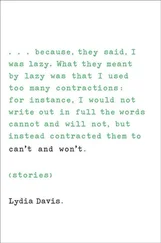





Обсуждение, отзывы о книге «The Collected Stories of Lydia Davis» и просто собственные мнения читателей. Оставьте ваши комментарии, напишите, что Вы думаете о произведении, его смысле или главных героях. Укажите что конкретно понравилось, а что нет, и почему Вы так считаете.