Alain Robbe-Grillet - The Voyeur
Здесь есть возможность читать онлайн «Alain Robbe-Grillet - The Voyeur» весь текст электронной книги совершенно бесплатно (целиком полную версию без сокращений). В некоторых случаях можно слушать аудио, скачать через торрент в формате fb2 и присутствует краткое содержание. Город: New York, Год выпуска: 1994, ISBN: 1994, Издательство: Grove Press, Жанр: Современная проза, на английском языке. Описание произведения, (предисловие) а так же отзывы посетителей доступны на портале библиотеки ЛибКат.
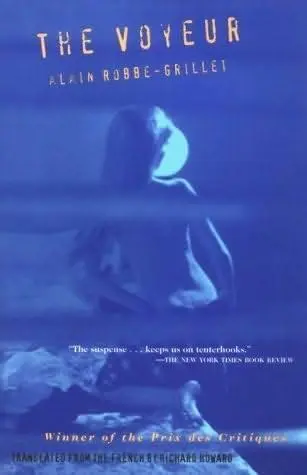
- Название:The Voyeur
- Автор:
- Издательство:Grove Press
- Жанр:
- Год:1994
- Город:New York
- ISBN:978-0802131652
- Рейтинг книги:5 / 5. Голосов: 1
-
Избранное:Добавить в избранное
- Отзывы:
-
Ваша оценка:
The Voyeur: краткое содержание, описание и аннотация
Предлагаем к чтению аннотацию, описание, краткое содержание или предисловие (зависит от того, что написал сам автор книги «The Voyeur»). Если вы не нашли необходимую информацию о книге — напишите в комментариях, мы постараемся отыскать её.
A triumphant display of the techniques of the “new novel,”
achieves the impossible feat of keeping us utterly engrossed in the mystery of the child’s murder while systematically raising doubts about whether it really occurred.
The Voyeur — читать онлайн бесплатно полную книгу (весь текст) целиком
Ниже представлен текст книги, разбитый по страницам. Система сохранения места последней прочитанной страницы, позволяет с удобством читать онлайн бесплатно книгу «The Voyeur», без необходимости каждый раз заново искать на чём Вы остановились. Поставьте закладку, и сможете в любой момент перейти на страницу, на которой закончили чтение.
Интервал:
Закладка:
The likeness was perfect. It was not only the still-childish face with the huge eyes, the slender, round neck, the golden color of the hair, but even the same dimple near the armpits and the same fragile texture of the skin. Slightly below the right hip was a tiny blackish-red mole about the size of an ant and shaped like a three-pointed star—it looked very much like a v or a y.
The sun was hot down in this sheltered hollow. Mathias unbuckled the belt of his duffle coat; although the sky was overcast, the air did not seem so fresh now that the wind no longer reached him. Toward the open sea, on the other side of the reefs protecting the cove, the same low rock could still be seen with its fringe of foam and its three motionless gulls. They had not changed direction; but since they were rather far away they continued, despite the observer’s change of position, to be seen from the same angle—that is, exactly in profile. Tlirough an invisible opening in the clouds a pale sunbeam illuminated the scene with a wan, flat light. The rather lusterless white of the birds, in this light, gave an impression of distance that was impossible to estimate; the imagination might locate them at a mile off, or twenty feet, or even, without much more effort, within arm’s reach.
“Here we are,” said the fisherman boisterously. The sunbeam disappeared. The grayish plumage of the gulls was restored to its sixty yards’ distance. At the edge of the steep cliff—too near, in places, following the recent cave-ins—the path sloped steeply down to the cottage and the bit of lawn. The cottage had only one small, square window. The roof was covered with thick, irregular, hand-hewn slates. “Here we are,” the voice repeated.
They went in, the sailor followed by the salesman who closed the door behind him; the latch caught by itself. The cottage was really a good way from the village and not “thirty seconds” as its owner had promised. The latter’s name was written on the door in chalk: Jean Robin. The clumsy script, both laborious and uncertain, suggested the school exercises of young children; but a child could not have reached so high on the door panel, even standing on tiptoe. The vertical side of the b, instead of being straight, leaned backward, and its upper loop, too rounded, looked like the reversed image of the bulge against which it was braced. Mathias, groping his way forward in the dark vestibule, wondered if the sailor had written these two words himself—and with what purpose. “Jean Robin”—the name suggested something, but nothing precise enough for him to locate the man in the past from which he claimed to emerge. The cottage’s dark interior seemed more complicated than its size and its single window had led him to suppose from outside. The salesman directed his steps according to the back preceding him—turning several times at sharp angles—without discovering whether he was crossing rooms, hallways, or only going through doors.
“Be careful here,” the man said, “there’s a step.”
His voice was low now, whispering, as if fearful of waking a sleeper, an invalid, an unfriendly dog.
The room impressed Mathias as being rather large—certainly less cramped than he had expected. The little square window—the one looking out toward the cove, doubtless—provided a brilliant, raw, but limited light, which did not reach the corners of the room, nor even its central section. Only the comer of a massive table and a few inches of rough flooring clearly emerged from the darkness. Mathias turned toward the light to look through the dirty panes.
He did not have time to recognize the landscape, for his attention was immediately drawn in the opposite direction by the noise of some utensil falling, a kitchen implement, probably. In the corner farthest from the window he could make out two silhouettes, one the fisherman’s and the other, which he had not noticed up to now, that of a girl or young woman—slender, graceful, and wearing a close-fitting dress which was either black or very dark. Her head did not reach to the man’s shoulder. She leaned over, bending her knees, to pick up the fallen object. Motionless above her, his hands on his hips, the sailor bent his head a little, as if to gaze at her.
Behind them were flames appearing through a circular opening in a horizontal surface—short yellow flames spreading sideways in order not to extend beyond the level of the opening. They issued from the grate of a large kitchen stove standing against the rear wall from which one of the two cast-iron lids had been removed.
Mathias walked around the big table to join the couple; but not the slightest attempt was made at an introduction, nor any other kind of speech. His exuberance gone now, the host’s expression was severe, his half-closed eyes producing a line across his brow portending either anxiety or anger. Something must have happened, while the salesman had his back turned, between him and the girl—his daughter?—his wife?—a servant?
They sat down at the table in silence. There was nothing on it but two soup plates, two glasses, and an ordinary hammer. The two men sat facing the window, each at an end of the long bench running the length of the table. The sailor uncorked the two bottles of wine one after the other with a corkscrew attached to his pocket knife. The woman set another glass and plate for Mathias; then she brought a casserole of boiled potatoes and finally, without bothering to put them on a plate, two whole broiled spider-crabs. Then she sat down on a stool facing the salesman—between him and the window, her back to the light.
Mathias tried to see through the panes. The sailor poured the wine. In front of them the two crabs were lying side by side, the angular legs in the air, half-crooked toward their bellies. Looking at the simple cotton dress worn by the girl opposite him, Mathias decided he was getting too warm. He took off his duffle coat, threw it on a box behind the bench, and unbuttoned his jacket. He regretted having let himself be brought all the way to this cottage, where he felt alien, importunate, as if he inspired defiance in its inhabitants, and where, furthermore, his presence was justified by no hope of a sale, as he might have guessed.
His two companions had begun to peel their potatoes, using their nails with deliberate movements. The salesman reached into the casserole and imitated them.
Suddenly the fisherman burst out laughing, so unexpectedly that Mathias gave a start; his eyes shifted from the girl’s black dress to his neighbor’s suddenly cheerful face. The man’s glass was empty again. Mathias drank a swallow from his own.
“It’s damned funny all the same!” said the man.
The salesman wondered if he should answer. He decided it was more discreet to busy himself with his task, facilitated by the unusual length of his nails. He looked at the thin, close-fitting black dress, and the reflections of the light playing about the base of the girl’s neck.
“When I think,” the man said, “that here we are, the two of us, calmly peeling potatoes together….” He laughed and left his sentence unfinished. Indicating the crabs with his chin, he asked, “Don’t you like hookers?”
Mathias answered in the affirmative, asked himself the same question, and decided that he had just lied. The odor, however, was not disagreeable. The sailor picked up one of the creatures and tore off its limbs one by one; with the largest blade of his knife he pierced the belly at two points and then stripped off the carapace with a precise, vigorous gesture; the body in one hand and the shell in the other, he stopped a moment to inspect the flesh.
“And they claim they’re empty!”
This exclamation was followed by several insults intended for the fish merchants, and the man finished with a few recriminations about the low prices spider-crabs were bringing now. At the same time he had taken the hammer and begun to break open the legs with sharp taps, using the table between his own plate and the salesman’s as an anvil.
Читать дальшеИнтервал:
Закладка:
Похожие книги на «The Voyeur»
Представляем Вашему вниманию похожие книги на «The Voyeur» списком для выбора. Мы отобрали схожую по названию и смыслу литературу в надежде предоставить читателям больше вариантов отыскать новые, интересные, ещё непрочитанные произведения.







Обсуждение, отзывы о книге «The Voyeur» и просто собственные мнения читателей. Оставьте ваши комментарии, напишите, что Вы думаете о произведении, его смысле или главных героях. Укажите что конкретно понравилось, а что нет, и почему Вы так считаете.