Alain Robbe-Grillet - The Voyeur
Здесь есть возможность читать онлайн «Alain Robbe-Grillet - The Voyeur» весь текст электронной книги совершенно бесплатно (целиком полную версию без сокращений). В некоторых случаях можно слушать аудио, скачать через торрент в формате fb2 и присутствует краткое содержание. Город: New York, Год выпуска: 1994, ISBN: 1994, Издательство: Grove Press, Жанр: Современная проза, на английском языке. Описание произведения, (предисловие) а так же отзывы посетителей доступны на портале библиотеки ЛибКат.
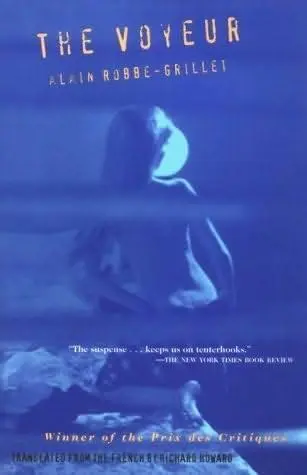
- Название:The Voyeur
- Автор:
- Издательство:Grove Press
- Жанр:
- Год:1994
- Город:New York
- ISBN:978-0802131652
- Рейтинг книги:5 / 5. Голосов: 1
-
Избранное:Добавить в избранное
- Отзывы:
-
Ваша оценка:
The Voyeur: краткое содержание, описание и аннотация
Предлагаем к чтению аннотацию, описание, краткое содержание или предисловие (зависит от того, что написал сам автор книги «The Voyeur»). Если вы не нашли необходимую информацию о книге — напишите в комментариях, мы постараемся отыскать её.
A triumphant display of the techniques of the “new novel,”
achieves the impossible feat of keeping us utterly engrossed in the mystery of the child’s murder while systematically raising doubts about whether it really occurred.
The Voyeur — читать онлайн бесплатно полную книгу (весь текст) целиком
Ниже представлен текст книги, разбитый по страницам. Система сохранения места последней прочитанной страницы, позволяет с удобством читать онлайн бесплатно книгу «The Voyeur», без необходимости каждый раз заново искать на чём Вы остановились. Поставьте закладку, и сможете в любой момент перейти на страницу, на которой закончили чтение.
Интервал:
Закладка:
At this moment the fat woman returned; Mathias was not sorry to have an opportunity to prove he was not a stranger, that he really had friends on the island, that he could be trusted. The sailor took her for his witness: “I come in here to buy some wine, and who do I find myself next to but old Mathias—I haven’t seen him in I don’t know how long. That’s a good one!”
The salesman didn’t know how long either; he too found the encounter strange. But it was useless trying to stir up his memories, he didn’t even know what he should be looking for.
“Such things happen,” the proprietress said.
She took the empty bottle and brought a full one in its place. After taking it from her, the sailor declared that it would be “best” to put it on his bill “with the others.” The woman made a dissatisfied face, but did not raise any objection. Looking at the wall with a vague expression, the sailor then announced that with a second bottle he could invite “this old Matt” to lunch. He addressed himself to no one in particular. No one answered.
Doubtless it was up to Mathias to intervene. But the man turned to him and began to question him with an increased cordiality about what had become of him “since old times.” It seemed difficult to tell him without knowing beforehand how long ago he meant. The salesman did not have to puzzle about this for long, however, for the sailor had apparently no intention of listening to his answer. His new old comrade spoke more and more rapidly, making gestures of which the vigor and extent endangered the full bottle in his left hand. Mathias soon gave up trying to unravel any clues concerning the common past supposedly linking him to this person. His entire attention barely sufficed to follow the movements—sometimes divergent, sometimes convergent, sometimes without apparent relation—of the free hand and the bottle of red wine. The former, more agile, led on the other; by weighing it down with a load equal to the one already encumbering the left hand, the agitation of both might have been reduced to almost nothing—to slight movements, slower and more orderly, less extensive, necessary perhaps, easy to follow, in any case, for an attentive observer.
But first of all there would have to be a certain lull to interrupt this series of intertwined gestures and sentences which increased from moment to moment, assuming an alarming intensity. The slight breaks still evident here and there were of no use, for they could only be discerned at a distance, hence too late, when the current was already re-established. Mathias regretted not having bought the second bottle when the occasion had obviously permitted. To return to that point now demanded an immediacy of reaction utterly beyond his power. He closed his eyes. Behind the sailor, the threatening—or liberating—wine, the glass door, the road, the stone wall, the sea continued to dash against the cliff in regular assaults. After the shock of each wave against the irregular rock walls came the sound of water falling back in a mass, followed by the rustling of innumerable white cascades streaming out of the hollows and down the projections of the rock, the diminishing murmur lasting until the next wave.
The sun had completely disappeared. Past the shoreline the sea appeared a flat, even green, opaque, as if it had been frozen. The waves seemed to form at a very short distance from land, suddenly swelling up, submerging the giant rocks off the coast and spreading milky fans behind them as they advanced, collapsing farther inshore, boiling into the indentations in the slope, surging into unsuspected holes, breaking against other waves in gutters and grottoes, or leaping toward the sky in plumes of surprising height—which nevertheless were repeated at the same points with each wave.
In an indentation protected by an oblique ledge, where the calmer water lapped in rhythm with the undertow, a thick layer of yellowish moss had accumulated, from which the wind tore off long strips, spreading them in whorls along the face of the cliff. Mathias was walking rapidly along the path on the cliff top, his suitcase in one hand and his duffle coat buttoned up, several yards behind the fisherman. The latter, a full bottle dangling at the end of each arm, had finally stopped talking because of the racket the waves made. From time to time he turned around to face the salesman, and cried out a few words, accompanying them with confused movements of his elbows—vestiges of vaster demonstrations. Mathias could not reconstitute their full development, for he was obliged, in order to turn his ear in the man’s direction, to keep his eyes elsewhere. He stopped for a moment in order to hear better. At the angle of a narrow passageway between two almost vertical walls, the water alternately swelled and hollowed with each wave; at this point there was neither foam nor backwash; the moving mass of water remained smooth and blue, rising and falling against the rock walls. The disposition of the nearby rocks forced a sudden influx of liquid into the narrows so that the level rose to a height greatly exceeding that of the initial wave. The collapse followed at once, creating in a few seconds, in the same place, a depression so deep that it was surprising not to be able to see sand, or pebbles, or the undulating fronds of seaweed at the bottom. On the contrary, the surface remained the same intense blue tinged with violet along the rock wall. But away from the coast, the sea appeared beneath a sky filled with clouds, a flat, even green, opaque, as if it had been frozen.
A reef farther offshore, where the swell seemed almost insignificant, escaped the periodic immersion despite its low configuration. A border of foam traced its contours. Three gulls sat perfectly still on slight eminences on it, one a little above the other two. They were sitting in profile, from where he was standing, all three facing the same direction and as identical as if they had been painted on canvas with a stencil—legs stiff, body horizontal, head raised, eve fixed, beak pointing toward the horizon.
Then the path descended to a little beach forming the end of a narrow cove full of reeds. The triangle of sand was completely covered by a beached fishing-smack and five or six crab traps—big round openwork baskets made of thin wands tied in place with osier knots. Immediately behind the beach, near the first reeds, stood a lone cottage in the center of a tiny lawn joined to the beach by a steep path. The fisherman pointed one of the bottles toward the slate roof and said, “Here we are.”
Mathias was surprised by his voice, which had suddenly become normal again: he no longer needed to shout to make himself heard; the deafening noise of sea and wind had disappeared so completely that it seemed he had been transported several miles away. He looked behind him. The slope down had barely begun, but the narrowness of the cove and the hillocks along the cliff top above him were enough to shelter the path almost immediately. The waves were no longer visible—neither their successive arrivals, nor their collapse, nor even their highest columns of spray—concealed as they were by the rocky projections three-quarters of the way across the entrance to this little basin. Protected as if by a series of staggered dikes, the water here had the smoothness of a flat calm. Mathias leaned over the perpendicular edge.
He saw beneath him, barely above the surface, a horizontal platform roughly hewn from the rock, long enough and wide enough for a man to stretch out comfortably. Whether the formation was entirely natural or the result of human handiwork, human beings certainly used it—or had used it in the past—probably for landing little fishing boats when the tide permitted. It was accessible, without too much difficulty, from the path, thanks to a series of breaks and faults forming a staircase missing only a few steps. The appointments of this rudimentary quay had been completed by four iron rings set into the vertical flank: the first two were quite low, on a level with the platform, about a yard apart, the others at a man’s height, and a little wider apart. The unusual position in which the legs and arms were thus held revealed the body’s grace. The salesman had recognized Violet immediately.
Читать дальшеИнтервал:
Закладка:
Похожие книги на «The Voyeur»
Представляем Вашему вниманию похожие книги на «The Voyeur» списком для выбора. Мы отобрали схожую по названию и смыслу литературу в надежде предоставить читателям больше вариантов отыскать новые, интересные, ещё непрочитанные произведения.






Обсуждение, отзывы о книге «The Voyeur» и просто собственные мнения читателей. Оставьте ваши комментарии, напишите, что Вы думаете о произведении, его смысле или главных героях. Укажите что конкретно понравилось, а что нет, и почему Вы так считаете.