William Vollmann - The Atlas
Здесь есть возможность читать онлайн «William Vollmann - The Atlas» весь текст электронной книги совершенно бесплатно (целиком полную версию без сокращений). В некоторых случаях можно слушать аудио, скачать через торрент в формате fb2 и присутствует краткое содержание. Год выпуска: 1996, ISBN: 1996, Издательство: Viking, Жанр: Современная проза, на английском языке. Описание произведения, (предисловие) а так же отзывы посетителей доступны на портале библиотеки ЛибКат.
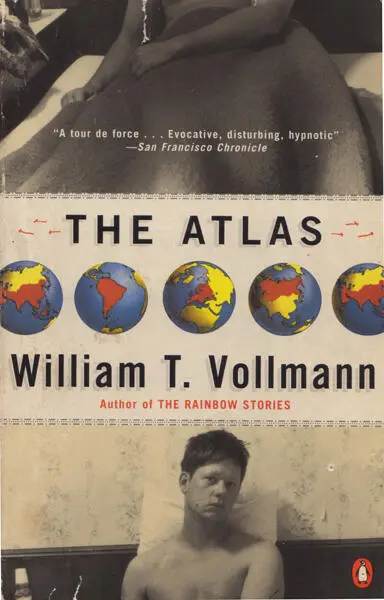
- Название:The Atlas
- Автор:
- Издательство:Viking
- Жанр:
- Год:1996
- ISBN:9780670865789
- Рейтинг книги:3 / 5. Голосов: 1
-
Избранное:Добавить в избранное
- Отзывы:
-
Ваша оценка:
The Atlas: краткое содержание, описание и аннотация
Предлагаем к чтению аннотацию, описание, краткое содержание или предисловие (зависит от того, что написал сам автор книги «The Atlas»). Если вы не нашли необходимую информацию о книге — напишите в комментариях, мы постараемся отыскать её.
The Atlas — читать онлайн бесплатно полную книгу (весь текст) целиком
Ниже представлен текст книги, разбитый по страницам. Система сохранения места последней прочитанной страницы, позволяет с удобством читать онлайн бесплатно книгу «The Atlas», без необходимости каждый раз заново искать на чём Вы остановились. Поставьте закладку, и сможете в любой момент перейти на страницу, на которой закончили чтение.
Интервал:
Закладка:
The woman who'd respectfully returned her ticket wanted to get rid of ill-made furniture, too. How could he blame her for doing that? First of all, he didn't love her more than the others. She needed to be loved exclusively, because she was sad in a different way than he was. While his incompleteness and emptiness made him so lonely that he sometimes couldn't sleep outside of a woman's arms, her own disease was self-hatred. Once he sent her a photograph in which, so he'd thought, her beauty had been definitively proved, and she thought it ugly, although at least she didn't throw it away. Some gray and cloudy species of dreariness, some foreign chemical or trace, had invaded her and inflamed her with listless sorrow long before they'd ever met, clinging to her like a poisonous mucus, and although he wanted to brush it away he couldn't; he didn't know how. His own need-driven selfishness, which she'd later name his culpability, only added to her hurt. Because she could not see her own excellence, his compliments rang sarcastic in her ears; sometimes he felt so guilty for hurting her that he wanted to kneel down and give her a revolver and respectfully request that she shoot him. How could he make her see how rare she was, how specially strange? Sometimes for a moment she'd smile at him through her guardedness and pain. But he could not be loyal only to her, and when he was with her he couldn't leave her alone. He'd take her hand on the subway, for instance, until she became angry, interpreting this as a kind of exhibitionistic possessive-ness or territorialism, like a dog marking ownership by means of pungent liquid irrelevancies, when in fact his was a different kind of selfishness, that same desperate loneliness which compelled him to take her hand again and again until she practically shook him off. He was not really bad, just greedy and unmeritorious. (She wasn't perfect, either.) Behind his screen of consideration, sincere though it was, he operated almost ruthlessly, so that his filthy love-claws hurt her again and again.
Clasping her pale amis behind her back as she gazed into a glass case filled with golden figures in some museum, she might have felt distracted from her struggle against the gray cloud if he were with her, because she truly liked someone to identify things to, thereby confirming her empire of names (when he asked what her favorite thing was, she said: Probably the funerary couch), but he just felt sulky and sorry for himself remembering the walnut-paneled hotel room in Philadelphia, with snow outside and the hazy peace inside from her cigarette smoke, the old room with its pale beige moldings, its browns and off-golds behind the netting curtains which hid the white sky and brick towers and roofs. The next morning all the snow had melted. The lobby's black and white floor-diamonds swarmed around her when she went out. In the window-ledges, the holes in the heater-grilles were as big as fingertips. The dark wood around them was cracked by the hot air which had fought so many winters. He stood watching her dwindle through the picture window; she was in a hurry to make her train. A rotund man in a black trench-coat stood with his hands in his pockets, his face pale, his eyes glittering like wet blackberries past their season; and the man was leaning beside the brass-bordered mirror. With a strange start of jealous anger, he understood that the man was watching her also. She never looked back. Possibly she didn't know he could see her. His own train, leaving, followed the parallel wildernesses of track, sooty arches and old snow. The blue sky clouded over with ugly birds. He passed buildings, bare trees old and dirty and dreary, crossed the wide straight river. Useless. He gazed at black tree-fingers in the reddish-brown dirt of spring. Broken-windowed houses looked back at him from over the railroad tracks; that was that. She'd said: You don't love me, and he said again that he did, and she said: I believe you think that you love me. I believe you love me as much as you can. — He sat there, sad and heavy and guilty. That was in the summertime when it was very hot. She made love with him only twice that time, once on the first night and once on the last. The first time he'd seduced her and afterward she'd said: It's not fair for you to make me want you. — The other time she'd done it as a surprise, probably out of pity. As soon as it was over she'd gotten out of bed, put on her clothes and sat staring at him from the other side of the room. The rest of the time they were at museums and she said: Come look at this calligraphy. — Memory-pictures crowded past like the high alert buttocks of cyclists speeding so silently down the river drive. Everything which he now recollected on that train was as clear as another glass of horseradish vodka with the meniscus trembling so alertly on the table whose red roses were less ruby-dark than the wine in the other goblets; the pianist sent out happiness in firm rhythms, turning his bald head in swivels of pleasure; the woman in the dress which was a meadow of black roses moved forward to kiss him, leaned back forking her mushrooms vol-au-vent, smiling, her shoulders shining; and the disk below the stem of his water glass burst into a dozen rainbows; and the beauty in the black dress was happy and frowned and ordered more wine, clasping her breastbone. That night the light had been a crooked bamboo pole in the red cushions of booths, and the woman in the black dress had brought his hand to her lips like autumn's river slow and strange. The crazy piano-notes sank into the coriander vodka; and after more coriander vodka he looked up and the woman in the black dress was gone, only the crumpled white napkin which had touched her mouth remaining to mark her. He sat still for awhile. Then he picked up the napkin and put his face to its lipstick stain. After he'd paid their bill he went outside and stood there for awhile gazing down the long street-canals which sparkled with cabs like square yellow beads. .
He was on that train all night and all day and all night and half the next day, so he came to know the Chinese cook, who'd pretend to charge him two hundred dollars instead of two for a couple of sodas; he'd tell the cook that the check was in the mail and then they'd both laugh; he got a crush on the black waitress, who always smiled and spoke softly and gently when she served his eggs and bacon (she put in extra toast); and his memories spilled ahead like the reflections of sedge-bundles in the ponds.
The river itself was calm, salt-blue in the twilight except for the rich brown shadows that hugged the far side under the trees. He remembered how the Nile, less modest than wide, became greenish-brown where deep, greenish-blue where shallow. Wide wet sandbars were hued like burned corn. The ship passed a yellow sand-hill crowned with tombs like anthills; and a long-necked ibis lurked among the oleanders on Lord Kitchener's island, which was an undulating green tree-strip. The tomb is the future. Perhaps that is why some people are not happy at the turning of the year. By chance he'd attended one Chinese New Year in Opium City. Across the border he'd seen the richly colored Hell Banknotes which the Chinese burned for their ancestors, so he expected fire, which there was, but where lay the joy of the future's dreams? Above that monotonous guitar song in a minor key, a strong raspy soldier-voice was singing to wordless people who danced strangely around a smoky sparky bonfire. — Mainly soldiers from the front, an old veteran said. This festival to make them happy. — Their dark uniforms were thick with sadness as they danced round and round in the cold and foggy darkness. Occasionally they did sing; he even heard all voices raised. Clouds of breath rose like smoke above the arc lights in the black sky. The voices chanted and then were silent. — Strange to admit that this occasion had no more sap than a dead branch, whereas a cave he'd once entered in Tasmania had been almost vivacious with inhuman strangeness from its very mouth where ferny darkness shattered the light into a billion bedraggled strings of limestone like carrots, fat leaves, spearheads; deeper in, bleached cave-spiders surveyed him from walls textured and webbed; there was a peace to this place without sadness, a patient transformation of water into rock which knew little of life and so could not be tortured by it; its history was written only in candle-white stalactites growing down to a pond. It had a sky, possessed its still white constellation of glowworms in the blackness. In that cave there was only eternity to fear. Hell is anything which continues long enough. He remembered a sunken bubble of a Jerusalem teahouse whose domed ceiling was whitewashed and arched, and as he sat in a cushioned niche drinking mulled cider against the chill a young Jew came to him and drew a picture of a dove. The Jew wished him shalom , which means peace, love, happiness, freedom, and all dreams coming true. He said that the young dove he had drawn wished only to live. The Jew's sweetness uplifted him. He was not in hell. But in another niche a man with glowing eyes, filled with the same pride and tenderness, expressed that spirit with words that sought to persuade, compel, dominate. His victim, a young Jewish-American girl, cringed miserably before him. He leaned toward her and said: Do you really like this country? Do you think the mentality and spirituality of this country fit you? — I don't know, replied the girl as bravely as she could. I'm here to find out. — You see, I know a guy, the man said. He came to open a business here. But, you know, he was not happy. This kind of thing disturbs me. That's why I must ask you. — There was no levity in this man, only a merciless sincerity. The girl struggled to speak, but he silenced her with a wave of his hand and told her: I think what you have already seen, that is enough. You must not wait any longer to make up your mind. — The poor girl was weeping. He would not let her alone. He said: To be a Jew in Israel, you must have some deep roots; you must be ready to get married and live the life. Elsewhere, you are only a Jew. Here it is different. If you're asking me, your place as a Jew is here. — There was an impressive quality to the man which only made his speechifying more unpleasant. And yet it was not meant as bullying at all. Another day he who travelled and watched arrived at the Western Wall, where two checkpoint police in blue knife-proof vests met him in a happy spirit. One of the pair said: Why don't you go in the army? The army's very good. . — and put his hand on his shoulder. The physical contact felt warm and loving. The policeman was proud of who he was. He wanted to help Israel; he also wanted to give this stranger before him a place in the world. His wish was heartfelt and had to be respected. Beneath palms and white towers he saw a sticker: EVERY YESHIVA SHOULD JOIN ISRAEL'S ARMY. EVERY JEWISH STUDENT SHOULD JOIN A YESHIVA. He ascended the Citadel wall, peered through the slits once used to pour boiling oil down on besiegers; went out and down the narrow street lined with handwoven scarves and tablecloths, rugs, leather purses and belts, fringed bedspreads, mounds of coriander, and, passing a coffee shop which was bright with caged birds he found himself at the edge of the Jewish zone. Green-garbed soldiers with Uzis stood tense and ready. He passed through a doorway and came out into the Arab side where two men in blue windbreakers that said POLICE were forcing couples to disengage hands; and he decided to visit the Aqsa mosque. He took off his shoes. Two Jewish soldiers were sitting on the wide flagstones, guarding rows of soldier-boots. — I'd like to kill all the dirty stinking Arabs, one said. — He entered the mosque, loving the blue tiles inscribed with Qur'anic verses. Some Jewish extremists had planted a bomb underneath but it hadn't gone off. Inside was the same still hollowed-out beauty as in the Tasmanian cave. Calligraphed Arabic letters rose like swords. There were silver flowers and disks on the ceiling, and the pillars were marbled like halvah. He saw some Qur'ans on a shelf at the rear; people were borrowing them like hymnals. He went to look at one, and a man screamed: Not allowed! and all the other people in that mosque regarded him with hatred. He went outside and was trying to understand the Dome of the Rock with his eyes when the hour for Muslim prayer arrived and an Arab yelled at him: Okay, the show is over! Get out! — And so he returned to the Jewish side, where two soldiers in green parkas stood beside a metal detector. An Arab passed through the metal detector and it did not go off. The soldiers called him back and frisked him roughly. An Orthodox Jew with long sidelocks set off the metal detector and the soldiers smiled and waved him through. Then it was his turn. The metal detector was silent. They didn't frisk him but they searched his bag. Not looking back, he walked down the arched tunnel, toward the flag with the blue stripes and the blue star. . YOU ARE PRESENTLY IN THE AREA OF THE WESTERN WALL. YOU ARE KINDLY REQUESTED TO FOLLOW THE INSTRUCTIONS OF THE GUARDS AND TO SAFEGUARD THE SANCTITY OF THE HOLY SITE. THE FOLLOWING ARE PROHIBITED… A soldier with a machine-gun strolled slowly across the worn white stones. — The train continued to move slowly as it came into a swollen blood vessel of track, then shadowed a long wall of boxcars overhung by whitish-yellow lights on poles.
Читать дальшеИнтервал:
Закладка:
Похожие книги на «The Atlas»
Представляем Вашему вниманию похожие книги на «The Atlas» списком для выбора. Мы отобрали схожую по названию и смыслу литературу в надежде предоставить читателям больше вариантов отыскать новые, интересные, ещё непрочитанные произведения.





Обсуждение, отзывы о книге «The Atlas» и просто собственные мнения читателей. Оставьте ваши комментарии, напишите, что Вы думаете о произведении, его смысле или главных героях. Укажите что конкретно понравилось, а что нет, и почему Вы так считаете.