Paul Theroux - Blinding Light
Здесь есть возможность читать онлайн «Paul Theroux - Blinding Light» весь текст электронной книги совершенно бесплатно (целиком полную версию без сокращений). В некоторых случаях можно слушать аудио, скачать через торрент в формате fb2 и присутствует краткое содержание. Год выпуска: 2006, Издательство: Mariner Books, Жанр: Современная проза, на английском языке. Описание произведения, (предисловие) а так же отзывы посетителей доступны на портале библиотеки ЛибКат.
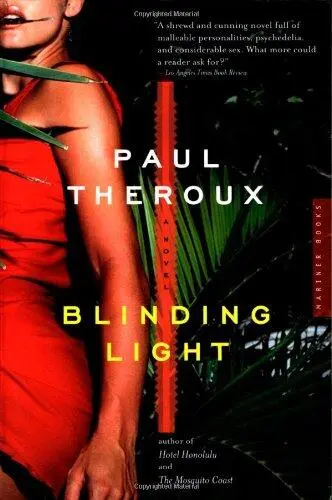
- Название:Blinding Light
- Автор:
- Издательство:Mariner Books
- Жанр:
- Год:2006
- ISBN:нет данных
- Рейтинг книги:5 / 5. Голосов: 1
-
Избранное:Добавить в избранное
- Отзывы:
-
Ваша оценка:
Blinding Light: краткое содержание, описание и аннотация
Предлагаем к чтению аннотацию, описание, краткое содержание или предисловие (зависит от того, что написал сам автор книги «Blinding Light»). Если вы не нашли необходимую информацию о книге — напишите в комментариях, мы постараемся отыскать её.
Blinding Light — читать онлайн бесплатно полную книгу (весь текст) целиком
Ниже представлен текст книги, разбитый по страницам. Система сохранения места последней прочитанной страницы, позволяет с удобством читать онлайн бесплатно книгу «Blinding Light», без необходимости каждый раз заново искать на чём Вы остановились. Поставьте закладку, и сможете в любой момент перейти на страницу, на которой закончили чтение.
Интервал:
Закладка:
He missed his datura, he missed its pleasures, he missed its benign guidance, the way it had helped him in new directions; he missed the way it had led him upward to a vantage point where he saw himself so clearly he could concentrate on his wholeness, like a man in front of a mirror sketching his self-portrait. He missed the complexities of color, the way one color appeared as separated layers, like leaves of innocent light given meaning when they were arrayed together. The drug had given him access, and now he was just a man on the outside.
The drug had allowed him to range widely in time and space, to peel experience from his body and mind, and now without it he was smaller and shallower, with an obscure sense of loss, like someone so stunned by the death of a loved one, he suffered all the more from the trauma because — so deranged by the loss — he could not recall the loved one’s name or face. Under the spell of the drug, the future that had once been full of suggestion and promise was now unreadable. The past was distant and inaccessible. He was a small figure on the parapet of the present, feeling very little except the obvious and violent compulsion to jump.
He was sighted now, returned to the gray daylight and misleading surfaces of the visible world.
With nothing to keep her at home, and as if atoning for all the time she had taken off, Ava worked long hours, odd hours, spending arduous days at the hospital. She was like a missionary doctor on a remote Third World island, where everyone expected favors, every patient was hopeless and desperate, every case an emergency, and failure was common. Ava knew all the Vineyard families. “I have to do it. If I didn’t, who would?” The sort of thing Steadman had seen in places like New Guinea and Haiti. Sometimes Ava worked twenty-four hours without sleep; she was often on call all night.
Cursing the pager, dreading the phone, the three a.m. emergencies, the midnight births, Steadman was reminded of the early days of their love affair. He had forgotten that she had a life of her own.
“This is normal,” she said when he complained. “Look, we were writing all day and fucking all night.”
“What’s wrong with that?”
“It’s nice, but let’s say it’s less usual,” she said. “I’m a doctor. I think the difficulties of doctoring made me a reckless lover. But now I’m back to work. Get used to it.”
She stopped using makeup. Her choice of clothes, even when she was not at the hospital, seemed clinical, even dowdy. Usually she wore green scrubs around the house.
“You got what you wanted,” she said. “Your book.”
“It wasn’t only that.”
“Okay. You got your reputation back. Your manhood.”
But he resisted simplifying it. He said, “Are you going to make it all my trip and deny that there was some pleasure in it for you?”
“It was like a year of insanity. Yes, I found it exciting, but I am so glad it’s over.”
He stared at her, and seeing she was unmoved, he said, “Don’t you see what’s beginning?”
“I can do without excitements. We have enough of those at the hospital.” She saw that he was still staring defiantly at her. “People die there. They give birth. They come in with bone splinters sticking out of their flesh. You should see a motorcycle victim sometime. These people are scared, they’re in pain. Some of them do nothing but cry. And we have a psychiatric unit, too, you know. They need me more than you do.”
He turned his back on her. He said, “It’s like you’ve forgotten everything we did those days.”
“When I start to miss it I’ll read your book.”
He wondered if he would ever feel as lost again as he had before he met her, but he told himself no, he had his book, he had no fear of solitude. Blindness was the ultimate in solitude, yet blindness had made him bold and filled him with courage.
“Listen to this,” he said one day, on her return from work. He read from a sheet of paper, a rare example of his handwriting. “After I drank, the most racking pangs succeeded: a grinding in the bones, deadly nausea, and a horror of the spirit that cannot be exceeded at the hour of birth or death. Then these agonies began swiftly to subside, and I came to myself as if out of a great sickness. There was something strange in my sensations, something indescribably new and, from its very novelty, incredibly sweet. I felt younger, lighter, happier in body; within I was conscious of a heady recklessness, a current of disordered sensual images running like a millrace in my fancy, a solution to the bonds of obligation, an unknown but not an innocent freedom of the soul—”
“How can you write that arrogant shit?” she said, interrupting him, and when he began to laugh at her, she hissed at him.
“I didn’t write it,” he said slyly. “A doctor wrote that.”
“Some quack,” she said.
“Dr. Jekyll,” he said. “He would have agreed with you!”
Without telling Ava — he wanted her to feel neglectful — he admitted to himself that his life was still full. He would have objected more loudly to being left on his own except that around the time Ava had returned to the hospital he began again to be in demand. He started to receive messages from intermediaries — Axelrod, the publisher’s publicity department, helpful friends — telling him there were people who wanted to meet him. He got calls nearly every day — people tipped off that he was writing again, that the author of Trespassing had a new book.
One of the requests came from the television show 60 Minutes. Would Steadman agree to an interview? He guessed how this had come about: Mike and Mary Wallace had been at Wolfbein’s most recent party. The hook would be: famous recluse, stricken blind, produces a new book in his enforced darkness. The title of the segment would be something like “Edge of Night.”
Axelrod had relayed the message. “They want to follow you around at home on the Vineyard and do an in-depth interview.”
Other messages, nearly all from TV shows and photographers, implored him to return their calls to discuss what they might do together. There was no ambiguity in the requests: he was to be seen close up by a camera, to be observed at work and at home — they put it in a kindly way. He was at first flattered but easily saw the renewed interest as intrusive journalism, the voyeuristic wish to film him walking into walls, stumbling, and perhaps falling on his face in picturesque Vineyard settings. Steadman knew that they wanted to see his sideways gait, his faltering gestures, his groping fingers, his big blank face and swiveling head. Great TV, they were thinking — and what a surprise they would get when they saw that he walked headlong with a strut and a slashing cane, with well-aimed gestures and an animated gaze.
“Out of the question,” he told Axelrod.
Someone from the New York Times called to schedule “At Home with Slade Steadman,” and again he suspected an eagerness to see him bumping his head and knocking things to the floor, crumbs on his shirt, mismatched socks. People magazine suggested something similar, but insisted on an exclusive. The Boston Globe reminded him that he was a native son, but it was the travel editor who called. Would Steadman consider an interview on the sailing ship Shenandoah ? Freelance photographers asked for sittings and portraits. There was no letup. And when the book was announced in the publisher’s catalogue the number of requests multiplied. Bookstores urged him to visit, universities asked him to speak, and would he please be the keynote speaker at a seminar on travel writing “for seniors with disabilities”?
In almost every inquiry there was an allusion to his blindness: offers of assistance, a limo, a ticket, an escort, “anything we can do to make this as painless as possible for you.” “We have many visually impaired students in our institution,” one letter said. “I did Borges,” one photographer claimed, adding, “I’d show you the contact sheets, but I guess you’ll have to take my word for it.” Subtler suggestions patronized him: “Lots of people ought to have the chance to share your story.” And one of the universities, offering a large fee and promising a good audience, wrote, “We have a full range of handicapped access.”
Читать дальшеИнтервал:
Закладка:
Похожие книги на «Blinding Light»
Представляем Вашему вниманию похожие книги на «Blinding Light» списком для выбора. Мы отобрали схожую по названию и смыслу литературу в надежде предоставить читателям больше вариантов отыскать новые, интересные, ещё непрочитанные произведения.









Обсуждение, отзывы о книге «Blinding Light» и просто собственные мнения читателей. Оставьте ваши комментарии, напишите, что Вы думаете о произведении, его смысле или главных героях. Укажите что конкретно понравилось, а что нет, и почему Вы так считаете.