Paul Theroux - Blinding Light
Здесь есть возможность читать онлайн «Paul Theroux - Blinding Light» весь текст электронной книги совершенно бесплатно (целиком полную версию без сокращений). В некоторых случаях можно слушать аудио, скачать через торрент в формате fb2 и присутствует краткое содержание. Год выпуска: 2006, Издательство: Mariner Books, Жанр: Современная проза, на английском языке. Описание произведения, (предисловие) а так же отзывы посетителей доступны на портале библиотеки ЛибКат.
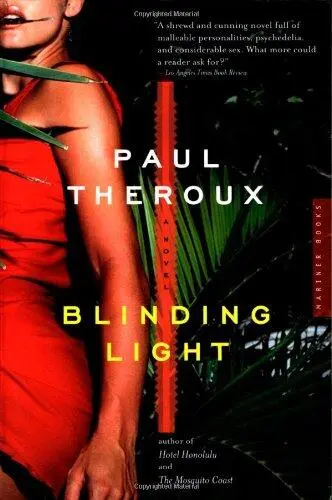
- Название:Blinding Light
- Автор:
- Издательство:Mariner Books
- Жанр:
- Год:2006
- ISBN:нет данных
- Рейтинг книги:5 / 5. Голосов: 1
-
Избранное:Добавить в избранное
- Отзывы:
-
Ваша оценка:
Blinding Light: краткое содержание, описание и аннотация
Предлагаем к чтению аннотацию, описание, краткое содержание или предисловие (зависит от того, что написал сам автор книги «Blinding Light»). Если вы не нашли необходимую информацию о книге — напишите в комментариях, мы постараемся отыскать её.
Blinding Light — читать онлайн бесплатно полную книгу (весь текст) целиком
Ниже представлен текст книги, разбитый по страницам. Система сохранения места последней прочитанной страницы, позволяет с удобством читать онлайн бесплатно книгу «Blinding Light», без необходимости каждый раз заново искать на чём Вы остановились. Поставьте закладку, и сможете в любой момент перейти на страницу, на которой закончили чтение.
Интервал:
Закладка:
“And so it seemed that underwear was a distinct and evocative form of nakedness. A woman in a slip or panties was the object of desire that a naked woman is now.” Steadman pressed his temples with his fingertips. “But only the past matters to me. Underwear was an invitation, and a greater temptation than nakedness. I can see it clearly.”
As though peering from overhead, past rooftops and telephone poles, he saw himself as a hurrying boy cutting through back yards to get to Carol Lumley’s house. The boy passed clotheslines and ducked behind them, recognizing the women’s underwear from the Sears catalogue and the Sunday newspapers. The Cronins’ daughter was a nurse, but even a nurse’s white uniform seemed like a version of underwear, and so did a man’s bathing suit.
A great fluttering whiteness on this warm day in early summer. The wind lifting the underwear also lifted the forsythia and the lilacs, the irises and the two-tone leaves of the poplars that went on spinning, the sun-struck laundry, bluish white in the deep green.
Hurrying under the clotheslines, he felt the flimsy silken things fluttering against his face, the warmth of them, their fragile beauty. He was fascinated by the variety, the shapes and sizes, some of them pink or fringed in lace, their softly rubbed seams, the stitches on bras, and the way some pieces were perfectly matched — the pairs of them in silk or satin pegged up together, the revelation of the back yards of his childhood.
Needing courage, though he had nothing else to do — school had ended for the summer — he had waited until late afternoon. Carol had said, “If you want to come over and sit on my porch I’ll probably be around. My parents might have to go out.”
The casual way she had said this was a greater inducement than if she had made a formal invitation. They were tentative exploratory words, but each one suggested a promise. The danger was that the more specific you were, the greater the blame, and the worse the sin. Vagueness was the tone of innocence, and though he was attracted to Carol Lumley he had no idea what lay beyond this attraction. He wanted to kiss her, he wanted to touch her, he wanted her to let him and for her to like it. He was fourteen years old.
He moved, hunched and watchful, like an intruder, from back yard to back yard — the Cronins’, the Halls’, the Fasullos’, the Flahertys’—on this hot bright breezy day, what his mother called a good drying day. In one yard Mrs. Fasullo was clothespinning her voluminous panties, and in another Mrs. Finn was harvesting her slips, and elsewhere the underwear flapped like flags or swelled with the wind, as if with the curves of a woman’s body.
Ducking through the last back yard, he came to the Lumleys’, and what stopped him was not Carol’s underwear — though he saw lots of it on the line amid the whole family’s underwear, from her mother’s bloomers and her father’s boxers down to the tiniest bras, the smallest panties, the half-slips, and the slips — what a small body she had. He caught sight of her blue nightgown, the kind he knew as a baby doll, and he paused and looked closely.
Trimmed with lace and pink bows, wooden clothespins holding its straps, the lovely thing hung and swayed as though Carol had just slipped out of it. He touched it and held it to his face, the blue satin warmed by the summer afternoon. And beside it, just out of reach, the matching blue panties. White satin ribbons were threaded at the shoulders, and the wide strip of lace at the hem was picked out with bows. It seemed to him both a gown and underwear, but it was designed for bed, and what mattered most to him was that it was meant to be admired by someone else.
“What the heck are you supposed to be doing?”
He was too startled to speak, and even when he saw Carol laughing at the window he was not calmed. He looked away. He felt he had revealed himself. Had she seen him clutch the baby doll and press it to his face? If so, he counted on the fact that what he had done was so absurd she would not understand it.
Anyway, she was gone from the window when he looked again, and a moment later, answering the front door, all she said was “What did you bring me?”
“Nothing.”
“And I bet you want some lemonade and all kinds of stuff.”
He shrugged and smiled and Carol made a disapproving face, what he thought of as a woman’s expression. She wore a pink blouse and white shorts, and though she was fourteen, as he was, she seemed much younger. She was thin and slight, with small breasts and fragile wrists and fingers, a body so slender it was like a young boy’s, a compact bum and skinny legs. But she had blue eyes, full lips, light curly hair — an angel’s face.
“You might as well sit over there,” she said, pointing to the porch swing, and she vanished from the doorway. She was gone some minutes, but he knew why when she returned with the glasses of lemonade and redder lips.
“You’ve got lipstick on.”
“Big deal,” she said, and pressed her lips together as if to make her lip color emphatic.
They sat apart, at either end of the porch swing. They held their glasses, and the only sound was the clink of the ice when they raised them to sip the lemonade.
“So, guess what, my parents just went out.”
He was gladdened by her saying that, and sipped again from his glass, and looked off the porch to the house opposite — the Martellos’—to scrutinize the sky above its roof. He wanted dusk to fall, he wanted shadows, he wanted to be insubstantial himself, smaller and less obvious in the dark, his face in shadow, his eyes hidden.
“Did you tell them I was coming over?”
“I forgot to.”
He laughed a little and saw that she noticed and got fierce.
“But I’m going to tell them,” she said, “that you came over looking for trouble.”
Horrified by the truth of what she said, he accidentally chinked the glass against his front teeth.
“Where did you tell your parents you were going?”
“Up the park. Softball game.”
The park was not far, two streets over, behind a tall fence, the game in progress and audible — shouts, cheers, the sometime slap of bat and ball meeting in a solid hit. Their revelations were like complicity, like an admission they were doing something wrong, and knew it, and were glad of it. But because he could hear the sounds of the softball game it seemed to make sitting on Carol’s porch with her less of a lie.
“What if they find out where you really are?”
“I don’t care,” he said. “I would have snuck out anyway.”
She seemed to like that. She sat back, shoving herself against the cushion, and said, “So why were you trying to steal my stuff off the clothesline?”
He shifted on the swing and said, “I wasn’t even looking at it.”
Her blue eyes narrowed on him. He could not tell what she was thinking, for the lower part of her face was in shadow. As long as there were shadows he did not care what she was thinking. And anyway, he liked her giggly teasing voice and her pretense of scolding, even her threats — they seemed to show that she liked him and wanted him to stay.
“I bet you want more lemonade.”
“I don’t care,” he said, although he did. But he was choking with desire and confusion and did not know what else to say.
She went for the lemonade and took longer than before, and when she returned he immediately smelled the perfume, stronger in the smoky dark of dusk on the porch. He loved the fragrance; he had never smelled such flowers; the odor pricked his eyes.
He thanked her for the lemonade. She tossed her curly hair. They rocked on the porch swing.
Finally she said, “My father says you’re smart.”
He turned to her. At the far end of the swing she was now mostly in shadow, except for her bright white shorts, so small on her body.
Читать дальшеИнтервал:
Закладка:
Похожие книги на «Blinding Light»
Представляем Вашему вниманию похожие книги на «Blinding Light» списком для выбора. Мы отобрали схожую по названию и смыслу литературу в надежде предоставить читателям больше вариантов отыскать новые, интересные, ещё непрочитанные произведения.











Обсуждение, отзывы о книге «Blinding Light» и просто собственные мнения читателей. Оставьте ваши комментарии, напишите, что Вы думаете о произведении, его смысле или главных героях. Укажите что конкретно понравилось, а что нет, и почему Вы так считаете.