Paul Theroux - Blinding Light
Здесь есть возможность читать онлайн «Paul Theroux - Blinding Light» весь текст электронной книги совершенно бесплатно (целиком полную версию без сокращений). В некоторых случаях можно слушать аудио, скачать через торрент в формате fb2 и присутствует краткое содержание. Год выпуска: 2006, Издательство: Mariner Books, Жанр: Современная проза, на английском языке. Описание произведения, (предисловие) а так же отзывы посетителей доступны на портале библиотеки ЛибКат.
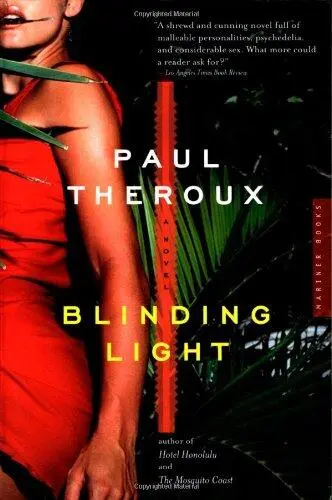
- Название:Blinding Light
- Автор:
- Издательство:Mariner Books
- Жанр:
- Год:2006
- ISBN:нет данных
- Рейтинг книги:5 / 5. Голосов: 1
-
Избранное:Добавить в избранное
- Отзывы:
-
Ваша оценка:
Blinding Light: краткое содержание, описание и аннотация
Предлагаем к чтению аннотацию, описание, краткое содержание или предисловие (зависит от того, что написал сам автор книги «Blinding Light»). Если вы не нашли необходимую информацию о книге — напишите в комментариях, мы постараемся отыскать её.
Blinding Light — читать онлайн бесплатно полную книгу (весь текст) целиком
Ниже представлен текст книги, разбитый по страницам. Система сохранения места последней прочитанной страницы, позволяет с удобством читать онлайн бесплатно книгу «Blinding Light», без необходимости каждый раз заново искать на чём Вы остановились. Поставьте закладку, и сможете в любой момент перейти на страницу, на которой закончили чтение.
Интервал:
Закладка:
And he had discovered through the drug’s blinding light that the truth was sexual: the source of truth was pleasure itself, fundamental and sensual. Everything else was a dishonest aspect of an elaborate and misleading surface — all lies.
He intended his book as a confession and a consolation. In a world full of desperate and bloody imagery, how could such a thing as sex be shocking? Yet he was interested in describing only the nightmarish intimacies of his sexuality. For the traveler who had gone everywhere else on earth, this was the undiscovered world of his mind and heart, the basis of his being, his inner life revealed, not anyone else’s. No one could say, “Not true!” when he knew it was his own truth, that he had risked blindness to understand.
One day in early summer he was with Ava in his library, working on the novel, when she handed a card to him. He framed the card in his hands, then smoothed it, touching the raised lettering with his fingertips, and said, “An invitation. I can just about read it. The Wallaces?”
Ava said, “The Wolfbeins. Party at their house.”
The noise Steadman made in his throat, adenoidal, approving, sounding interested, put Ava on the defensive.
Ava said, “You could do without going.”
She was the one who usually wanted to attend parties, and when they had stayed away she accused Steadman of being vain, of sniffing at his old friends, of being a prima donna. The Wolfbeins’ summer place was in Lambert’s Cove, which necessitated a long drive from Steadman’s up-island house, and for the past few summers Steadman had avoided such parties. Yet he was interested.
“I think I should go.”
“Are you serious?”
“My debut,” he said.
“What a word.”
“To show myself as I am.”
She laughed loudly. “You sound like such a fairy, saying that.”
“You don’t get it.” He was smiling, with his face in front of her, his blank gaze. “I mean go blind.”
He could hear Ava’s whole body react, seeming to stiffen in objection. “That’s just a stunt,” she said.
“I am most myself when I’m blind.”
“It’s a drug!” Ava said. “You are seeing phosphenes — they exist outside a light source. It’s a dazzling delusion, a kind of migraine. And what will you do when it wears off?”
Steadman turned away from her and said, “I have to go there.”
He was thinking of the future — his desire to move on, because he needed to distance himself from Trespassing and its youthful halftruths. And since taking the drug he had thought a great deal about death. He might die at any time. And the man he was now bore no resemblance to the man people thought they knew. He imagined them praising him in a eulogy, putting themselves in charge of his history, writing his obituary, speculating, for no one was more presumptuous or untruthful than an obituarist.
“No one knows me,” he said. “No one ever knew me.”
Ava was silent. She did not need to insist or even mention that she knew him, that she was the only one. She said, “Finish the book, if you want to reveal yourself.”
He shrugged, because that was obvious and it had always been his intention. He was obsessed with writing the one book that would say everything about him, disclose all his secrets. He would have to call it a novel, because the names would be changed, but the rest, the masquerade of fiction, would be true, for a man in a mask is most himself.
“I want people to see me like this,” he said. “My friends, anyway.”
“Going to the Wolfbeins’ is going public,” Ava said. “It’s always the A-list.”
He was silent again. He could see she wanted a fight. And anyway it was true — he wanted to go public.
“Your blindness is a lie,” she said. “It’s temporary. The phosphenes are in your brain and your optic nerve, caused by whatever shit is in the drug.”
“No,” he said.
“A game,” she said.
“A choice,” he said. “And I want to see these people.”
“See?”
“Know them,” he said.
3
STEADMAN WORE DARK GLASSES, he carried a narrow white cane. He did not need the cane, except as a prop and a boast. The insect eyes of his lenses and his thick pushed-back hair emphasized his sharp inquisitive face. Ava had chosen his clothes. He could have passed for a stroller at the West Chop Club — white slacks, yellow shirt, white espadrilles, a slender whisking cane.
“You putz,” Harry Wolfbein said. And to Ava: “What’s with him?”
Steadman said, “Relax, Harry. I’m blind.”
A rush of air was audible at the word, and in a vacuum of embarrassment that followed it Wolfbein breathed hard in apology.
Steadman wished only to state his blindness, not discuss it, not be clucked over and pitied. So, to cut him off, Steadman said, “There’s some sort of engine noise over there I’ve never heard before.” He gestured beyond the house, toward the big garage. “Transformer, generator — what is it?”
“Bug zapper,” Wolfbein said.
Steadman knew he was lying. He said, “Then what’s all the auxiliary power for?”
Before Wolfbein could recover and respond, a man entering behind him said, “Oh, God, another rat-fuck.”
Recognizing Bill Styron’s voice, Steadman greeted the writer and his wife, Rose. They said they were glad to see him. He did not announce his blindness; everyone would know soon enough. As for his dark glasses and cane, the Styrons just smiled in sympathy. In his nonwriting years, as a reaction to his obscurity, Steadman had affected odd habits of dress and behavior, as a defense, so that his raffish eccentricity would be noticed and not his silence.
“Rat-fuck” was the right expression for a party where a mob of people stood and drank and yelled in your face, looking past your head as you looked past theirs, for relief, for escape, for someone better known or wittier. At a certain point a party was just that: a loud room of coarse static, like a rookery of big frantic birds.
The moment he had arrived at the Wolfbeins’ house in Lambert’s Cove he knew the party was unlike any other summer thrash. He did not discern the contours of people; he understood their essence. He needed to be blind to feel the voltage, the pitch and whine of it, like the whir of a spinning ball of molecules. The furious hum beneath the chatter that drifted from the house kept Steadman listening and in that hum discerning the distinct character of people. If he had not been blind, would he have been aware of the woman — all eager atoms — who had begun to stare at him and stalk him from the moment he stepped onto the front porch?
He heard her heartbeat, he sensed the woman as a pulse in the air, as an odor, a hot eye, in the deepening shadow. And when he drew near her and was surrounded by other guests, she touched him, probably thinking that he would not be able to distinguish her from the others — stroked his arm, touched his mouth, left a taste on his lips. It was not her touch that lingered but an oily dampness, as if her salty sweat-warmed hair still clung to him and got into his nose and onto his tongue. He had caught the animal scent and kept sniffing it, the trail of it that curled from the woman’s body like a distinct invitation in all that noise.
As a younger man, Steadman had liked such party loudness for its concealment. The noise was like darkness and made your plea inaudible to everyone except the woman you were imploring. A party was an occasion for a dog-like mating ritual, for bottom-sniffing and innuendo. In a large noisy crowd in which anyone could be touched, a party was a liberating prelude to sex. A crowd became a sort of dance, in a room in which you paired up with someone and got her to agree to see you later, meet you secretly; it was an opportunity, a beginning, an abrupt courtship.
Читать дальшеИнтервал:
Закладка:
Похожие книги на «Blinding Light»
Представляем Вашему вниманию похожие книги на «Blinding Light» списком для выбора. Мы отобрали схожую по названию и смыслу литературу в надежде предоставить читателям больше вариантов отыскать новые, интересные, ещё непрочитанные произведения.










Обсуждение, отзывы о книге «Blinding Light» и просто собственные мнения читателей. Оставьте ваши комментарии, напишите, что Вы думаете о произведении, его смысле или главных героях. Укажите что конкретно понравилось, а что нет, и почему Вы так считаете.