Paul Theroux - Hotel Honolulu
Здесь есть возможность читать онлайн «Paul Theroux - Hotel Honolulu» весь текст электронной книги совершенно бесплатно (целиком полную версию без сокращений). В некоторых случаях можно слушать аудио, скачать через торрент в формате fb2 и присутствует краткое содержание. Год выпуска: 2002, Издательство: Mariner Books, Жанр: Современная проза, на английском языке. Описание произведения, (предисловие) а так же отзывы посетителей доступны на портале библиотеки ЛибКат.
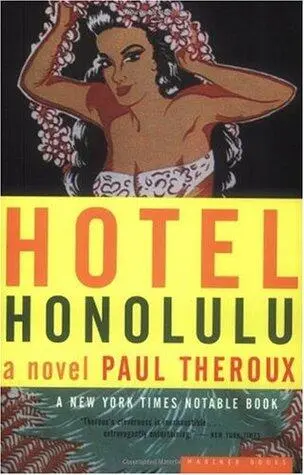
- Название:Hotel Honolulu
- Автор:
- Издательство:Mariner Books
- Жанр:
- Год:2002
- ISBN:нет данных
- Рейтинг книги:4 / 5. Голосов: 1
-
Избранное:Добавить в избранное
- Отзывы:
-
Ваша оценка:
Hotel Honolulu: краткое содержание, описание и аннотация
Предлагаем к чтению аннотацию, описание, краткое содержание или предисловие (зависит от того, что написал сам автор книги «Hotel Honolulu»). Если вы не нашли необходимую информацию о книге — напишите в комментариях, мы постараемся отыскать её.
Hotel Honolulu — читать онлайн бесплатно полную книгу (весь текст) целиком
Ниже представлен текст книги, разбитый по страницам. Система сохранения места последней прочитанной страницы, позволяет с удобством читать онлайн бесплатно книгу «Hotel Honolulu», без необходимости каждый раз заново искать на чём Вы остановились. Поставьте закладку, и сможете в любой момент перейти на страницу, на которой закончили чтение.
Интервал:
Закладка:
"If the lawyer agree, you maybe go use the guest house," Kekua
said.
Feeling superstitious I said no, and instead rented a place behind Lionberg's property, a small green bungalow, under a mango tree on a lovely sloping bluff of ironwoods. As at the Hotel Honolulu there was a monkeypod tree in front of the house, with clumps of tangled orchids clinging to its trunk.
"Them are hononos," Sweetie said. "Flowers come in March. Smell beautiful."
Though Sweetie was uneasy about the move — we were too far from town, she said — Rose was in her element. She delighted in the sound of roosters crowing. She wanted a dog. She found some friends and put
herself in charge of them, telling them about the Waikiki hotel in which she had once lived, and enjoying the fact that they were impressed.
"Main thing about bees," Kekua said when I visited the estate. "The work easier for two people."
"You're in luck, Kekua."
I learned to harvest honey from Lionberg's hives. Kekua, a handyman, hammered together the shallow boxes, called supers, that we used for enlarging the hives, piling them like separate stories on the tenement of the hive. The towering arrangement reminded me of the Hotel Honolulu and how Buddy had referred to it as "multi-eye-story."
Kekua showed me how to split the hives. He identified the worker bees, explained how they created a new queen and how the drones went on a fertilizing flight. He smoked the hives and carefully lifted their lids ("Bees no like big noises. . bees no like rain. . bees no like cloud") and brushed the masses of smokedrugged bees aside, exposing the racks of amber honeycomb. I poked my finger into the sun-heated comb and licked the warm honey.
"What you think? Ono, eh?"
"Yeah." And I thought, I am at last where I want to be.
In this lovely climate with long sunny seasons there were new blossoms every month, and never cold weather, much less a frost. So the bees flourished the whole year. With its long periods of idleness — and
Kekua did the woodwork — this sort of boutique beekeeping was the perfect pastime, as well as a viable business.
"Like Sherlock Holmes," I said one day to Kekua.
But you had retired, Holmes. We heard of you as living the life of a hermit among your bees and your books in a small farm.
Exactly, Watson. Here is the fruit of my leisured ease. .
Kekua smiled through his veil and kept chipping away at the accumulation of propolis on a hive.
"He's in a book," I said. "A detective."
Kekua shrugged inside his shapeless white beekeeper's suit. More than ever I was convinced that I was where I wanted to be, in a place where a good soul like Kekua knew propolis but not Sherlock Holmes, and as for books — as Buddy used to say, "We don't read 'em, we just chew on the covers."
In this gorgeous world, birds uttered long, meaningful phrases and people spoke in flat monosyllables. In the lunches I'd had with Leon Edel, we had told each other we were in the perfect place. And it seemed right somehow for Rose, too. I was happy to deliver her from Honolulu, and didn't have the heart to exile her to the mainland.
As for Sweetie, "This is the real country," she said. The woods frightened her, the wind in the ironwoods kept her from sleeping, the surf was far more powerful than in town, she got lost on the roads. She missed
her friends, Puamana never called, there were no sidewalks she could skate on.
"What's that?" I asked her one day, seeing her on the sofa, bent over a thick book she held on her knees.
"Anna Cara Neena. Greatest book in the world," she said in a sad, cheated voice. "Supposedly."
"Who told you that?"
"Peewee."
She had bought it to please me, but she couldn't penetrate it. She sobbed with exasperation and said she was stupid. I took her in my arms and said, "Never mind."
"You're high maintenance," she said. "Tolstoy!"
"Tolstoys 'R' Us," Rose called out from the other room.
The smell of this big unread paperback moldering in the damp climate made the book unwelcome, but when at last I decided to toss it, to perform a kind of ritual purification, I could not find it.
There were feral pigs in the woods — hairy, black, tusky, wildeyed. They made tunnels through the tall guinea grass. An owl, a local pueo, came out at dusk from the trees below the green bungalow as the neighbor's dogs began to bark. Roof rats nested in the eaves of the house — they got there by climbing up the mango tree, nibbling fruit on the way, and tottering along the branches, then dropping onto the roof. Wharf rats
chewed holes in the walls. In Hawaii there were always rats, and always sharks just offshore, and cockroaches patterned like tortoiseshell, and geckos and moths and ten kinds of ants. These were the certain proof and reminder that Hawaii was paradise.
I did nothing for a while except work among the bees, straightening and tidying the hives, extracting the honey in the spinner, and sometimes driving with Kekua into town to sell it by the gallon at health food stores. I liked the simple-minded honey gathering — the bees did most of the work. Sometimes I was stung. The bee stings itched pleasantly afterward.
I remembered the day I had spent with Lionberg and the bees, having taken Sweetie along to meet him. He was harvesting honey. I helped him carry the boxes, which were the separate stories of the hive, filled with frames that contained the honeycomb. We took turns spinning the frames in the extractor. The honey whipped out of the cut combs and flowed smooth and syrupy out of the spigot at the base of the barrel. The honey gathered in the drooping drumhead of cheesecloth over a bucket and drained through in a steady stream, filling the bucket. There were always dead or dying bees in the heavy puddle of honey in the cheesecloth strainer.
Bees drown noiselessly in honey, without much of a fuss. It is almost as though they are enjoying it — they certainly seem so, in their drunken hesitation, their slow guzzling struggle, the brief flutter and then the stuck wings, the body mired, and at last, gorged on sweetness, they are motionless, dead and darker. It was the look of insects freshly caught in
amber in the Paleozoic, all warmth and softness and smooth sap, and in time they became the black and broken bugs in the brittle fragments of resin. I used to watch the bees and think: This is the way a lush would drown in whiskey, sinking and smiling at the bottom of a still as the bubbles rose to the surface.
Lionberg must have known what I was thinking, because he made a point of marveling at the bees. He claimed he was an amateur beekeeper, but like everything else he did, he was careful and accomplished.
"That's you," Sweetie said, poking at a drowned bee in the depths of the honey puddle. Itwas understood that his life was perfect.
"No," Lionberg said. He smiled. "But I can imagine the feeling."
Now he was dead. Jogging along in sunshine in Kekua's pickup truck, I reflected on my life, beginning with my first misapprehensions. For years, especially your early years, you wonder how you're going to end up. Now I knew I had come to the end of something. Long ago, as a kid, I had seen myself as a fur trapper in the Canadian Arctic, and then as a doctor. In Africa I had imagined myself as an appointed official, or a chancellor of a university. Later, in England, my ambition had been to be lord of the manor — a particular manor in the Marshwood Vale of Dorsetshire. All this time I had been writing. Then my life was fractured. I fled and found myself with fragments of my life, and so swiftly had time passed that I had outstripped my ability to write any of it. And, having exiled myself to the Pacific, starting again with nothing, I suspected that there was no end for me but only a dying fall.
Читать дальшеИнтервал:
Закладка:
Похожие книги на «Hotel Honolulu»
Представляем Вашему вниманию похожие книги на «Hotel Honolulu» списком для выбора. Мы отобрали схожую по названию и смыслу литературу в надежде предоставить читателям больше вариантов отыскать новые, интересные, ещё непрочитанные произведения.




Обсуждение, отзывы о книге «Hotel Honolulu» и просто собственные мнения читателей. Оставьте ваши комментарии, напишите, что Вы думаете о произведении, его смысле или главных героях. Укажите что конкретно понравилось, а что нет, и почему Вы так считаете.