Adam Mars-Jones - Cedilla
Здесь есть возможность читать онлайн «Adam Mars-Jones - Cedilla» весь текст электронной книги совершенно бесплатно (целиком полную версию без сокращений). В некоторых случаях можно слушать аудио, скачать через торрент в формате fb2 и присутствует краткое содержание. Год выпуска: 2008, Издательство: Faber and Faber, Жанр: Современная проза, на английском языке. Описание произведения, (предисловие) а так же отзывы посетителей доступны на портале библиотеки ЛибКат.
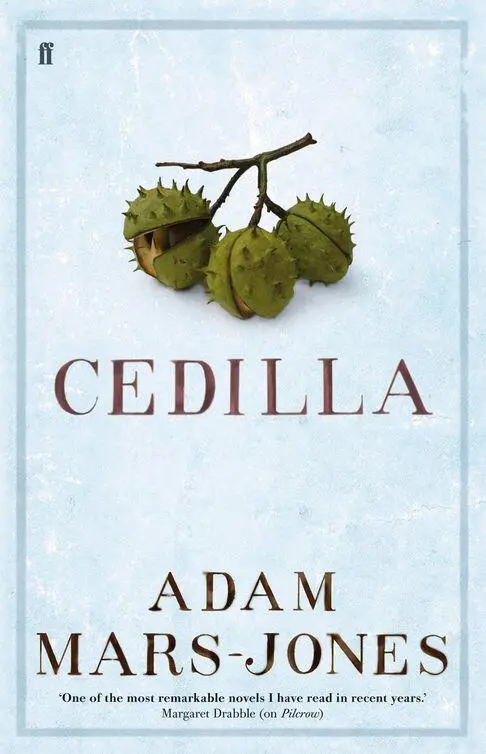
- Название:Cedilla
- Автор:
- Издательство:Faber and Faber
- Жанр:
- Год:2008
- ISBN:нет данных
- Рейтинг книги:3 / 5. Голосов: 1
-
Избранное:Добавить в избранное
- Отзывы:
-
Ваша оценка:
Cedilla: краткое содержание, описание и аннотация
Предлагаем к чтению аннотацию, описание, краткое содержание или предисловие (зависит от того, что написал сам автор книги «Cedilla»). Если вы не нашли необходимую информацию о книге — напишите в комментариях, мы постараемся отыскать её.
Cedilla — читать онлайн бесплатно полную книгу (весь текст) целиком
Ниже представлен текст книги, разбитый по страницам. Система сохранения места последней прочитанной страницы, позволяет с удобством читать онлайн бесплатно книгу «Cedilla», без необходимости каждый раз заново искать на чём Вы остановились. Поставьте закладку, и сможете в любой момент перейти на страницу, на которой закончили чтение.
Интервал:
Закладка:
My mind received in drips what would have swamped it at a greater rate of flow. I understood now who the Sallys or Sallies were. There were personifications of the willow, also known as the sallow or salley (I knew a Yeats poem about the Salley Gardens) — in fact the weeping willows round the pond where I had been reclining in porous rapture that day. Salix sepulcralis .
Why those particular willows should have difficulty propagating themselves I didn’t know, since under normal circumstances they take root readily from cuttings and indeed anywhere that broken branches lie on the ground. But there it was. Mescalito had been concerned for them. It suddenly struck me as wonderful that the cactus god should reach out in fellow feeling to the willow, despite the remoteness of their families and the huge disparity of habitat.
I had a sense of the willow as a somehow œcumenical tree, contributing impartially to conventional and alternative medicine. The sap is heavily charged with the salicylic acid which gives us aspirin, grand-daddy of the non-steroidal anti-inflammatory. But why would anyone seek a remedy for colds and fevers in the willow to start with? Because it grew, as was symbolically appropriate, in cool damp places. That was before the two branches of medicine separated, and started to pretend that they didn’t share a root.
Peter had left the record sleeve propped up where I could see it. The photograph showed water in movement over a riverbed of large stones. The music expressed a serene turbulence of its own, if I’m any judge of these things. Moura Lympany playing Rachmaninoff’s Second Piano Concerto. Nicolai Malko waving his willow wand in front of the Philharmonia Orchestra.
It was our idea that classical music and illegal drugs couldn’t both be present in the same room, at least in Mum’s view of the world, and so that Rachmaninoff would wash all suspicion away. An inspired notion, as long as it didn’t catch on too widely and become discredited. Dear Marje, I’m at my wits’ end about my teenaged son. He’s started listening to Beethoven. Is he taking drugs?
The soloist’s name was a magic spell in its own right, whether I was in my right mind or the righter one brought on by the drug. Moura Lympany. Those syllables struck my mental membranes with the rippled impacts of liquid timpani.
Over time I had to modify my ideas about the drug I had ingested. It was a matter of simple mathematics. It would have needed 500 milligrams or so of the active ingredient of Lophophora williamsii to deliver the organic version of such an experience. It would have been a substantial tablet, and not the little pill I had bought, which must therefore have been LSD. I had a moment of hallucinated insight, connecting the synthesising of salicylic acid in 1897 by Felix Hoffmann with the synthesising of lysergic acid by Albert Hoffmann in 1943. Might not the Hoffmanns be father and son? Well, no they couldn’t, since in reality Albert’s surname has only the one n . I was reluctant to leave the domain of the drug, where everything links up and nothing is superfluous, nothing dangles.
It wasn’t sensible to regret my change of subject. The results from my Part I exams had told their own story: a First for my German oral, an Upper Second for my spoken Spanish. A Lower Second overall. Reading Modern Languages had indeed been a lost cause, while reading English was merely a losing battle. Even my strengths (as I saw them) did me no good. An American lecturer came to lead a seminar on Thomas Mann, which I attended. The professor made a meal of the last sentence of Mann’s story Mario and the Magician , saying it was a wonderful ending and the key to the meaning of the whole. Fine, but make sure you’re using an accurate translation. The last sentence in German contains the clause ‘ich konnte und kann nicht umhin’, meaning ‘I can’t think otherwise’, or simply ‘I have to agree’. The translation on which the prof was placing so much weight said the opposite — ‘I don’t think so’, or something of the sort.
I put up my hand to explain that the translation was defective, and the prof just said again, ‘Such a wonderful ending.’
‘It can’t mean what you want it to mean. It’s not possible in the German.’
‘Uh-huh,’ was the best he could manage at short notice. Then he regrouped his forces and said, ‘Literature can accommodate any amount of ambiguity. That’s a great thing. We must agree to disagree. There’s no dishonour in that. And I thank you for your contribution.’
Deputising for the tide
We didn’t agree to disagree. We disagreed about our disagreement. Ambiguity is one thing, ignorance is another. He couldn’t admit to being wrong on the facts of language. He was reduced to pretending that his interpretation could overrule the text, and there was dishonour in that. When he said, ‘Thank you for your contribution,’ it was another twisting of language, this time of the English language (so he had fewer excuses). What he meant was closer to ‘Piss off, you little wretch, and next time you have a bright idea keep it to yourself.’
I was rather disillusioned about the way the academic world worked. I was naïve. Small boys don’t enjoy it when their sandcastles are swept away by the tide, particularly when an even smaller boy deputises for the tide, on his first day at the beach.
Not everything in the English department was so uninspiring. I attended some of Muriel Bradbrook’s lectures on Ibsen. She was the Mistress of Girton who had wanted to protect her charges, if not from sex then at least from its repetition, by locking the doors at ten o’clock. As a lecturer she insisted that we couldn’t understand the plays unless we understood the geography of Norway. She would rather we looked at pictures of fjords than volumes of criticism.
I found this exhilarating, until I started to think it was just another version of what I had heard in the Faculty of Modern (and Mediaeval) Languages. Nothing short of total immersion is any good.
One German word which had the power to reproach me was a fashionable one in English at the time, gestalt . All I had in the way of a life was a series of interlocking routines — bedder, Hall, lectures, yoghurt manufacture — with none of the feeling of an organic whole. My summer enlightenment had faded like a tan.
Perhaps I had as strong a claim as anyone to the word gestalt , since I at least knew its derivation from the Old High German stellen , meaning (to locate the core of a cluster of ideas) to shape. My life had no controlling shape.
Still, there were pockets in my week that gave me pleasure and some small sense of belonging. I had got into the habit, for instance, of drinking a half-pint of beer at the Cambridge Arms on a fairly regular basis. Perhaps as often as twice a week. It was my first experiment in having a ‘local’, a step on the way to the stranger state of actually being a local. The Cambridge Arms, on King Street, was pleasantly nondescript. The public bar at least didn’t attract much of a university crowd. King Street itself was modest, not exactly a back street but mainly used by university people as a short cut, or for sheer relief when the glory of the colleges became too much to bear.
Adjusting my bow tie
The public bar of the Cambridge Arms had the advantage, from my point of view, of an outstandingly friendly and coöperative Australian barman. He was called Kerry Bashford, and after a while we evolved a routine. I would park outside and sound the horn in my trademark pattern, the series of blasts which spelled out Om Mane Padme Om , and Kerry would come out and help me get into the wheelchair, after lifting it out of the boot of the car. He lifted the chair one-handed, swinging it in an effortless arc. He was quite unselfconscious about his strength and the grace it produced. I liked the fact that he didn’t suddenly freeze up with the realisation that he could do such a lot with his body that I couldn’t. Why is it supposed to please me when people hunch their shoulders to atone for being tall, or restrict their movements to apologise for being flexible? There’s nothing wrong with enjoying your body. I would if I could. I do when I can. It’s much easier to see that the body is an illusion if you’ve actually spent some time there.
Читать дальшеИнтервал:
Закладка:
Похожие книги на «Cedilla»
Представляем Вашему вниманию похожие книги на «Cedilla» списком для выбора. Мы отобрали схожую по названию и смыслу литературу в надежде предоставить читателям больше вариантов отыскать новые, интересные, ещё непрочитанные произведения.








Обсуждение, отзывы о книге «Cedilla» и просто собственные мнения читателей. Оставьте ваши комментарии, напишите, что Вы думаете о произведении, его смысле или главных героях. Укажите что конкретно понравилось, а что нет, и почему Вы так считаете.