Carole Maso - Ghost Dance
Здесь есть возможность читать онлайн «Carole Maso - Ghost Dance» весь текст электронной книги совершенно бесплатно (целиком полную версию без сокращений). В некоторых случаях можно слушать аудио, скачать через торрент в формате fb2 и присутствует краткое содержание. Год выпуска: 2013, ISBN: 2013, Издательство: Dzanc Books, Жанр: Современная проза, на английском языке. Описание произведения, (предисловие) а так же отзывы посетителей доступны на портале библиотеки ЛибКат.
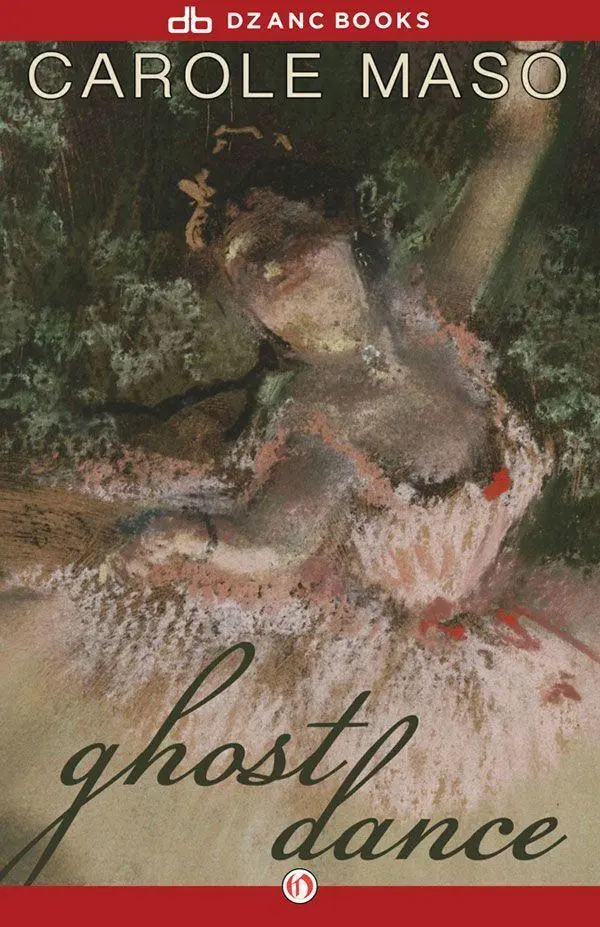
- Название:Ghost Dance
- Автор:
- Издательство:Dzanc Books
- Жанр:
- Год:2013
- ISBN:9781480441897
- Рейтинг книги:5 / 5. Голосов: 1
-
Избранное:Добавить в избранное
- Отзывы:
-
Ваша оценка:
Ghost Dance: краткое содержание, описание и аннотация
Предлагаем к чтению аннотацию, описание, краткое содержание или предисловие (зависит от того, что написал сам автор книги «Ghost Dance»). Если вы не нашли необходимую информацию о книге — напишите в комментариях, мы постараемся отыскать её.
has to offer. Like her artist-protagonists, Maso's subject as well as medium is language, and she is brave and dangerous in her command of it. She abandons traditional narrative forms in favor of a shaped communication resembling Beckett and rivalling his evocative skill. Immersed in dilated and intense prose, the readers view is a privilege one, riding the crest of clear expression as it navigates the tangled terrain of loss and desperate sorrow.
Ghost Dance — читать онлайн бесплатно полную книгу (весь текст) целиком
Ниже представлен текст книги, разбитый по страницам. Система сохранения места последней прочитанной страницы, позволяет с удобством читать онлайн бесплатно книгу «Ghost Dance», без необходимости каждый раз заново искать на чём Вы остановились. Поставьте закладку, и сможете в любой момент перейти на страницу, на которой закончили чтение.
Интервал:
Закладка:
“It looks like a wishbone,” I said, dreamily.
“Well, it looks like a piece of junk to me!” my grandmother said. “I’ll be damned if you’re going to go sticking a fork in the ground looking for water we don’t need while this whole place goes to ruin.”
“You don’t stick it in the ground,” my grandfather said softly.
“Angelo,” she said, “try to be a little bit sensible.”
“Oh, don’t worry,” he said, but already my grandfather had left behind the world of chores.
We walked day after day through the hot summer pointing the fork toward the ground and listening for a vein of water.
“Shh,” he said, “we must be very quiet, it will sound like music.” But we never once found even one chord of water. “There’s something I’m not doing right,” he said. “I don’t have the thoughts right somehow.” He closed his eyes and held the fork tightly.
Then one day, just as he was about to give up, the man who sold him the fork called to say there was going to be a convention. My grandmother took the call.
“I’m going to tell you what that man said on the phone, Angelo, and then I’m going to make a comment of my own, so don’t interrupt me.
“There’s going to be a convention for people like you on the twentieth of August. Now if you go to that convention, I swear, may the children be my witnesses, I’m going to join my sisters in California and you can fend for yourself here.”
“You wouldn’t really—”
“I’m serious. I’ll buy my plane ticket. If you’re going to go crazy, at least have the decency not to make us all watch it. We got enough crazy people in this family already. We don’t need you going on us, too.”
Now that she had started, my grandmother could not seem to stop. Her voice flowed like torrents of water.
“Their own mother goes away for months and months at a time and your son ignores them, sitting in some dark room with the music on. It’s not right, Angelo, it’s not right. These kids need you, old as you may be. Don’t go senile on us now. Something just snapped — after that damned World’s Fair your son insisted we go to. Unsnap it, Angelo. These kids need you.”
My grandfather, standing with the fork in his hand, said nothing.
“I’ll live somewhere where I’m not afraid to look around for fear I’ll see you going crazy and holding that stick.”
“OK,” he said, “everybody up,” and he marched us all out to the garbage shed. “It’s gone now,” he shouted, throwing it in the garbage can. “It’s over. It’s all over now. Are you satisfied, Maria?” he said sadly.
She did not look at him.
“All right, children, you’ve had enough excitement for one day. It’s time for bed,” my grandmother said. “Tomorrow your parents are coming for a visit.” She tucked us in.
“Did you mean what you said to Grandpa?” I asked.
“Yes,” she said, “even word of it.”
That night Grandpa went to bed early. He was asleep, in fact, before we were. We could hear him from our rooms babbling in some troubled dialect. Hetcher thought, getting out of bed, that he might ease my grandfather’s difficult sleep by slipping out to the shed and retrieving the divining rod that had promised so much. I heard him opening the door of the shed and taking the top oft the garbage can. It was easy to find, right on top. He carried it into the house.
“Didn’t you hear her?” I whispered. “You’re going to send Grandma to California if you’re not careful. Why would you want to do that.?”
“I’m just going to keep it under the bed,” he whispered. “No one will know.”
He was right about the fork, no one ever found out about it. After a while even I forgot it was there. Hetcher did, too, I think.
That night Grandpa got up many times. I saw him go to the bathroom, fill a glass with water, drink it, fill it again, and carry it back to his room. “My throat is parched,” he said to me vacantly when we bumped into each other in the hall at 5:00 A.M. “I’m parched,” he said, tottering back to bed.
Grandpa did not get out of bed until late, almost eleven o’clock the next day, which was very unusual for him. Grandma paced outside the room worried.
“What’s wrong?” she asked, when he finally appeared. “Are you feeling all right? Are you sick?”
“I had to finish my dream,” he said.
By the time he was dressed, Mom and Dad had arrived. They looked happy, in love, like newlyweds. They held hands under the table and looked at us curiously, as if they had no children yet, only dreams of them.
“Oh, what beautiful children!” my mother said, as if we were someone else’s.
“Hi, Mom,” I said, kissing her, not knowing what else to say. “Hi, Daddy.”
My grandfather walked in, hugged my mother, and sat down.
“I had a dream,” he said, like a child who had never had one before. “I saw-mountains,” he said, “pitch-black mountains. I never saw mountains like this before. And on these mountains there were people who could call water from the sky at will.” My grandmother gave out a sort of groan.
“Black, black mountains.”
“The Black Hills?” my mother said. “The sacred land of the Indians?”
“The Indians?” he cried. “Yes, that must be it! Those people were Indians! Of course. Where are these Black Hills?”
“South Dakota,” she said. It sounded beautiful when she said it: South Dakota — like a song.
My grandfather took my grandmother’s hand. “I must do this,” he said, “for the children.”
She knew him well enough to know there was no stopping him. It was already too late. He had started off alone in the middle of last night while she slept. “South Dakota,” he said. He was already halfway there, she knew, as he stood up and walked to the desk where the maps were kept.
My grandfather, whose Indian name turned out to be “Dreams of Rain,” not only learned that meteorological secret but manv other things as well. He went to the Black Hills over and over in his last five years and he told us everything.
“‘Moves on Water’ is Father’s Indian name,” he told us one day. “‘Brave Ghost’ is the name for your mother.”
As soon as a person died, messengers were sent to summon faraway relatives. Widows or widowers singed or cut their hair and with sharp objects made long, deep gashes in their skin. Grief stricken, they would wail for days and beat their breasts with stones and pestles.
Often the ghost lingers near the place it died and for one year attempts to lure-away the people it loved in life.
On a day Grandma was to be out the entire afternoon, Grandpa, in a serious mood, led us into his bedroom.
“Listen carefully,” he said. “This is important. Watch carefully.” From under his bed he took out a shoebox. In it were three plastic bags.
“This is black cornmeal,” he said, lifting the first bag up. “After my death, pour some out into your left hand, pass it around your head four times, and cast it away. This makes the road dark. It will prevent dream visits by the spirit. Do you understand what I am saying?”
“Yes, Grandpa,” we said together.
“Good. The white cornmeal comes next,” he said, and he pointed to the second bag. “Take the white cornmeal in the right hand and sprinkle it, saying, ‘May you offer us your good wishes. May we be safe. May our days be fulfilled.’” Fletcher wrote it down. “This,” Grandpa said, “ensures the proper relation between the living and the dead. Now,” his voice grew softer, “on the fourth morning after my death, leave the windows and doors open so that my spirit can leave the house for good. There,” he said, pointing to the third bag — pine resin incense. “Burn this on the fourth day.”
Читать дальшеИнтервал:
Закладка:
Похожие книги на «Ghost Dance»
Представляем Вашему вниманию похожие книги на «Ghost Dance» списком для выбора. Мы отобрали схожую по названию и смыслу литературу в надежде предоставить читателям больше вариантов отыскать новые, интересные, ещё непрочитанные произведения.









Обсуждение, отзывы о книге «Ghost Dance» и просто собственные мнения читателей. Оставьте ваши комментарии, напишите, что Вы думаете о произведении, его смысле или главных героях. Укажите что конкретно понравилось, а что нет, и почему Вы так считаете.