Carole Maso - Ghost Dance
Здесь есть возможность читать онлайн «Carole Maso - Ghost Dance» весь текст электронной книги совершенно бесплатно (целиком полную версию без сокращений). В некоторых случаях можно слушать аудио, скачать через торрент в формате fb2 и присутствует краткое содержание. Год выпуска: 2013, ISBN: 2013, Издательство: Dzanc Books, Жанр: Современная проза, на английском языке. Описание произведения, (предисловие) а так же отзывы посетителей доступны на портале библиотеки ЛибКат.
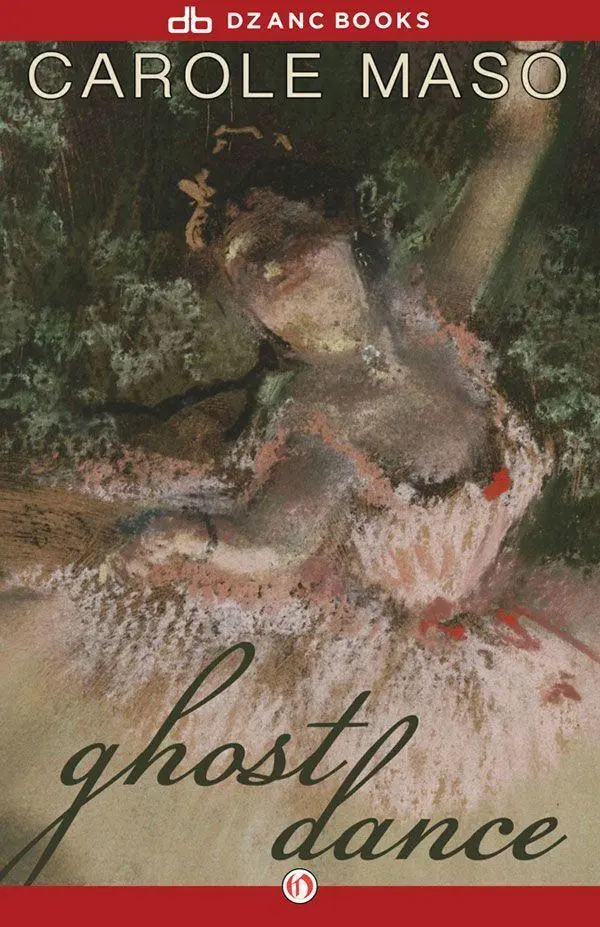
- Название:Ghost Dance
- Автор:
- Издательство:Dzanc Books
- Жанр:
- Год:2013
- ISBN:9781480441897
- Рейтинг книги:5 / 5. Голосов: 1
-
Избранное:Добавить в избранное
- Отзывы:
-
Ваша оценка:
Ghost Dance: краткое содержание, описание и аннотация
Предлагаем к чтению аннотацию, описание, краткое содержание или предисловие (зависит от того, что написал сам автор книги «Ghost Dance»). Если вы не нашли необходимую информацию о книге — напишите в комментариях, мы постараемся отыскать её.
has to offer. Like her artist-protagonists, Maso's subject as well as medium is language, and she is brave and dangerous in her command of it. She abandons traditional narrative forms in favor of a shaped communication resembling Beckett and rivalling his evocative skill. Immersed in dilated and intense prose, the readers view is a privilege one, riding the crest of clear expression as it navigates the tangled terrain of loss and desperate sorrow.
Ghost Dance — читать онлайн бесплатно полную книгу (весь текст) целиком
Ниже представлен текст книги, разбитый по страницам. Система сохранения места последней прочитанной страницы, позволяет с удобством читать онлайн бесплатно книгу «Ghost Dance», без необходимости каждый раз заново искать на чём Вы остановились. Поставьте закладку, и сможете в любой момент перейти на страницу, на которой закончили чтение.
Интервал:
Закладка:
We especially guarded my grandfather’s story of the afterlife. We knew we could not just blurt it out any time. We had to wait until Grandmother had planned a trip into town or was going to visit friends on another farm before my grandfather would tell it. Consistent and brave, she was the watchdog of rationality in a largely irrational family, and my grandfather did not like to upset her. We did not mind waiting, the plans we had to make, the whispering; his surreptitious inflections only made the story better.
When my grandmother was safely down the road marketing or talking with the neighbors, my grandfather would begin the story. He always started in a soft voice with the best of intentions but by the end he’d be shouting as loud as Fletcher and I.
My grandfather looked forward to the day his soul would grow light and rise and he could finally dance on the surface of the sun.
“It’s very hot, but your feet don’t burn,” Fletcher would say dreamily.
“You have no feet,” I said in a high voice, “or arms or anything, but somehow you know it’s you anyway.”
“That’s right,” my grandfather said. “It’s because only your soul goes.”
“The soul knows things we never taught it,” we said together. “The soul remembers things we didn’t think we knew. It knows languages we never learned.”
His hands tried to capture the movement of the soul out of the body for us. They sort of fluttered from his heart in front of our faces, and we watched spellbound as they rose toward the ceiling. Once in a while my grandmother would come in just in time to witness my grandfather standing on a chair, his arms stretched over his head, his hands beating against the rafters as the soul journeyed through the roof off into the sky. Fletcher and I would be swaying around his feet chanting something like, “The soul is a beautiful boat, the soul is a slow, beautiful boat.”
It must have looked to my grandmother, blown in from the real world, like some primitive dance meant to ward off dark spirits, and in a way I guess it was. She took a deep breath. “Angelo, come down here,” she’d say as quietly as she could, “before you break your neck.” Once he was down she would whisper, loud enough for us to hear behind the refrigerator door where we were getting juice, “Such things to tell children, Angelo. Shame on you.” She felt it her duty always to voice her opinion, to try to retrieve our lives from the dream if it was at all possible. But my grandfather smiled, just a little, as she scolded him; I think he measured the degree of success of any particular story by the disapproval in my grandmother’s eyes.
“Well,” Fletcher would say, quite soberly, “what do you think happens after we die, Grandma?”
My grandmother, despite years of Mass, believed that the end was the end, and since no one had come back to talk about it there was nothing else really to think. “No one know of anyway,” she’d say, looking at my grandfather, waiting for him to admit that he, too, did not know one person who had returned with proof.
“Proof!” he’d laugh. “Oh, my Maria, where is your faith?” Her lack of faith pained him.
“So this is it?” he gasped, gesturing out the window where a few sheep roamed against a field of brilliant green.
“As if this were not enough for you, Angelo!” she laughed.
“Faith,” he said, massaging her shoulders. “Faith,” he said, tickling her at the waist.
And in fact she was right. It was this world my grandfather loved — the world that held my grandmother’s stern voice; the world where we stood by his side, listening to his stories, loving him; yes, the world where sheep roamed and food grew in dirt.
“But I sense there is more,” he said. The gout in his hands was bothering him. “Don’t you know?”
What my grandmother knew was that what always happened would continue to happen, despite what we sad humans wished for so desperately. To use our energy on any sort of speculation was to waste it. Life was short — at her age she could vouch for it.
Both my grandparents’ attitudes towards the afterlife struck me as highly developed and acceptable. We spent every summer with them, and every summer I waited for the day when some philosophy might grow inside me. But the summer days with my grandparents passed quickly, like so many brightly colored playing cards being flipped in a deck, and at the end I had neither my grandfather’s faith that what waited for him on that brilliant day when his breathing changed shape was heaven nor my grandmother’s rational accepting eye.
What I wished for every night, staring at the ceiling before I dozed off, was a point of view, something I believed, a way to respond to the world that would be distinctly my own. Although Fletcher was younger than I, it seemed he had an opinion about everything as soon as you asked him. But any good argument — any beautiful face, a sliver of sunlight, the modulations of a voice — might alter my views or change my mind. Over and over I looked to my parents, but they were little help. All they could do was to send me back to the world; they were unwilling or perhaps unable to translate it for me.
I wonder if my parents, had they been simpler people, more predictable, more easily satisfied, would have been any better at being parents. They shrank from the parental role, uncomfortable in the authoritative stance. “Children do not grow better by themselves,” my grandmother said sadly into my father’s ear, and I do wonder what it would have been like to have had examples set and rules made, to have had meals on a schedule and someone who cared if you didn’t do homework or missed school. No one scolded us if w e forgot to brush our teeth or drank black coffee or stayed up past midnight. The idea of parents having power over their children seemed absurd to my father, and senselessness of any kind made my mother shudder.
“How do you get a point of view?” I would badger my parents. “How do you know something for sure?” I would ask over and over. My father would always shrug. To him it smacked of philosophy classes long ago at Princeton. And my mother, not inclined toward this sort of thought, would just laugh her long, lovely laugh. “Oh, Vanessa,” she’d say, elongating the vowels, “oh, Vanessa.”
The only thing that ever came close to guidance from them was my mother’s cryptic instruction, “You must be able to face what you see — to let it in, whatever it might be.” This advice, I am afraid, was wasted on me then. While other mothers were suggesting to their daughters what they might talk about on dates or showing them the various ways to shave a leg, my mother was telling me all she could: to trust myself and to trust what I saw. “You must be willing to live dangerously, to take risks.” But to live dangerously in Mystic, Connecticut, I wondered, what did she mean? I didn’t know, though I always suspected that my mother’s life was very dangerous indeed.
I decided to start observing my parents very carefully to see what it was they actually meant by “to live dangerously, to take risks.” In the spirit of my grandmother, I was looking for examples, for proof — a pattern, a repetition, a design of some sort. My grandmother would have called this enterprise a waste of time, and on this occasion she would have been right — no pattern ever emerged.
Still, I continued to watch. I watched them so often and so intentiy that soon my body assumed a position which it always took thereafter to accommodate deep concentration. One eye is squinted, my head is tilted to the side, my arms are folded across my chest. Candid photos of me at numerous occasions reveal this pose — at parties, at the zoo, at picnics, at poetry readings. Whether I am eight or ten or sixteen I always look the same: my right eye squints, my head tilts to the side, fixed in concentration, as if sheer w ill might expose to me the secrets of the universe. But, of course, this posture, a child’s invention, never helped to unravel the intricate workings of my parents’ hearts.
Читать дальшеИнтервал:
Закладка:
Похожие книги на «Ghost Dance»
Представляем Вашему вниманию похожие книги на «Ghost Dance» списком для выбора. Мы отобрали схожую по названию и смыслу литературу в надежде предоставить читателям больше вариантов отыскать новые, интересные, ещё непрочитанные произведения.



Обсуждение, отзывы о книге «Ghost Dance» и просто собственные мнения читателей. Оставьте ваши комментарии, напишите, что Вы думаете о произведении, его смысле или главных героях. Укажите что конкретно понравилось, а что нет, и почему Вы так считаете.