John Braine - Room at the Top
Здесь есть возможность читать онлайн «John Braine - Room at the Top» весь текст электронной книги совершенно бесплатно (целиком полную версию без сокращений). В некоторых случаях можно слушать аудио, скачать через торрент в формате fb2 и присутствует краткое содержание. Жанр: Современная проза, на английском языке. Описание произведения, (предисловие) а так же отзывы посетителей доступны на портале библиотеки ЛибКат.
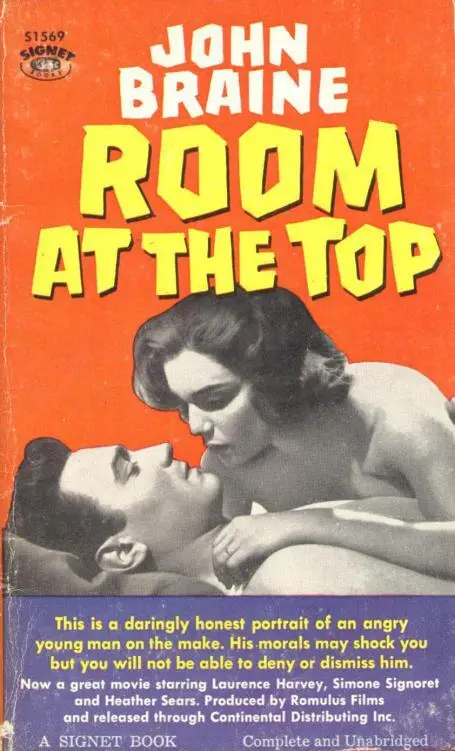
- Название:Room at the Top
- Автор:
- Жанр:
- Год:неизвестен
- ISBN:нет данных
- Рейтинг книги:3 / 5. Голосов: 1
-
Избранное:Добавить в избранное
- Отзывы:
-
Ваша оценка:
Room at the Top: краткое содержание, описание и аннотация
Предлагаем к чтению аннотацию, описание, краткое содержание или предисловие (зависит от того, что написал сам автор книги «Room at the Top»). Если вы не нашли необходимую информацию о книге — напишите в комментариях, мы постараемся отыскать её.
Room at the Top — читать онлайн бесплатно полную книгу (весь текст) целиком
Ниже представлен текст книги, разбитый по страницам. Система сохранения места последней прочитанной страницы, позволяет с удобством читать онлайн бесплатно книгу «Room at the Top», без необходимости каждый раз заново искать на чём Вы остановились. Поставьте закладку, и сможете в любой момент перейти на страницу, на которой закончили чтение.
Интервал:
Закладка:
"I used to live here."
"I'm sorry." He'd taken off his spectacles and started to clean them with a little square of cloth, his face becoming weak and plump and civilian. "It was a terrible thing to happen. Terrible." He'd looked at the half-wing on my tunic. "You'll get your revenge," he said. He'd replaced his spectacles, his face regaining its purposefulness. "Yes," he said, "give the bastards hell."
Had he really said that, or had I imagined it? But he had used those exact words; I remembered how he'd stuck out his chin and frowned, trying to look like an MOI poster. The background was ideal - the wringing machine blown through the kitchen window, the stone sink cracked in two, a heavy grey sock, darned at the heel, lying half under a lump of plaster, and all of the crockery, except one thick half-pint mug, mixed up in fragments with butter and sugar and jam and bread and sausages and golden syrup.
Father and Mother had gone to bed when the bomb dropped. The siren had sounded but it was unlikely that they'd taken any notice. Dufton simply wasn't worth the trouble of raiding. They'd died instantly - at least, that was the phrase which Zombie Number One (looking uncommonly prosperous in a new suit and a Macclesfield silk tie) had used, standing with the Town Clerk and the Efficient Zombie in a group of official condolence. There'd even been whisky, offered with an air of ceremonial furtiveness. And I'd wanted to laugh when drinking the whisky because I was suddenly reminded of the picture Charles used to paint of the Council cache of liquor - a huge cellar crammed with rare liqueurs and vintage wines, guarded by huge eunuchs with drawn scimitars. I'd had an insane impulse to ask if they still stocked the Zombie specialties like blood-and-Benedictine.
I stepped forward into the bareness which had been the living room. Quite calmly now - more calmly than I had done that August morning - I reconstructed it in my memory. I was sure about the cream valance, the red velvet curtains, the big photograph of myself as a child which had hung over the mantelshelf; but I couldn't be quite certain about the location of the oak dining table. I closed my eyes for a moment and it came into focus by the far wall with three Windsor chairs round it. And there was the sofa with the blue cloth cover; it was most important to remember that. When its springs began to perish, my father brought a leather car seat from a junk-dealer's. The sofa cover was loose, and when my parents both went out I used sometimes to take it off and, sitting on the right-hand side, drive Birkin's Bentley or the Saint's Hirondel for hours at a stretch.
The walls had been decorated half in fawn and orange paper and half in imitation oak panelling. The paper was reduced to a few shreds now, the imitation oak panelling was pulped with dust and smoke and weather. There had been a pattern of raised beads; I struck a match and held it close to the wall and I could still see some of the little marks where as a child I'd picked the beads off with my fingernails. I felt a sharp guilt at the memory; the house should have been inviolate from minor indignities.
The fireplace had survived the bomb untouched; the two loose bricks on its left-hand side had still been projecting like buck teeth. For as long as I could remember, they'd annoyed me; but on the Death Morning they seemed unbearably pathetic. And the draught control handle over the fireplace - a chromium hand clutching a rod - which had frightened me in my dreams, seemed frightening no longer, but lost and in pain, a sick child's.
Everyone had been very kind and there'd been a constant stream of callers at Aunt Emily's. A shower of gifts had been pressed upon me by every organisation in the town and there was even talk of some kind of fund being opened for me. The truth was that the whole elaborate machinery for the relief of blitz victims had been unemployed until Father and Mother were killed, so it had set enthusiastically to work on me, like an elephant picking up a peanut. In a way, though, I'd rather enjoyed being the centre of attention, warm between the cosy breasts of sympathy.
A sluggish wind crept down from the Pennines, cold and damp and spiteful, trying to find a gap in my defences. It retired, defeated by alcohol and meat and the thick wool of my overcoat and the soft cashmere of my scarf; it had no power over me now, it was a killer only of the poor and the weak. I looked at the small space which had once been my home; I'd come a long way since 1941.
Too far perhaps; I thought of my father. He was a good workman; too good a workman to be sacked and too outspoken about his Labour convictions to be promoted. He told me this entirely without bitterness; in fact, I'd detected a note of pride in his deep, slow voice. "If Ah'd joned t'Con Club, lad, Ah'd be riding to work in mi own car ..."
I didn't, at the age of fifteen, share my father's pride, because the hypothetical car which he'd so high-mindedly rejected was all too real to me. So instead of the look of approval which he expected he received merely a sullen glare.
My mother knew what was in my mind. " You've never gone short, Joseph," she said. She always called me by my full name when she wanted to read the Riot Act. "Your father would starve before he'd sell himself for a handful of silver" - this was one of her favourite quotations and her use of it, I don't know why, always embarrassed me intensely - "but he'd never see his own in want. I knew that when I married him. I could have had a common, fat man with a motorcar, but I wanted something better than that."
She smiled at Father; intercepting that smile, I felt shut-out, bewildered, childish. My father was sitting in the armchair to the left of the fireplace, smoking his pipe and listening to, of all things, Noel Coward's "The Stately Homes of England." He was as completely relaxed as the grey tomcat asleep by the fire with its head on my feet. That, I might say, was as far as the image extended; there was nothing even remotely feline about my father. He had a face like the statue of some Victorian industrialist, heavy and firm and deeply lined, giving an impression of stern willingness. He was, in fact, a very handsome man; his features were regular, his hair thick and bright, and his teeth - this was rare in Dufton - were white and even. It was an obsolete handsomeness, a Charles Hawtrey, bay-rum, Sweet Adeline kind, solid and male and wholesome. Mother had a thin lively face which only just missed horsiness. She was never still and rarely silent. She had a fresh, rosy complexion and clear blue eyes; at thirty-eight, her hair was already greying but the effect, paradoxically, was to make her look younger, as if she were only pretending to be old.
Father rose. He rose very quickly and smoothly. He was a big man (six feet and over one hundred and ninety pounds) but he hadn't the ponderous clumsiness of most big men. He moved rather as a young bull moves, but without its blind menace.
"Ah'm bahn for a gill, lass," he said. He ruffled my hair as he passed. "Mind what Ah say, Joe. There's some things that can be bought too dear."
Then I remembered the bomb, and the whole scene dissolved. It was as if my mind were in watertight compartments. Behind the doors of this particular compartment, even six years after, were things I couldn't face. It was bad enough when these things happened to strangers; I remembered the WAAF messroom at my first station after a direct hit. I'd stood that better than I'd expected, thinking of it simply as a mess to be cleared up, even after I'd seen that fair-haired girl from Doncaster with both eyes running down her cheeks. But what made me really sick was treading on a piece of flesh which squirmed from under my foot like a mouse. The invasion of the abbatoir, the raw physical horror suddenly becoming undisputed master - I couldn't connect it with Father and Mother, I refused to accept it.
Читать дальшеИнтервал:
Закладка:
Похожие книги на «Room at the Top»
Представляем Вашему вниманию похожие книги на «Room at the Top» списком для выбора. Мы отобрали схожую по названию и смыслу литературу в надежде предоставить читателям больше вариантов отыскать новые, интересные, ещё непрочитанные произведения.







Обсуждение, отзывы о книге «Room at the Top» и просто собственные мнения читателей. Оставьте ваши комментарии, напишите, что Вы думаете о произведении, его смысле или главных героях. Укажите что конкретно понравилось, а что нет, и почему Вы так считаете.