John Braine - Room at the Top
Здесь есть возможность читать онлайн «John Braine - Room at the Top» весь текст электронной книги совершенно бесплатно (целиком полную версию без сокращений). В некоторых случаях можно слушать аудио, скачать через торрент в формате fb2 и присутствует краткое содержание. Жанр: Современная проза, на английском языке. Описание произведения, (предисловие) а так же отзывы посетителей доступны на портале библиотеки ЛибКат.
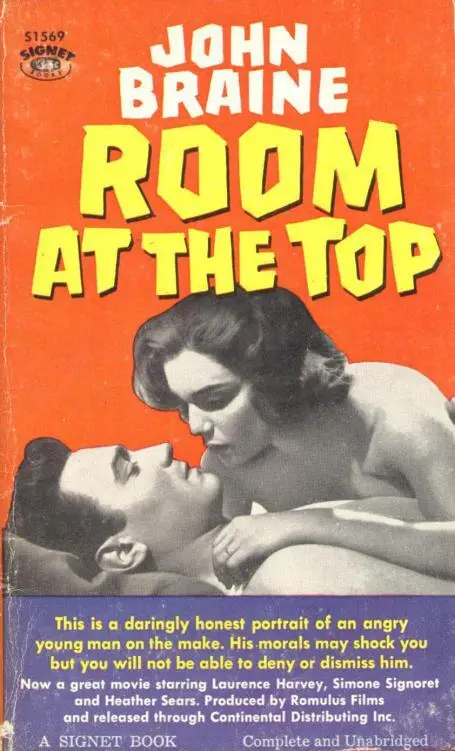
- Название:Room at the Top
- Автор:
- Жанр:
- Год:неизвестен
- ISBN:нет данных
- Рейтинг книги:3 / 5. Голосов: 1
-
Избранное:Добавить в избранное
- Отзывы:
-
Ваша оценка:
Room at the Top: краткое содержание, описание и аннотация
Предлагаем к чтению аннотацию, описание, краткое содержание или предисловие (зависит от того, что написал сам автор книги «Room at the Top»). Если вы не нашли необходимую информацию о книге — напишите в комментариях, мы постараемся отыскать её.
Room at the Top — читать онлайн бесплатно полную книгу (весь текст) целиком
Ниже представлен текст книги, разбитый по страницам. Система сохранения места последней прочитанной страницы, позволяет с удобством читать онлайн бесплатно книгу «Room at the Top», без необходимости каждый раз заново искать на чём Вы остановились. Поставьте закладку, и сможете в любой момент перейти на страницу, на которой закончили чтение.
Интервал:
Закладка:
He snorted. "In love with her! Drivel! In lust with her. And Daddy's bank balance. I know you, you scoundrel. Do what Uncle Charles advises, and all will be gas and gaiters."
"I might try it," I said. "Another beer?"
"Wait," Charles whispered as a young man in a Crombie overcoat came through the door. "The Glittering Zombie's being democratic. After all, we went to school with him."
He waved at the newcomer. "Come over here, Cyril." He winked at me. "By Jove, old man, it's nice to see you. What are you having?" He was using his captain's accent, I observed with amusement. It was a wartime acquisition; he'd learned it in ten days flat after he'd seen a young Cockney sublieutenant driven to suicide by the jeers of the Standard English types. He did it rather well; the Glittering Zombie, a simple soul whose father had been a corporation dustman before the war, was, as always, impressed and flattered.
"Let me , Charlie," he said quickly. "Something short, eh?"
I returned to Aunt Emily slightly oiled.
"Hello, love," she said when I came in. "Been with Charles?"
"Talking over old times," I said. "We're going out tonight. I'll have supper at his place."
"Where are you going?"
"I don't really know yet."
"Not far from a bottle, if I know Charles."
She was sitting by the fire with her hands folded. It was quite dark in the Front Room; the fire burned with a kind of restrained brightness, reflecting itself gently from the unscratched furniture. A faint smell of cigars and wine and chocolate still hung over the room. Aunt Emily looked very much like my mother; her face had the same thin elegance and the same air of restrained energy. Aided by the beer and the whisky and the faint sadness of the Front Room, the tears came to my eyes.
"What's up, lad?"
"You made me think of Mother."
She sighed. "Ee, I remember her well as a young lass. She used to run the house after Father died. She wor proper determined, wor your mother. Your grandma had all t'heart knocked out of her when your grandpa wor killed at t'mill. During t'first war, that was, and them coining money then, but not a penny-piece of compensation did your grandma get. T'same people went bankrupt in 1930. T'owd meister shot himself."
"Good," I said.
"It wasn't good for those that wor thrown out of work." She looked at me sternly. "Think on how lucky you are, Joe. T'Town Hall can't go bankrupt. Tha'll never go hungry. Or have to scrat and scrape saving for thi old age."
"It's not so bad in the mills now," I said. "No one's out of work. Dammit, some of the millhands are better off than I."
"Aye," she said, "they can get ten and twelve pounds if they work fifty and sixty and seventy hours a week in t'heat and t'din and t'muck. But how long will it last?"
She rose. "Ah'll make some tea," she said. "Your uncle's having a lay-down and t'boys are out playing." She winked. "So there's only tee and me in t'house, and we'll have a right cup of tea. Ah've been putting a bit aside for you coming home."
Moved by an impulse of affection, I kissed her on the cheek. "Make it so t'spoon'll stand up in it, love," I said. "And I want a pint pot." I kissed her on the other cheek. "You're very good to me, Auntie," I said.
"It's t'beer that's making thee so sloppy," she said, but I could see that she was pleased by the springiness of her step as she went out.
When she came back with the tea I offered her a cigarette. To my surprise, she accepted it. "I am a devil, aren't I?" she said, puffing away inexpertly.
The tea was both astringent and sweet, and she'd put some rum in it. 'That's t'first right cup of tea Ah've had sin' Ah left home," I said.
"Time you had a home of your own."
"I'm too young yet," I said weakly.
"You're old enough. Old enough to be running after all t'lasses in sight, Mi do know."
"No one'll have me, Auntie. I'm not rich enough."
"Fiddlesticks. You're not bad-looking and you have a good steady job. And you're not shy, you're brass-faced, in fact. Don't try to tell me you can't get a lass, Joe Lampton, because Ah'll noan credit it. Haven't you met anyone at this theatre you keep writing about?"
It was no use; I never could withstand her questioning for very long. (I think that perhaps I was unconsciously making up to Mother through her for all the times I'd answered perfectly reasonable questions with boorish grunts or studied vagueness.)
"There's a girl named Susan Brown," I said. "I've taken her out a few times. She's rather attractive."
"Who is she?"
"Her father owns a factory near Leddersford. He's on the Warley Council."
She looked at me with a curious pity. "Money marries money, lad. Be careful she doesn't break your heart. Is she really a nice lass, though?"
"She's lovely," I said. "Not just lovely to look at - she's sweet and innocent and good."
"I bet she doesn't work for a living either, or else does a job for pin money. What good's a girl like that to you? Get one of your own class, lad, go to your own people."
I poured myself another cup of tea. I didn't like its taste any longer; it was too strong, stuffy and pungent like old sacking. "If I want her, I'll have her."
"I wonder how fond you really are of her," Aunt Emily said sadly.
"I love her. I'm going to marry her." But I felt shame-faced as I spoke the words.
On my way to the Siege Gun that evening I went past my old home. Christmas Eve's snow had already melted, and it was cold with a damp enclosing coldness; it was like being locked in a disused cellar. I paused by the gap where our house had stood; I had no desire to receive old memories but instantly, unbidden, the events of that morning in 1941 - the Bad Morning, the Death Morning - unreeled themselves like a film.
It was the smell which had upset me most. There was nothing there now but a faint mustiness; but on the Bad Morning it had been chokingly strong - the blitz smell, damp plaster and bonemeal. I'd accepted it as part of the atmosphere in London and the Home Counties, but here in Dufton it was as incongruous as a tiger.
There was no rubble now, no broken glass, no fluttering shreds of wallpaper. The pavement had been roped off that morning: among the debris was the bathroom mirror, which somehow had survived the explosion and seemed to wink derisively in the August sun, as if it had survived at my parents' expense. For a moment I'd pretended that the bomb had fallen on some other house, and that very soon I'd be talking the whole thing over with Mother. The houses were so much alike with their oak-grained doors, lace curtains, yellowstoned doorsteps, and fronts of stained Accrington brick (good for a thousand years) that it was easy to see how the Town Hall had made the mistake. Come to that, the front of the house had been so neatly sheared off that it was possible to imagine some macabre practical joke having been played - hadn't Charles and I often agreed that Zombies have a queer sense of humour?
There'd been the usual group of spectators with the usual expression of futile excitement, voyeurs of disaster; I didn't speak to any of them because I hated them so much that I couldn't speak. I shut them out of my mind because if I'd lost control of myself I should simply have been providing them with an extra pleasure, an unexpected titillation.
I'd ducked under the ropes and entered through the front porch, which was still standing, the door ajar. I could have entered with equal ease at any point where the wall had stood; but it would have been disrespectful, like dropping ash on a corpse.
"Clear out," the man in overalls had said. He was standing at the far corner of the living room with a small red notebook in his hand. His ARP helmet had been pushed back to show a mop of thick white hair; he was wearing heavy horn-rim spectacles and a bushy white moustache. He was small and square-shouldered and stood with his feet wide apart as if the floor were swaying. "Clear out," he repeated. "That wall's coming down soon. Christ, haven't you ever seen a blitzed house before?"
Читать дальшеИнтервал:
Закладка:
Похожие книги на «Room at the Top»
Представляем Вашему вниманию похожие книги на «Room at the Top» списком для выбора. Мы отобрали схожую по названию и смыслу литературу в надежде предоставить читателям больше вариантов отыскать новые, интересные, ещё непрочитанные произведения.





Обсуждение, отзывы о книге «Room at the Top» и просто собственные мнения читателей. Оставьте ваши комментарии, напишите, что Вы думаете о произведении, его смысле или главных героях. Укажите что конкретно понравилось, а что нет, и почему Вы так считаете.