Richard Ford - The Sportswriter
Здесь есть возможность читать онлайн «Richard Ford - The Sportswriter» весь текст электронной книги совершенно бесплатно (целиком полную версию без сокращений). В некоторых случаях можно слушать аудио, скачать через торрент в формате fb2 и присутствует краткое содержание. Год выпуска: 1995, Издательство: Vintage Books, Жанр: Современная проза, на английском языке. Описание произведения, (предисловие) а так же отзывы посетителей доступны на портале библиотеки ЛибКат.
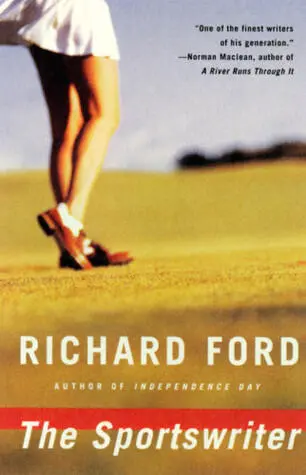
- Название:The Sportswriter
- Автор:
- Издательство:Vintage Books
- Жанр:
- Год:1995
- ISBN:нет данных
- Рейтинг книги:3 / 5. Голосов: 1
-
Избранное:Добавить в избранное
- Отзывы:
-
Ваша оценка:
The Sportswriter: краткое содержание, описание и аннотация
Предлагаем к чтению аннотацию, описание, краткое содержание или предисловие (зависит от того, что написал сам автор книги «The Sportswriter»). Если вы не нашли необходимую информацию о книге — напишите в комментариях, мы постараемся отыскать её.
The Sportswriter — читать онлайн бесплатно полную книгу (весь текст) целиком
Ниже представлен текст книги, разбитый по страницам. Система сохранения места последней прочитанной страницы, позволяет с удобством читать онлайн бесплатно книгу «The Sportswriter», без необходимости каждый раз заново искать на чём Вы остановились. Поставьте закладку, и сможете в любой момент перейти на страницу, на которой закончили чтение.
Интервал:
Закладка:
“I don’t know your stepbrother,” I say.
She picks up the wallet and holds the snapshot up so I am looking directly into the swarthy smart-aleck’s face. “Him,” she says. “This poor old thing, here.”
So much of life can’t be foreseen. A hundred private explanations and exculpations come rushing up into my throat, and I have to swallow hard to hold them back. Though, of course, there is nothing to say. Like all needless excuses, the unraveling is not worth the time. However, I feel a swirling dreaminess, an old familiar bemusement, suddenly rise into my appreciation of everything around me. Irony is returned. I have a feeling that if I tried to speak now, my mouth would move, but no sound would occur. And it would scare us both to death. Why, in God’s name, isn’t it possible to let ignorance stay ignorance?
“That poor boy’s already dead and gone to heaven,” Vicki says. She turns the picture toward her and looks at it appraisingly. “He got killed at Fort Sill, Oklahoma. A Army truck hit him. He’s my Daddy’s wife’s son. Was. Bernard Twill. Beany Twill.” She pops the wallet closed and puts it on the table. “I didn’t even really know him. Lynette just gave me his picture for my wallet when he died. I don’t know how come I kept it.” She looks at me in a sweet way. “I’m not stayin mad. It’s just an old purse with nothin in it. Women’re strange on their purses.”
“I’m going to get back in bed,” I say in a voice that is hardly a whisper.
“Long as you’re happy, to hell with the rest. That’s a good motto, isn’t it?”
“Sure. It’s great,” I say, crawling into the big cold bed. “I’m sorry about all this.”
She smiles and sits looking at me as I pull the sheet up around my chin and begin to think that it is not a hard life to imagine, not at all, mine and Vicki Arcenault’s. In fact, I would like it as well as it’s possible to like any life: a life of small flourishes and clean napkins. A life where sex plays an ever-important nightly role — better than with any of the eighteen or so women I knew before and “loved.” A life appreciative of history and its generations. A life of possible fidelity, of going fishing with some best friend, of having a little Sheila or a little Matthew of our own, of buying a fifth-wheel travel trailer — a cruising brute — and from its tiny portholes seeing the country. Paul and Clarissa could come along and join our gang. I could sell my house and move not to Pheasant Run but to an old Quakerstone in Bucks County. Possibly when our work is done, a tour in the Peace Corps or Vista — of “doing something with our lives.” I wouldn’t need to sleep in my clothes or wake up on the floor. I could forget about being in my emotions and not be bothered by such things.
In short, a natural extension of almost all my current attitudes taken out beyond what I now know.
And what’s wrong with that? Isn’t it what we all want? To look out toward the horizon and see a bright, softened future awaiting us? An attractive retirement?
Vicki turns on the television and takes up a rapt stare at its flicking luminance. It’s ice skating at 2 A.M. (basketball’s a memory). Austria, by the looks of it. Cinzano and Rolex decorate the boards. Tai and Randy are skating under steely control. He is Mr. Elegance — flying camels, double Salchows, perfect splits and lofts. She is all in the world a man could want, vulnerable yet fiery, lithe as a swan, in this their once-in-a-lifetime, every thing-right for a flawless 10. Together they perform a perfect double axel, two soaring triple toe loops, a spinning Lutz jump, then come to rest with Tai in a death spiral on the white ice, Randy her goodly knight. And the Austrians cannot control it one more second. These two are as good as the Protopopovs, and they’re Americans. Who cares if they missed the Olympics? Who cares if rumors are true that they despise each other? Who cares if Tai is not so beautiful up close (who is, ever)? She is still exotic as a Berber with regal thighs and thunderous breasts. And what’s important is they have given it their everything, as they always do, and every Austrian wishes he could be an American for just one minute and can’t resist feeling right with the world.
“Oh, don’t you just love them two?” Vicki says, sitting cross-legged on her chair, smoking a cigarette and peering into the brightly lit screen as though staring into a colorful dream-life.
“It’s pretty wonderful,” I say.
“Sometimes I want to be her so much,” she says, blowing smoke out the corner of her mouth. “Really. Ole Randy….”
I turn and close my eyes and try to sleep as the applause goes on, and outside in the cold Detroit streets more sirens follow the first one into the night. And for a moment I find it is really quite easy and agreeable not to know what’s next, as if the sirens were going out into this night for no one but me.
6
Snow. By the time I leave my bed, a blanket of the gently falling white stuff has covered the concrete river banks from Cobo to the Ren-Cen, the river sliding by brackish and coffee-colored under a quilted Michigan sky. So much for a game under the lights. Spring has suddenly disappeared and winter stepped in. I am certain by tomorrow the same weather will have reached New Jersey (we are a day behind the midwest in weather matters), though by then, here will have thawed and grown mild again. If you don’t like the weather, wait ten minutes.
Vicki is still deep asleep in her black crepe de Chine, and though I would like to wake her and have a good heart-to-heart, last night feels otherwordly, and optimism about “us two” is what’s in need of emphasizing. A talk can always wait till later.
I shower and dress in a hurry, pockets loaded with note pads and a small recorder, and head off to breakfast and my trip to Walled Lake. I leave a note on the bed table saying I’ll be back by noon, and she should watch a movie on HBO and have a big breakfast sent up.
The Pontchartrain lobby has a nice languorous-sensuous Saturday feel despite the new snow, which the bellhops all agree is “freakish” and can’t last past noon, though a number of guests are lining up to check out for the airport. The black newsstand girl sells me a Free Press with a big smile and a yawn. “I’m bout shoulda stayed in bed,” she laughs in a put-on accent. On the rack there is an issue of my magazine with a story I wrote about the surge in synchronized swimming in Mexico — all the digging work was done by staff. I’m tempted to make some mention of it just in passing, but I wander off to breakfast instead.
In the La Mediterranée Room I order two poached, dry toast and juice, and ask the waiter to hurry, while I check on the early leaders in the AL East — who’s been sent down, who’s up for a cup of coffee. The Free Press sports section has always been my favorite. Photographs galore. A crisp wide-eyed layout with big, readable coldtype print and a hometown writing style anyone could feel at home with. There is a place for literature, but a bigger one for sentences that are meant to be read, not mused over: “Former Brother Rice standout, Phil Staransky, who picked up a couple timely hits in Wednesday’s twi-nighter, on the way to going three-for-four, already has plenty of experts around Michigan and Trumbull betting he’ll see more time at third before the club starts its first swing west. Pitching Coach Eddie Gonzalez says there’s no doubt the Hamtramck native ‘figures in the big club’s plans, especially,’ Gonzalez notes, ‘since the young man left off trying to pull everything and began swinging with his head.’” When I was in college I had a pledge bring it right to my bed every morning, and was even a mail subscriber when we first moved to Haddam. From time to time I think of quitting the magazine and coming back out to do a column. Though I’m sure it’s too late for that now. (The local sports boys never take kindly to the national magazine writers because we make more money. And in fact, I’ve been given haywire information from a few old beat writers, which, if I’d used it, would’ve made me look stupid in print.)
Читать дальшеИнтервал:
Закладка:
Похожие книги на «The Sportswriter»
Представляем Вашему вниманию похожие книги на «The Sportswriter» списком для выбора. Мы отобрали схожую по названию и смыслу литературу в надежде предоставить читателям больше вариантов отыскать новые, интересные, ещё непрочитанные произведения.




Обсуждение, отзывы о книге «The Sportswriter» и просто собственные мнения читателей. Оставьте ваши комментарии, напишите, что Вы думаете о произведении, его смысле или главных героях. Укажите что конкретно понравилось, а что нет, и почему Вы так считаете.