Richard Ford - The Sportswriter
Здесь есть возможность читать онлайн «Richard Ford - The Sportswriter» весь текст электронной книги совершенно бесплатно (целиком полную версию без сокращений). В некоторых случаях можно слушать аудио, скачать через торрент в формате fb2 и присутствует краткое содержание. Год выпуска: 1995, Издательство: Vintage Books, Жанр: Современная проза, на английском языке. Описание произведения, (предисловие) а так же отзывы посетителей доступны на портале библиотеки ЛибКат.
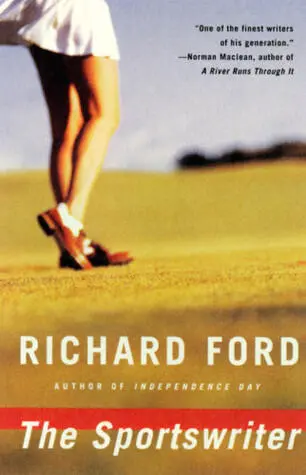
- Название:The Sportswriter
- Автор:
- Издательство:Vintage Books
- Жанр:
- Год:1995
- ISBN:нет данных
- Рейтинг книги:3 / 5. Голосов: 1
-
Избранное:Добавить в избранное
- Отзывы:
-
Ваша оценка:
The Sportswriter: краткое содержание, описание и аннотация
Предлагаем к чтению аннотацию, описание, краткое содержание или предисловие (зависит от того, что написал сам автор книги «The Sportswriter»). Если вы не нашли необходимую информацию о книге — напишите в комментариях, мы постараемся отыскать её.
The Sportswriter — читать онлайн бесплатно полную книгу (весь текст) целиком
Ниже представлен текст книги, разбитый по страницам. Система сохранения места последней прочитанной страницы, позволяет с удобством читать онлайн бесплатно книгу «The Sportswriter», без необходимости каждый раз заново искать на чём Вы остановились. Поставьте закладку, и сможете в любой момент перейти на страницу, на которой закончили чтение.
Интервал:
Закладка:
Only our house got broken into, hateful Polaroids scattered around, the letters from the woman in Kansas found, and X seemed suddenly to think we were too far gone, farther gone than we knew, and life just seemed unascendant and to break between us, not savagely or even tragically, just ineluctably, as the real writers say.
A lot happens to you in your life and comes to bear midway: your parents can die (mine, though, died years before), your marriage can change and even depart, a child can succumb, your profession can start to seem hollow. You can lose all hope. Any one thing would be enough to send you into a spin. And correspondingly it is hard to say what causes what, since in one important sense everything causes everything else.
So with all this true, how can I say I “love” Vicki Arcenault? How can I trust my instincts all over again?
A good question, but one I haven’t avoided asking myself, for fear of causing more chaos in everybody’s life.
And the answer like most other reliable answers is in parts.
I have relinquished a great deal. I’ve stopped worrying about being completely within someone else since you can’t be anyway — a pleasant unquestioning mystery has been the result. I’ve also become less sober-sided and “writerly serious,” and worry less about the complexities of things, looking at life in more simple and literal ways. I have also stopped looking around what I feel to something else I might be feeling. With all those eighteen women, I was so bound up creating and resolving a complicated illusion of life that I lost track of what I was up to — that I ought to be having a whale of a good time and forget about everything else.
When you are fully in your emotions, when they are simple and appealing enough to be in, and the distance is closed between what you feel and what you might also feel, then your instincts can be trusted. It is the difference between a man who quits his job to become a fishing guide on Lake Big Trout, and who one day as he is paddling his canoe into the dock at dusk, stops paddling to admire the sunset and realizes how much he wants to be a fishing guide on Lake Big Trout; and another man who has made the same decision, stopped paddling at the same time, felt how glad he was, but also thought he could probably be a guide on Windigo Lake if he decided to, and might also get a better deal on canoes.
Another way of describing this is that it’s the difference between being a literalist and a factualist. A literalist is a man who will enjoy an afternoon watching people while stranded in an airport in Chicago, while a factualist can’t stop wondering why his plane was late out of Salt Lake, and gauging whether they’ll still serve dinner or just a snack.
And finally, when I say to Vicki Arcenault, “I love you,” I’m not saying anything but the obvious. Who cares if I don’t love her forever? Or she me? Nothing persists. I love her now, and I’m not deluding myself or her. What else does truth have to hold?
A t twelve-forty-five I am awake. Vicki sleeps beside me, breathing lightly with a soft clicking in her throat. In the room there is the dense dimensionless feeling of going to sleep in the dark though waking up still in the dark and wondering about the hours till dawn: how many will there be still? Will I suffer some unexpected despair? How am I likely to pass the time? I am usually — as I’ve said — such a first-rate sleeper that I’m not bothered by these questions. Though I’m certain part of my trouble is the ordinary thrill of being here, with this woman, free to do anything I please — that familiar old school’s out we all look and hope for. Tonight would be a good time to take a solo walk in the dark city streets, turn my collar up, get some things thought out. But I have nothing to think out.
I turn on the television with the sound off, something I often do when I’m on the road alone, while I browse a player roster or sharpen up some notes. I love the television in other cities, the assurance of looking up from my chair in some strange room to see a familiar newscaster talking in his familiar Nebraska accents, clad in a familiarly unappealing suit before a featureless civic backdrop (I can never remember the actual news); or to see an anonymous but completely engrossing athletic event acted out in a characterless domed arena, under the same lemony light, to the tune of the same faint zizzing, many miles from anywhere my face would be known. These comprise a comfort I would not like to do without.
On television the station reruns a pro basketball game I am only too happy to watch. Detroit plays Seattle. (Reruns, inciden tally, are where you learn a game inside and out. They’re far superior to the actual game in the actual place it’s played, where things are usually pretty boring and you often forget altogether about what you’re there for and find yourself getting interested in other things.)
I go get Vicki’s Le Sac bag, open it up and take out one of her Merits, and light it. I have not smoked a cigarette in at least twenty years. Not since I was a freshman in college and attended a fraternity smoker where older boys gave me Chesterfields and I stood against a wall, hands in pockets, and tried to look like the boy everyone would want to ask to join: the silent, slender southern boy with eyes older than his years, something already jaded and over-experienced about him. Just the one we need.
While I’m at it, I push down through the bag. Here is a rosary (predictable). The United inflight magazine (swiped). A card of extra pearlescent buttons (useful). Car keys to the Dart on a big brass ring with a V insignia. An open tube of Velamints. Two movie ticket stubs from a theater where Vicki and I saw part of an old Charlton Heston movie (until I fell asleep). The flight-insurance policy. A paperback copy of a novel, Love’s Last Journey , by someone named Simone La Noire. And a fat, brown leather wallet with a tooled western-motif of a big horse head on shiny grain.
In it — right up front — is a picture of a man I’ve never seen before, a swank-looking greaseball character, wearing an open-collared white shirt and a white big-knit shepherd’s roll cardigan. The fellow has thick, black eyebrows, a complicated but strict system of dark hair waves, narrow eyeslits and a knifey smile set in the pouting, mocking angle of swarthy self-congratulation. Around his pencil-neck is a gold cross on a chain. It is Everett.
The carpet king from the other Big D is a leering, hip-sprung lounge lizard in a fourth-rate Vegas motel; the kind of fellow who wears his cigarettes under his shirt sleeve, possesses long, skinny arms and steely fingers, and as a policy drinks huge amounts of cheap beer at all hours of the day and night. I would recognize him anywhere. Lonesome Pines was full of such types, from the best possible homes, and all capable of the sorriest depravities. I couldn’t be more disappointed to find his picture here. Nor more perplexed. It’s possible that he is a superior, good-natured yokel and were we ever to meet (which we won’t), we’d cement a sensible common ground from which to express earnestly our different opinions about the world. (Sports, in fact, is the perfect lingua franca for such crab-wise advances between successive boyfriends and husbands who might otherwise fall into vicious fistfights.)
But in truth I couldn’t give a damn about Everett’s selling points. And I am of a mind to flush his picture down the commode then stand my ground when the first complaint is offered.
I take a deep, annoyed drag on my cigarette and attempt a difficult French Inhale I once saw practiced in college. But the smoke gets started backwards in my throat and not up my nose, and suddenly I’m seized by a terrifying airlessness and have to suppress a horrible gagging. I make a swift stagger into the bathroom and close the door to keep from waking Vicki with a loud grunt-cough that purples my face.
Читать дальшеИнтервал:
Закладка:
Похожие книги на «The Sportswriter»
Представляем Вашему вниманию похожие книги на «The Sportswriter» списком для выбора. Мы отобрали схожую по названию и смыслу литературу в надежде предоставить читателям больше вариантов отыскать новые, интересные, ещё непрочитанные произведения.








Обсуждение, отзывы о книге «The Sportswriter» и просто собственные мнения читателей. Оставьте ваши комментарии, напишите, что Вы думаете о произведении, его смысле или главных героях. Укажите что конкретно понравилось, а что нет, и почему Вы так считаете.