Richard Ford - The Sportswriter
Здесь есть возможность читать онлайн «Richard Ford - The Sportswriter» весь текст электронной книги совершенно бесплатно (целиком полную версию без сокращений). В некоторых случаях можно слушать аудио, скачать через торрент в формате fb2 и присутствует краткое содержание. Год выпуска: 1995, Издательство: Vintage Books, Жанр: Современная проза, на английском языке. Описание произведения, (предисловие) а так же отзывы посетителей доступны на портале библиотеки ЛибКат.
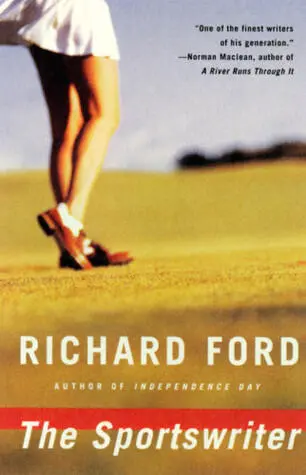
- Название:The Sportswriter
- Автор:
- Издательство:Vintage Books
- Жанр:
- Год:1995
- ISBN:нет данных
- Рейтинг книги:3 / 5. Голосов: 1
-
Избранное:Добавить в избранное
- Отзывы:
-
Ваша оценка:
The Sportswriter: краткое содержание, описание и аннотация
Предлагаем к чтению аннотацию, описание, краткое содержание или предисловие (зависит от того, что написал сам автор книги «The Sportswriter»). Если вы не нашли необходимую информацию о книге — напишите в комментариях, мы постараемся отыскать её.
The Sportswriter — читать онлайн бесплатно полную книгу (весь текст) целиком
Ниже представлен текст книги, разбитый по страницам. Система сохранения места последней прочитанной страницы, позволяет с удобством читать онлайн бесплатно книгу «The Sportswriter», без необходимости каждый раз заново искать на чём Вы остановились. Поставьте закладку, и сможете в любой момент перейти на страницу, на которой закончили чтение.
Интервал:
Закладка:
The clock at St. Leo the Great sounded ten, and something began happening at 116 Cleveland.
The yellow stoop light flashed on. Someone inside spoke in a tone of patient instruction, and the front door opened. My son, Paul, stepped out.
Paul in tennis shorts, and a Minnesota Twins shirt I brought him from a trip I took. He is ten, small and not overly clever yet, a serious, distractable boy with a good heart, and all the sweet qualities of second sons: patience, curiosity, some useful inventiveness, sentimentality, a building vocabulary, even though he is not much of a reader. I have tried to think that things will turn out well for him, though when we powwow up in his room, a place he keeps furnished with Sierra Club posters of eagles and large Audubon mergansers and grebes, he always seems to display a moody enthrallment, as if there is some sovereign event in his life he senses is important but cannot for some reason remember. Naturally I am very proud of him, and his sister, too. They both carry on like soldiers.
Paul had brought outside with him one of the birds from his dovecote. A mottled rock dove, a handsome winger. He toted it manfully to the curb, using the two-handed professional bird handler’s way he’s taught himself. I surveilled him like a spy, slumped behind the steering wheel, the shadow of the big túpelo making me not especially noticeable, though Paul was too intent on his own business to see me.
At the curb he took the pigeon in one small hand, slipped the hood and neatly pocketed it. The bird cocked its head peckishly at his new surroundings. The sight, though, of Paul’s familiar, serious face calmed it.
Paul studied the pigeon for a time, grappling it once again in both hands, and via the still darkness I could hear his boy’s voice talking. He was coaching the bird in some language he had practiced. “Remember this house.” “Fly this special route.” “Be careful of this hazard or that obstacle.” “Think of all we’ve worked on.” “Remember who your friends are”—all of it good advice. When he’d finished, he held the bird to his nose and sniffed behind its beaky head. I saw him close his eyes, and then it was up, pitched, the bird’s large bright wings seizing the night instantly, up and gone and out of sight like a thought, its wings white and then quickly small as it cleared the closure of trees — gone.
Paul looked up a moment, watching it. Then, as if he’d forgotten all about any loosed bird, he turned and stared at me across the street, slouched like Officer Carnevale in my cruiser car. He had seen me probably for quite some time, but had gone on with his business like a big boy who knows he’s watched and doesn’t care for it, but understands those are the rules.
Paul walked across the street in his little boy’s ungainly gait but with a gainly smile, a smile he’d give, I know, to a total stranger.
“Hi Dad,” he said through the window.
“Hi, Paul.”
“So what’s up?” He still smiled at me like an innocent boy.
“Just sort of sitting here now.”
“Is it all right?”
“It’s great. Whose car’s that out front there?”
Paul looked back behind him at the Thunderbird. “The Litzes.” (Neighbor, lawyer, no problem.) “Are you coming inside?”
“I just wanted to check up on you folks. Just being a patrol car.”
“Clary’s asleep. Mom’s watching news,” Paul said, adopting his mother’s way of dropping definite articles, a midwest mannerism. They went to market. She has flu. We bought tickets .
“Who was that you gave his freedom to?”
“Ole Vassar.” Paul looked up the street. Paul names his birds after hillbilly tunesters — Ernest, Chet, Loretta, Bobby, Jerry Lee — and had adopted his father’s partiality for oie as a term of pure endearment. I could’ve hauled him through the window and hugged him till we both cried out, so much did I love him at that moment. “I didn’t give him his freedom right off, though.”
“Old Vassar has a mission first, then?”
“Yes sir,” Paul said and looked down at the pavement. It was clear I was burdening his privacy, of which he has plenty. But I knew he felt he had to talk about Vassar now.
“What’s Vassar’s mission?” I asked bravely.
“To see Ralph.”
“Ralph. What’s he going to see Ralph for?”
Paul sighed a small boy’s put-on sigh, transformed back from a big boy. “To see if he’s all right. And tell him about us.”
“You mean it’s a report.”
“Yeah. I guess.” Head still down at the pavement.
“On all of us?”
“Yeah.”
“And how did it come out?”
“Good.” Paul avoided my eyes in another direction.
“My part okay, too?”
“Your part wasn’t too long. But it was good.”
“That’s all right. Just so I made it in. When’s Ole Vassar reporting back?”
“He isn’t. I told him he could live in Cape May.”
“Why is that?”
“Because Ralph’s dead. I think.”
I had taken him and his sister to Cape May only last fall, and I was interested now that he supposed the dead lived there. “It’s a one-way mission, then.”
“Right.”
Paul stared fiercely at the door of my car and not at me, and I could sense he was confused by all this talk of dead people. Kids are most at home with sincerity and the living (who could blame them?), unlike adults, who sometimes do not have an unironical bone in their bodies, even for things that are precisely in front of them and can threaten their existence. Paul’s and mine, though, has always been a friendship founded on sincerity’s rock.
“What do you know tonight to tickle me?” I said. Paul is a secret cataloger of corny jokes and can make anyone laugh out loud, even at a joke they’ve heard before, though he often chooses to withhold. I myself envy his memory.
For this question, though, he had to consider. He wagged his head backwards in pretend-thought, and stared into the tree boughs as if all the good jokes were up there. (What did I say about things always changing and surprising us? Who would’ve thought a drive down a dark street could produce a conversation with my own son! One in which I find out he’s in contact with his dead brother — a promising psychological indicator, though a bit unnerving — plus get to hear a joke as well.)
“Ummm, all right,” Paul said. He was all Johnny now. By the way he stuffed his hands in his pockets and averted his mouth I could tell he thought it was a pretty funny one.
“Ready?” I said. With anyone else this would spoil the joke. But with Paul it is protocol.
“Ready,” he said. “Who speaks Irish and lives in your back yard?”
“I don’t know.” I give in straight away.
“Paddy O’Furniture.” Paul could not hold back his laughter a second and neither could I. We both held our sides — he in the street, I in my car. We laughed like monkeys loud and long until tears rose in his eyes and mine, and I knew if we did not rein ourselves in, his mother would be out wondering (silently) about my “judgment.” Ethnics, though, are among our favorite joke topics.
“That’s a prize-winner,” I said, wiping a tear from my eye.
“I have another one, too. A better one,” he said, grinning and trying not to grin at the same time.
“I have to drive home now, sonny,” I said. “You’ll have to remember it for me.”
“Aren’t you coming inside?” Paul’s little eyes met mine. “You can sleep on the couch.”
“Not tonight,” I said, joy bounding in my heart for this sweet Uncle Milty. I would’ve accepted his invitation if I could, taken him up and tickled his ribs and put him in his bed. “Rain Czech.” (One of our oldest standbys.)
Читать дальшеИнтервал:
Закладка:
Похожие книги на «The Sportswriter»
Представляем Вашему вниманию похожие книги на «The Sportswriter» списком для выбора. Мы отобрали схожую по названию и смыслу литературу в надежде предоставить читателям больше вариантов отыскать новые, интересные, ещё непрочитанные произведения.

Обсуждение, отзывы о книге «The Sportswriter» и просто собственные мнения читателей. Оставьте ваши комментарии, напишите, что Вы думаете о произведении, его смысле или главных героях. Укажите что конкретно понравилось, а что нет, и почему Вы так считаете.