Richard Ford - The Sportswriter
Здесь есть возможность читать онлайн «Richard Ford - The Sportswriter» весь текст электронной книги совершенно бесплатно (целиком полную версию без сокращений). В некоторых случаях можно слушать аудио, скачать через торрент в формате fb2 и присутствует краткое содержание. Год выпуска: 1995, Издательство: Vintage Books, Жанр: Современная проза, на английском языке. Описание произведения, (предисловие) а так же отзывы посетителей доступны на портале библиотеки ЛибКат.
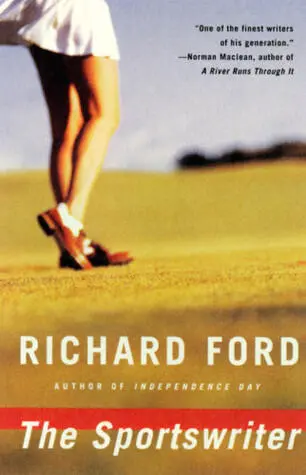
- Название:The Sportswriter
- Автор:
- Издательство:Vintage Books
- Жанр:
- Год:1995
- ISBN:нет данных
- Рейтинг книги:3 / 5. Голосов: 1
-
Избранное:Добавить в избранное
- Отзывы:
-
Ваша оценка:
The Sportswriter: краткое содержание, описание и аннотация
Предлагаем к чтению аннотацию, описание, краткое содержание или предисловие (зависит от того, что написал сам автор книги «The Sportswriter»). Если вы не нашли необходимую информацию о книге — напишите в комментариях, мы постараемся отыскать её.
The Sportswriter — читать онлайн бесплатно полную книгу (весь текст) целиком
Ниже представлен текст книги, разбитый по страницам. Система сохранения места последней прочитанной страницы, позволяет с удобством читать онлайн бесплатно книгу «The Sportswriter», без необходимости каждый раз заново искать на чём Вы остановились. Поставьте закладку, и сможете в любой момент перейти на страницу, на которой закончили чтение.
Интервал:
Закладка:
Nine o’clock on the Thursday before Easter far down the suburban train line. A town, almost any town, would seem to have secrets all its own. Though if you believed that you’d be wrong. Haddam in fact is as straightforward and plumb-literal as a fire hydrant, which more than anything else makes it the pleasant place it is.
None of us could stand it if every place were a grizzled Chicago or a bilgy Los Angeles — towns, like Gotham, of genuine woven intricacy. We all need our simple, unambiguous, even factitious townscapes like mine. Places without challenge or double-ranked complexity. Give me a little Anyplace, a grinning, toe-tapping Terre Haute or wide-eyed Bismarck, with stable property values, regular garbage pick-up, good drainage, ample parking, located not far from a major airport, and I’ll beat the birds up singing every morning.
I slowed to take a peek at the marquee of the First Presbyterian, at the edge of the seminary grounds. I occasionally pop in on a given Sunday just to see what they’re up to and lift my spirits with a hymn. X and I attended when we first moved here, but she eventually lost interest, and I began working Sundays. Years ago, when I was a senior and in need of an antidote to the puddling, laughless, guilty ironies of midwar Ann Arbor, I began attending a liberal and nondogmatic Westminster group on Maynard Street. The preacher, who referred to himself as a “moderator,” was a tall, acned, open-collared scarecrow who aimed his mumbled sermons toward world starvation, the UN and SEATO, and who seemed embarrassed when it came time to stand up and pray and always kept his darting eyes open. A skinny little anorexic wife was his assistant — they were both from Muskegon — and our congregation consisted mostly of elderly professors’ widows, a few confused and homely coeds and a homosexual or two just coming to grips with things.
I lasted five weeks, then put my Bible away and started staying up Saturday nights at the fraternity and getting good and drunk. Christianity, like everything else in the Ann Arbor of those times, was too factual and problem-solving-oriented. The spirit was made flesh too matter-of-factly. Small-scale rapture and ecstasy (what I’d come for) were out of the question given the mess the world was in. Consequently I loathed going.
But the First Presbyterians of Haddam offer a good, safe-and-sound approach to things. Their ardent hope is to bring you down to earth by causing your spirit to lift — a kind of complex spiritual orienteering. The regulars all have no doubts about what they’re there for; they’re there to be saved or give a damned good impression of it, and nobody’s pulling the wool over anybody else’s eyes.
What I could read off the marquee, however, seemed strange business, though it will probably turn out to be as ordinary as toast — a trick to lure the once-a-year guys into thinking church has changed.
“The Race To The Tomb”
The preacher will have some witty, eyebrow-arching joke to start off: “Now this fella, Jesus, he was really some heckuva peculiar kind of guy, wouldn’t you say so?” And we all would. Then straight away we’d get to the hard-nosed corroborating of the resurrection and suggesting how such a fate might be ours.
I slipped on by, gave Officer Carnevale the lucky thumbs-up, which he managed moodily to return, then drove straight over to The Presidents — up Tyler, down Pierce and winding a sinewy way to Cleveland Street, before stopping under a giant tupelo across from 116, X’s little white clapboard colonial. Her Citation sat in the narrow drive, an unknown blue car parked at the curb.
Quick as a ferret I left my car, crossed the street, crouched and laid my hand on the hood of the unknown blue car — a Thunderbird — then stole back to mine before anyone on Cleveland Street could see. As I had hoped, the Bird was as cold as a murderer’s heart, and I was relieved to believe it belonged to a neighbor, or to some relative visiting the Armentis next door. Though it could’ve been a suitor I knew nothing about — one of the fat-belly credit card boys from the country club, a thought which changed relief back to doubt.
My plan had been to pay an innocent visit. I hadn’t seen Paul and Clarissa in four days, a long interval in the normal course of our lives. The two of them usually waltz by after school, eat a sandwich, sit and chat together, rummage around their former rooms the way they used to, play Yahtzee or Clue, read books, all while I try by fervent misdirection to prove a continuity in their little lives with my presence. Periodically I quit the work I’m doing and clump upstairs to tease and flirt with them, answer their questions, challenge them and try to woo them back to me in some plain and forthright way, a strategy they’re wise to but don’t mind because they love me, know I love them, and have no choice, really. We are, all four of us in this, a solid and divided family, doing our level bests to see our duty clearly.
Last night I hoped to stay for a drink, see the kids to bed, yak with X for half an hour, then end up, possibly, spending the night on the couch, something I hadn’t done in some time (not, in fact, since I met Vicki) but felt a fierce urge to do suddenly.
Still if I’d gone hat-in-hand up to the door, on a mission of somber fatherhood, I couldn’t be sure I wouldn’t have interrupted an intime —the kids away on overnights at the Armentis, the lights turned up to facilitate the best atmosphere of grownup-bittersweet-excitement-since-so-much-has-gone-before, for the benefit of neighbors interested in seeing a proud woman make the best of a fractured life. I would’ve been thunderstruck to intercept some well-dressed corporate-level type with love in his eyes, athwart the precise couch I hoped to curl up on. X would’ve been in her rights to say I’d torpedoed her attempts at getting her feet on the ground, and the fellow would’ve been in his rights to run me out or punch me. And we’d have both ended up having to leave (the two men always have to trudge off into the night alone, though occasionally they become friends if they meet up later in a bar).
My whole scenario, in short, had lost its glow, and I was left in the dark understory, facing the blue intruder car with nothing to do more than breathe the plush air and endorse X’s neighborhood. The Presidents, with their precise fifty-foot frontages, their mature mulberries and straight sidewalks, are actually an excellent location for a young, divorced lady with children, steady means and an independent bent, to dig her heels in. Up and down the street are other young free-thinking people on the way someplace in the world, sharp-eyed, idealistic folks who spotted a good investment and acted fast, and now have some value to sit on. The immigrant Italians who built them (some chosen right out of Sears catalogs) now prefer Delray Beach and Fort Myers and citizens’ groups more their own age, and have left their neighborhoods to the young, though hardly ever their own young, who prefer the likes of Pheasant Run and Kendall Park. The banks have proved compassionate with mortgage points and variable rates, and as a result the young liberals — most of them prospering stockbrokers, corporate speech writers, and public defenders — have revived a proud, close-knit neighborhood and property-value ethic where everybody looks after everybody else’s kids and grinds their own espresso. Bright new façades and paint jobs. New footings dug. A reshingled weather stoop. Smart art-deco numerals and a pane of discreetly stained glass done at home. All of it promisingly modern.
X, I think, is happy here. My children are close to their school, their friends and me. It is not the same as Hoving Road where we all once hung our hats, but things change in ways none of us can expect, no matter how damn much we know or how smart and good-intentioned each of us is or thinks he is. Who’d know that Ralph would die? Who’d know that certainty would grow rare as diamonds? Who’d know our home would be broken into and everything suddenly break apart? Did Walter Luckett know he’d meet Mr. Wrong two nights ago and alter his life again after his wife already had? No, you bet not. None of our lives is really ordinary; nothing humdrum in our delights or our disasters. Everything is as problematic as geometry when it’s affairs of the heart in question. A life can simply change the way a day changes — sunny to rain, like the song says. But it can also change again.
Читать дальшеИнтервал:
Закладка:
Похожие книги на «The Sportswriter»
Представляем Вашему вниманию похожие книги на «The Sportswriter» списком для выбора. Мы отобрали схожую по названию и смыслу литературу в надежде предоставить читателям больше вариантов отыскать новые, интересные, ещё непрочитанные произведения.

Обсуждение, отзывы о книге «The Sportswriter» и просто собственные мнения читателей. Оставьте ваши комментарии, напишите, что Вы думаете о произведении, его смысле или главных героях. Укажите что конкретно понравилось, а что нет, и почему Вы так считаете.