Richard Ford - Independence Day
Здесь есть возможность читать онлайн «Richard Ford - Independence Day» весь текст электронной книги совершенно бесплатно (целиком полную версию без сокращений). В некоторых случаях можно слушать аудио, скачать через торрент в формате fb2 и присутствует краткое содержание. Год выпуска: 1996, Издательство: Vintage, Жанр: Современная проза, на английском языке. Описание произведения, (предисловие) а так же отзывы посетителей доступны на портале библиотеки ЛибКат.
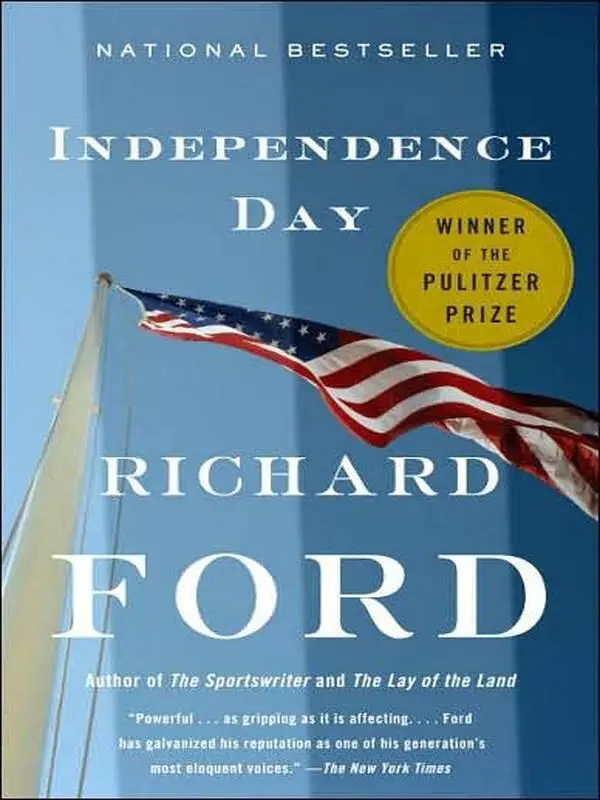
- Название:Independence Day
- Автор:
- Издательство:Vintage
- Жанр:
- Год:1996
- ISBN:нет данных
- Рейтинг книги:3 / 5. Голосов: 1
-
Избранное:Добавить в избранное
- Отзывы:
-
Ваша оценка:
Independence Day: краткое содержание, описание и аннотация
Предлагаем к чтению аннотацию, описание, краткое содержание или предисловие (зависит от того, что написал сам автор книги «Independence Day»). Если вы не нашли необходимую информацию о книге — напишите в комментариях, мы постараемся отыскать её.
, Richard Ford deepens his portrait of one of the most unforgettable characters in American fiction, and in so doing gives us an indelible portrait of America. Frank Bascombe, in the aftermath of his divorce and the ruin of his career, has entered an "Existence Period," selling real estate in Haddam, New Jersey, and mastering the high-wire act of normalcy. But over one Fourth of July weekend, Frank is called into sudden, bewildering engagement with life.
is a moving, peerlessly funny odyssey through America and through the layered consciousness of one of its most compelling literary incarnations, conducted by a novelist of astonishing empathy and perception.
Independence Day — читать онлайн бесплатно полную книгу (весь текст) целиком
Ниже представлен текст книги, разбитый по страницам. Система сохранения места последней прочитанной страницы, позволяет с удобством читать онлайн бесплатно книгу «Independence Day», без необходимости каждый раз заново искать на чём Вы остановились. Поставьте закладку, и сможете в любой момент перейти на страницу, на которой закончили чтение.
Интервал:
Закладка:
“I always think about the Fourth of July as if I needed to have something accomplished by now, or decided,” she says. “Maybe that was one of my problems last night. It’s from going to school in the summers for so long. The fall just seems too late. I don’t even know late for what.”
I, though, am thinking about a more successful color tour. Michigan: Petoskey, Harbor Springs, Charlevoix. A weekend on Mackinaw Island, riding a tandem. (All things, of course, I did with Ann. Nothing’s new.)
Sally raises both her arms above her head, joins hands and does a slinky yoga stretch, getting the kinks out of everything and causing her bracelets to slide up her arm in a jangly little cascade. This pace of things, this occasional lapse into silence, this unurgency or ruminance, is near the heart of some matter with us now. I wish it would vamoose. “I’m boring you,” she says, arms aloft, luminous. She’s nobody’s pushover and a wonderful sight to see. A smart man should find a way to love her.
“You’re not boring me,” I say, feeling for some reason elated. (Possibly the leading edge of a cool front has passed, and everybody on the seaboard just felt better all at once.) “I don’t mind it that you like me. I think it’s great.” Possibly I should kiss her again. A real one.
“You see other women, don’t you?” she says, and begins to shuffle her feet into a pair of flat gold sandals.
“Not really.”
“What’s ‘not really’?” She picks her wine glass up off the floor. A mosquito is buzzing my ear. I’m more than ready to head inside and forget this topic.
“I don’t. That’s all. I guess if somebody came along who I wanted to see”—“see”: a word I hate; I’m happier with “boff” or “boink,” “roger” or “diddle”—“then I feel like that’d be okay. With me, I mean.”
“Right,” Sally says curtly.
Whatever spirit has moved her to put her sandals on has passed now. I hear her take a deep breath, wait, then let it slowly out. She is holding her glass by its smooth round base.
“I think you see other men,” I say hopefully. Cuff links come to mind.
“Of course.” She nods, staring over the porch banister toward small yellow dots embedded in darkness at an incomprehensible distance. I think again of us Divorced Men, huddled for safety’s sake on our bestilled vessel, staring longingly at the mysterious land (possibly at this very house), imagining lives, parties, cool restaurants, late-night carryings-on we ached to be in on. Any one of us would’ve swum ashore against the flood to do what I’m doing. “I have this odd feeling about seeing other men,” Sally says meticulously. “That I do it but I’m not planning anything.” To my huge surprise, though I’m not certain, I think she scoops a tear from the corner of her eye and massages it dry between her fingers. This is why we are staying on the porch. I of course didn’t know she was actually “seeing” other men.
“What would you like to be waiting on?” I say, too earnestly.
“Oh, I don’t know.” She sniffs to signify I needn’t worry about further tears. “Waiting’s just a bad habit. I’ve done it before. Nothing, I guess.” She runs her fingers back through her thick hair, gives her head a tiny clearing shake. I’d like to ask about the anchor, ball and chain, but this is not the moment, since all I’d do is find out. “Do you think you’re waiting for something to happen?” She looks up at me again, skeptically. Whatever my answer, she’s expecting it to be annoying or deceitful or possibly stupid.
“No,” I say, an attempt at frankness — something I probably can’t bring off right now. “I don’t know what it’d be for either.”
“So,” Sally says. “Where’s the good part in anything if you don’t think something good’s coming, or you’re going to get a prize at the end? What’s the good mystery?”
“The good mystery’s how long anything can go on the way it is. That’s enough for me.” The Existence Period par excellence. Sally and Ann are united in their distaste for this view.
“My oh my oh my!” She leans her head back and stares up at the starless ceiling and laughs an odd high-pitched girlish ha-ha-ha . “I underestimated you. That’s good. I … never mind. You’re right. You’re completely right.”
“I’d be happy to be wrong,” I say, and look, I’m sure, goofy.
“Fine,” Sally says, looking at me as if I were the rarest of rare species. “Waiting to be proved wrong, though — that’s not exactly taking the bull by the horns, is it, Franky?”
“I never really understood why anybody’d take a bull by its horns in the first place,” I say. “That’s the dangerous end.” I don’t much like being called “Franky,” as though I were six and of indeterminate gender.
“Well, look.” She is now sarcastic. “This is just an experiment. It’s not personal.” Her eyes flash, even in the dark, catching light from somewhere, maybe the house next door, where lamps have been switched on, making it look cozy and inviting indoors. I wouldn’t mind being over there. “What does it mean to you to tell somebody you love them? Or her?”
“I don’t really have anybody to say that to.” This is not a comforting question.
“But if you did? Someday you might.” This inquiry suggests I have become an engaging but totally out-of-the-question visitor from another ethical system.
“I’d be careful about it.”
“You’re always careful.” Sally knows plenty about my life — that I am sometimes finicky but in fact often not careful. More of irony.
“I’d be more careful,” I say.
“What would you mean if you said it, though?” She may in fact believe my answer will someday mean something important to her, explain why certain paths were taken, others abandoned: “It was a time in my life I was lucky enough to survive;” or “This’ll explain why I got out of New Jersey and went to work with the natives in Pago Pago.”
“Well,” I say, since she deserves an honest answer, “it’s provisional. I guess I’d mean I see enough in someone I liked that I’d want to make up a whole person out of that part, and want to keep that person around.”
“What does that have to do with being in love?” She is intent, almost prayerful, staring at me in what I believe may be a hopeful manner.
“Well, we’d have to agree that that was what love was, or is. Maybe that’s too severe.” (Though I don’t really think so.)
“It is severe,” she says. A fishing boat sounds a horn out in the ocean dark.
“I didn’t want to exaggerate,” I say. “When I got divorced I promised I’d never complain about how things turned out. And not exaggerating is a way of making sure I don’t have anything to complain about.” This is what I tried explaining to smushed-dick Joe this morning. With no success. (Though what can it mean for one’s desideratum to come up twice in one day?)
“You can probably be talked out of your severe view of love, though, can’t you? Maybe that’s what you meant by being happy to be wrong.” Sally stands as she says this, once again raises her arms, wine glass in hand, and twists herself side to side. The fact that one leg is shorter than the other is not apparent. She is five feet ten. Almost my height.
“I haven’t thought so.”
“It really wouldn’t be easy, I guess, would it? It’d take something unusual.” She is watching the beach where someone has just started an illegal campfire, which makes the night for this moment seem sweet and cheerful. But from sudden, sheer discomfort, and also affection and admiration for her scrupulousness, I’m compelled to grab my arms around her from behind and give her a hug and a smoochy schnuzzle that works out better than the last one. She is no longer humid underneath her caftan, where she seems to my notice to be wearing no clothes, and is sweeter than sweet. Though her arms stay limp at her side. No reciprocation. “At least you don’t need to worry how to trust all over again. All that awful shit, the stuff my dying people never talk about. They don’t have time.”
Читать дальшеИнтервал:
Закладка:
Похожие книги на «Independence Day»
Представляем Вашему вниманию похожие книги на «Independence Day» списком для выбора. Мы отобрали схожую по названию и смыслу литературу в надежде предоставить читателям больше вариантов отыскать новые, интересные, ещё непрочитанные произведения.

Обсуждение, отзывы о книге «Independence Day» и просто собственные мнения читателей. Оставьте ваши комментарии, напишите, что Вы думаете о произведении, его смысле или главных героях. Укажите что конкретно понравилось, а что нет, и почему Вы так считаете.