Richard Ford - Independence Day
Здесь есть возможность читать онлайн «Richard Ford - Independence Day» весь текст электронной книги совершенно бесплатно (целиком полную версию без сокращений). В некоторых случаях можно слушать аудио, скачать через торрент в формате fb2 и присутствует краткое содержание. Год выпуска: 1996, Издательство: Vintage, Жанр: Современная проза, на английском языке. Описание произведения, (предисловие) а так же отзывы посетителей доступны на портале библиотеки ЛибКат.
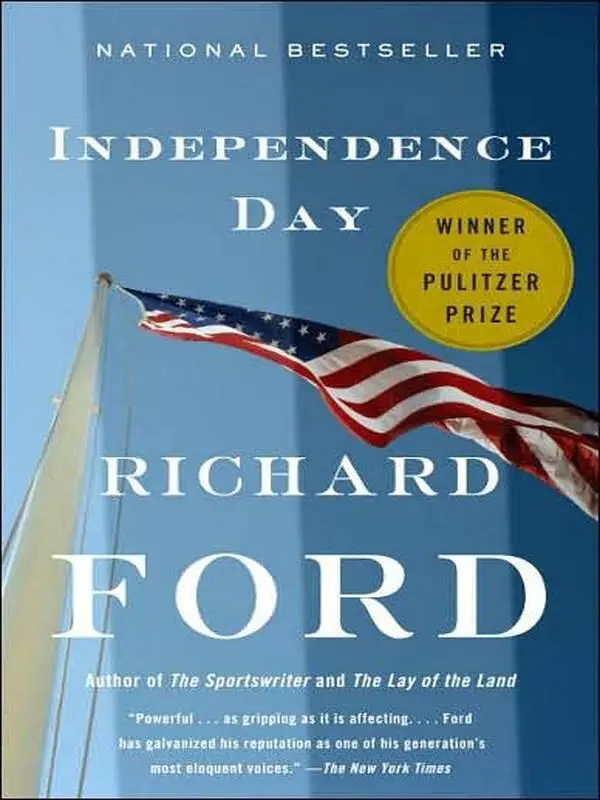
- Название:Independence Day
- Автор:
- Издательство:Vintage
- Жанр:
- Год:1996
- ISBN:нет данных
- Рейтинг книги:3 / 5. Голосов: 1
-
Избранное:Добавить в избранное
- Отзывы:
-
Ваша оценка:
Independence Day: краткое содержание, описание и аннотация
Предлагаем к чтению аннотацию, описание, краткое содержание или предисловие (зависит от того, что написал сам автор книги «Independence Day»). Если вы не нашли необходимую информацию о книге — напишите в комментариях, мы постараемся отыскать её.
, Richard Ford deepens his portrait of one of the most unforgettable characters in American fiction, and in so doing gives us an indelible portrait of America. Frank Bascombe, in the aftermath of his divorce and the ruin of his career, has entered an "Existence Period," selling real estate in Haddam, New Jersey, and mastering the high-wire act of normalcy. But over one Fourth of July weekend, Frank is called into sudden, bewildering engagement with life.
is a moving, peerlessly funny odyssey through America and through the layered consciousness of one of its most compelling literary incarnations, conducted by a novelist of astonishing empathy and perception.
Independence Day — читать онлайн бесплатно полную книгу (весь текст) целиком
Ниже представлен текст книги, разбитый по страницам. Система сохранения места последней прочитанной страницы, позволяет с удобством читать онлайн бесплатно книгу «Independence Day», без необходимости каждый раз заново искать на чём Вы остановились. Поставьте закладку, и сможете в любой момент перейти на страницу, на которой закончили чтение.
Интервал:
Закладка:
Possibly this is one more version of “disappearing into your life,” the way career telephone company bigwigs, overdutiful parents and owners of wholesale lumber companies are said to do and never know it. You simply reach a point at which everything looks the same but nothing matters much. There’s no evidence you’re dead, but you act that way.
But to dispel this wan, cavern-of-winds feeling, I try fervently now to picture the first girl I ever “went” with, willing like a high-schooler to project lurid mind-pictures and arouse myself into taking matters in hand, after which sleep’s a cinch. Except my film’s a blank; I can’t seem to remember my first sexual conduction, though experts swear it’s the one act you never forget, long after you’ve forgotten how to ride a bicycle. It’s there on your mind when you’re parked on a porch in your diaper at the old folks home, lost in a row of other dozing seniors, hoping to get a little color in your cheeks before lunch is served.
My hunch, though, is that it was a little pasty brunette named Brenda Patterson, whom a military-school classmate and I convinced to go “golfing” with us on the hot Bermuda-grass links at Keesler AFB, in Mississippi, then half-pleaded, half-teased and almost certainly browbeat into taking her pants down in a stinking little plywood men’s room beside the 9th green, this in exchange for our — me and my pal “Angle” Carlisle — grim-facedly returning the favor (we were fourteen; the rest is hazy).
Otherwise it was years later in Ann Arbor, when, nuzzling under some cedar shrubs in the Arboretum, below the New York Central trestle, I made an effort in full watery daylight to convince a girl named Mindy Levinson to let me do it just with our pants half down, our young tender flesh all over stickers and twigs. I remember she said yes, though, as uninspired as it now seems, I’m not even certain if I went through with it.
Abruptly now my mind goes electric with sentences, words, strings of unrelateds running on in semi-syntactical disarray. I sometimes can go to sleep this way, in a swoony process of returning sense to nonsense (the pressure to make sense is for me always an onerous, sometimes sleepless one). In my brain I hear: Try burning life’s congested Buckeye State biker … There is a natural order of things in the cocktail dress … I’m fluent in the hysterectomy warhead (don’t I?) … Give them the Locution, come awn back, nah, come awn, the long term’s less good for you … The devil’s in the details, or is it God …
Not this time, apparently. (What kinship these bits enjoy is a brainteaser for Dr. Stopler, not me.)
Sometimes, though not that often, I wish I were still a writer, since so much goes through anybody’s mind and right out the window, whereas, for a writer — even a shitty writer — so much less is lost. If you get divorced from your wife, for instance, and later think back to a time, say, twelve years before, when you almost broke up the first time but didn’t because you decided you loved each other too much or were too smart, or because you both had gumption and a shred of good character, then later after everything was finished, you decided you actually should’ve gotten divorced long before because you think now you missed something wonderful and irreplaceable and as a result are filled with whistling longing you can’t seem to shake— if you were a writer , even a half-baked short-story writer, you’d have someplace to put that fact buildup so you wouldn’t have to think about it all the time. You’d just write it all down, put quotes around the most gruesome and rueful lines, stick them in somebody’s mouth who doesn’t exist (or better, a thinly disguised enemy of yours), turn it into pathos and get it all off your ledger for the enjoyment of others.
Not that you ever truly lose anything, of course — as Paul is finding out with pain and difficulty — no matter how careless you are or how skilled at forgetting, or even if you’re a writer as good as Saul Bellow. Though you do have to teach yourself not to cart it all around inside until you rot or explode. (The Existence Period, let me say, is made special for this sort of adjusting.)
For example. I never worry about whether or not my parents felt rewarded because they only had me or if they might’ve wanted another child (a memory-based anxiety that could drive the right person nuts). And it’s simply because I once wrote a story about a small, loving family living on the Mississippi Gulf Coast who have one child but sort of want another one, ya-ta-ya-ta-ya-ta — ending with the mother taking a solitary boat ride on a hot windy day (very much like this one) out to Horn Island, where she walks on the sand barefoot, picks up a few old beer cans and stares back at the mainland until she realizes, due to something being said by a nun to some nearby crippled children, that wishing for things that can’t be is — you guessed it — like being on an island with strangers and picking up old beer cans, when what she needs to do is get back to the boat (which is just whistling) and return to her son and husband, who are that day on a bass-fishing trip but will soon be back, wanting supper, and who that very morning have told her how much they both love her, but which has succeeded only in making her sad and lonely as a hermit and in need of a boat ride….
This story, of course, is in a book of stories I wrote, under the title, “Waiting Offshore.” Though since I stopped writing stories eighteen years ago I’ve had to find other ways to cope with unpleasant and worrisome thoughts. (Ignoring them is one way.)
When Ann and I were first married and living in NYC, in 1969, and I was scribbling away like a demon, hanging around my agent’s office on 35th Street and showing Ann my precious pages every night, she used to stand at the window pouting because she could never find, she felt, much direct evidence of herself in my work — no cameos, no tall, slouchingly athletic golfer types of strong, resolute Dutch extraction, saying calamitously witty or incisive things to take the starch out of lesser women or men, who, naturally, would all be sluts or bores. What I used to tell her was — and God smite me if I’m lying almost twenty years later — that if I could encapsulate her in words, it would mean I’d rendered her less complex than she was and would therefore signify I was already living at a distance from her, which would eventuate in my setting her aside like a memory or a worry (which happened anyway, but not for that reason and not with complete success).
Indeed, I often tried telling her that her contribution was not to be a character but to make my little efforts at creation urgent by being so wonderful that I loved her; stories being after all just words giving varied form to larger, compelling but otherwise speechless mysteries such as love and passion. In that way, I explained, she was my muse; muses being not comely, playful feminine elves who sit on your shoulder suggesting better word choices and tittering when you get one right, but powerful life-and-death forces that threaten to suck you right out the bottom of your boat unless you can heave enough crates and boxes — words, in a writer’s case — into the breach. (I have not found a replacement for this force as yet, which may explain how I’ve been feeling lately and especially here today.)
Ann, of course, in her overly factual, Michigan-Dutch way, didn’t like the part that seemed to be my secret, and always assumed I was simply bullshitting her. If we were to have a heart-to-heart at this very minute, she would finally get around to asking me why I never wrote about her. And my answer would be that it was because I didn’t want to use her up, bind her in words, set her aside, consign her to a “place” where she would be known, but always as less than she was. (She still wouldn’t believe me.)
Читать дальшеИнтервал:
Закладка:
Похожие книги на «Independence Day»
Представляем Вашему вниманию похожие книги на «Independence Day» списком для выбора. Мы отобрали схожую по названию и смыслу литературу в надежде предоставить читателям больше вариантов отыскать новые, интересные, ещё непрочитанные произведения.
Обсуждение, отзывы о книге «Independence Day» и просто собственные мнения читателей. Оставьте ваши комментарии, напишите, что Вы думаете о произведении, его смысле или главных героях. Укажите что конкретно понравилось, а что нет, и почему Вы так считаете.