Richard Ford - Independence Day
Здесь есть возможность читать онлайн «Richard Ford - Independence Day» весь текст электронной книги совершенно бесплатно (целиком полную версию без сокращений). В некоторых случаях можно слушать аудио, скачать через торрент в формате fb2 и присутствует краткое содержание. Год выпуска: 1996, Издательство: Vintage, Жанр: Современная проза, на английском языке. Описание произведения, (предисловие) а так же отзывы посетителей доступны на портале библиотеки ЛибКат.
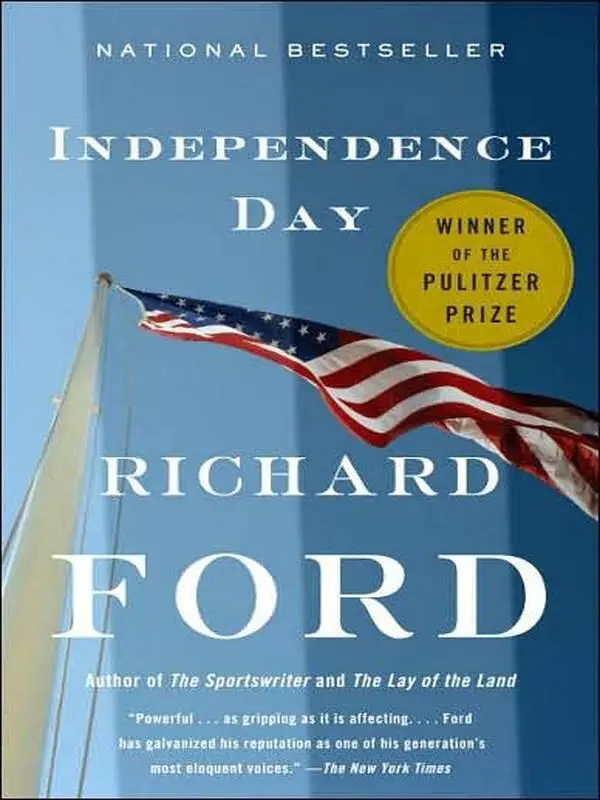
- Название:Independence Day
- Автор:
- Издательство:Vintage
- Жанр:
- Год:1996
- ISBN:нет данных
- Рейтинг книги:3 / 5. Голосов: 1
-
Избранное:Добавить в избранное
- Отзывы:
-
Ваша оценка:
Independence Day: краткое содержание, описание и аннотация
Предлагаем к чтению аннотацию, описание, краткое содержание или предисловие (зависит от того, что написал сам автор книги «Independence Day»). Если вы не нашли необходимую информацию о книге — напишите в комментариях, мы постараемся отыскать её.
, Richard Ford deepens his portrait of one of the most unforgettable characters in American fiction, and in so doing gives us an indelible portrait of America. Frank Bascombe, in the aftermath of his divorce and the ruin of his career, has entered an "Existence Period," selling real estate in Haddam, New Jersey, and mastering the high-wire act of normalcy. But over one Fourth of July weekend, Frank is called into sudden, bewildering engagement with life.
is a moving, peerlessly funny odyssey through America and through the layered consciousness of one of its most compelling literary incarnations, conducted by a novelist of astonishing empathy and perception.
Independence Day — читать онлайн бесплатно полную книгу (весь текст) целиком
Ниже представлен текст книги, разбитый по страницам. Система сохранения места последней прочитанной страницы, позволяет с удобством читать онлайн бесплатно книгу «Independence Day», без необходимости каждый раз заново искать на чём Вы остановились. Поставьте закладку, и сможете в любой момент перейти на страницу, на которой закончили чтение.
Интервал:
Закладка:
And I am then into South Mantoloking and am almost “home.”
I stop along the beach road at a store where LIQUOR is sold, buy two bottles of Round Hill Fumé Blanc ’83, eat a candy bar (my last bite was at six), then walk out onto the windy, salty sidewalk to call for messages, unwilling not to know if the Markhams have resurfaced.
Message one of five, in fact, is Joe Markham, at noon in the full dudgeon of his helpless state. “Yeah. Bascombe? Joe Markham speaking. Gimme a call. Area code 609 259–6834. That’s it.” Clunk. Words like bullets. Perhaps he can wait a bit.
Message two. A cold call. “Right. Mr. Bascombe? My name is Fred Koeppel. Maybe Mr. Blankenship mentioned my name.” (Mr. Who?) “I’m considering putting my house on the market up in Griggstown. I’m sure it’ll go pretty quick. It’s a sellers’ market, so I’m told. Anyway, I’d like to discuss it with you. Maybe let you list it if we can work a fair commission. It’ll sell itself, is my view. It’ll just be paperwork for you. My number is …” A commission, fair or unfair, is 6 %. Click.
Message three. “Joe Markham.” (Basically the same news.) “Yeah. Bascombe. Gimme a call. Area code 609 259–6834.” Clunk. “Oh yeah, it’s one or whatever on Friday.”
Message four. Phyllis Markham. “Hi, Frank. Try to get in touch with us.” Bright as a sprite. “We have some questions. Okay? Sorry to bother you.” Clunk.
Message five. A voice I don’t recognize though briefly imagine to be Larry McLeod: “Look, chump! Ah-mo-ha-tuh-fuck-you-up, unu-stan-where-ahm-cummin-frum? Cause”—more distinct now, as if somebody else was talking—“I’m like sicka yo shit. Got it, chump? Fuckah?” Clunk. We get used to these in the realty biz. The police philosophy is, if they’re calling, they’re harmless. Larry, however, wouldn’t leave such a message no matter how hot under the collar he’d gotten at my thinking I deserve to be paid money for letting him live in my house. Some part of him, I believe, is too dignified.
I’m relieved there’s no call from Ann or Paul, or worse. When Paul was hauled away to juvenile detention by the Essex P.D. and Ann had to go get him out, it was Charley O’Dell who called to say, “Look, Frank, this’ll all parse out right. Just hold steady. We’ll be in touch.” Parse out. Hold steady. WE? I haven’t wanted to hear such niceness again, but been touchy I might have to. Charley, though (obviously at Ann’s request), has since then been mum about Paul’s problems, leaving them for his real parents to hassle over and try to fix.
Charley, of course, owns his own probs: a big, dirty-blond, overweight, bad-tempered, pimply-faced daughter named Ivy (who Paul refers to as IV), a student in an experimental writing program in NYC, who’s currently living with her professor, aged sixty-six (older even than Charley), while writing a novel surgerying her parents’ breakup when she was thirteen, a book that (according to Paul, who’s had parts read to him) boasts as its first lines: “An orgasm, Lulu believed, was like God — something she’d heard was good but didn’t really believe in. Though her father had very different ideas.” In another life I might be sympathetic to Charley, but not in this one.
S ally’s rambling dark-green beach house at the end of narrow Asbury Street is, when I hike up the old concrete seawall steps alongside and attain the beach-level promenade, locked, and she surprisingly gone, though all the side-opening windows upstairs and down are thrown out to catch a breeze. I am still early.
I, for a while, have had my own set of keys, though for a moment I simply stand on the shaded porch (plastic wine sack in hand) and gaze at the quiet, underused stretch of beach, the silent, absolute Atlantic and the gray-blue sky against which more near-in sailboats and Windsurfers joust in the summer haze. Farther out, a dark freighter inches north on the horizon. It is not so far from here that in my distant, postdivorce days I set sail for many a night’s charter cruise with the Divorced Men’s Club, all of us drinking grappa and angling for weakfish off Manasquan, a solemn, hopeful, joyless crew, mostly scattered now, most remarried, two dead, a couple still in town. Back in ’83 we’d come over as a group, using the occasion of a midnight fishing excursion to put an even firmer lock on our complaints and sorrows — important training for the Existence Period, and good practice if your resolve is never to complain about life.
On the beach, beyond the sandy concrete walk, moms under beach umbrellas lie fast asleep on their heavy sides, arms flung over sleeping babies. Secretaries with a half day off to start the long weekend are lying on their bellies, shoulder to shoulder, chatting, winking and smoking cigarettes in their two-pieces. Tiny, stick-figure boys stand bare-chested at the margins of the small surf, shading their eyes as dogs trot by, tanned joggers jog and elderlies in pastel garb stroll behind them in the fractured light. Here is human hum in the barely moving air and surf-sigh, the low scrim of radio notes and water subsiding over words spoken in whispers. Something in it moves me as though to a tear (but not quite); some sensation that I have been here, or nearby, been at dire pains here time-ago and am here now again, sharing the air just as then. Only nothing signifies, nothing gives a nod. The sea closes up, and so does the land.
I am not sure what chokes me up: either the place’s familiarity or its rigid reluctance to act familiar. It is another useful theme and exercise of the Existence Period, and a patent lesson of the realty profession, to cease sanctifying places — houses, beaches, hometowns, a street corner where you once kissed a girl, a parade ground where you marched in line, a courthouse where you secured a divorce on a cloudy day in July but where there is now no sign of you, no mention in the air’s breath that you were there or that you were ever, importantly you, or that you even were . We may feel they ought to, should confer something — sanction, again — because of events that transpired there once; light a warming fire to animate us when we’re well nigh inanimate and sunk. But they don’t. Places never cooperate by revering you back when you need it. In fact, they almost always let you down, as the Markhams found out in Vermont and now New Jersey. Best just to swallow back your tear, get accustomed to the minor sentimentals and shove off to whatever’s next, not whatever was. Place means nothing.
D own the wide, cool center hall I head to the shadowy, high, tin-ceilinged kitchen that smells of garlic, fruit and refrigerator freon, where I unload my wine into the big Sub-Zero. A “Curtain Call” note is stuck on the door: “FB. Go jump in the ocean. See you at 6. Have fun. S.” No words about where she might be, or why it’s necessary to use both the “F” and the “B.” Perhaps another “F” lurks in the wings.
Sally’s house, as I make my way up toward a nap, always reminds me of my own former family pile on Hoving Road — too many big wainscoted downstairs rooms with bulky oak paneling, pocket doors and thick chair rails, too much heavy plaster and a God’s own excess of storage and closet space. Plus murky, mildewy back stairways, floors worn smooth and creaky with use, dented crown moldings, medallions, escutcheons, defunct gas wall fixtures from a bygone era, leaded glass, carved newel posts and the odd nipple button for a bell only servants (like canines) could hear — a house to raise a family in a bygone fashion or retire to if you’ve got the scratch to keep it up.
But for me, Sally’s is a place of peculiar unease on account of its capacity to create a damned unrealistic, even scary, illusion of the future — which is one more reason I couldn’t stand my own, could barely even sleep in it when I got back from France, in spite of high hopes. Suddenly I couldn’t bear its woozy, fusty, weighted clubbiness, its heavy false promise that since the appearance of things can stay the same, life’ll take care of itself too. (I knew better.) This is why I couldn’t wait to get my hands on Ann’s, with its re-habbed everything — clean sheetrock, new, sealed skylights made in Minnesota, polyurethaned floors, thermopanes, level-headed aluminum siding — nothing consecrated by or for all time, only certified as a building serviceable enough to live in for an uncertain while. Sally, though, who’s already as cut off from her past as an amnesia victim, doesn’t see things this way. She is calmer, smarter than I am, less a creature of extremes. Her house, to her, is just a nice old house she sleeps in, a comfortably convincing stage set for a life played out in the foreground, which is a quality she’s perfected and that I find admirable, since it so matches what I would have be my own.
Читать дальшеИнтервал:
Закладка:
Похожие книги на «Independence Day»
Представляем Вашему вниманию похожие книги на «Independence Day» списком для выбора. Мы отобрали схожую по названию и смыслу литературу в надежде предоставить читателям больше вариантов отыскать новые, интересные, ещё непрочитанные произведения.








Обсуждение, отзывы о книге «Independence Day» и просто собственные мнения читателей. Оставьте ваши комментарии, напишите, что Вы думаете о произведении, его смысле или главных героях. Укажите что конкретно понравилось, а что нет, и почему Вы так считаете.