Richard Ford - Independence Day
Здесь есть возможность читать онлайн «Richard Ford - Independence Day» весь текст электронной книги совершенно бесплатно (целиком полную версию без сокращений). В некоторых случаях можно слушать аудио, скачать через торрент в формате fb2 и присутствует краткое содержание. Год выпуска: 1996, Издательство: Vintage, Жанр: Современная проза, на английском языке. Описание произведения, (предисловие) а так же отзывы посетителей доступны на портале библиотеки ЛибКат.
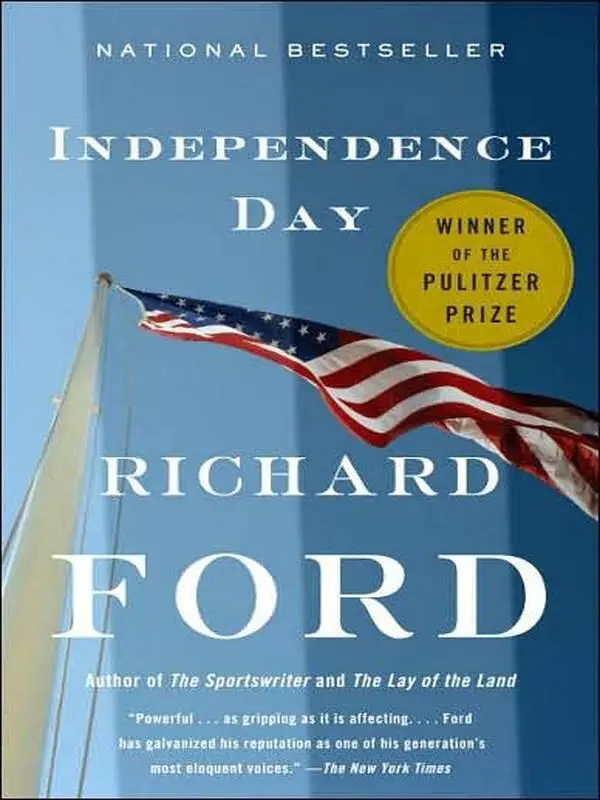
- Название:Independence Day
- Автор:
- Издательство:Vintage
- Жанр:
- Год:1996
- ISBN:нет данных
- Рейтинг книги:3 / 5. Голосов: 1
-
Избранное:Добавить в избранное
- Отзывы:
-
Ваша оценка:
Independence Day: краткое содержание, описание и аннотация
Предлагаем к чтению аннотацию, описание, краткое содержание или предисловие (зависит от того, что написал сам автор книги «Independence Day»). Если вы не нашли необходимую информацию о книге — напишите в комментариях, мы постараемся отыскать её.
, Richard Ford deepens his portrait of one of the most unforgettable characters in American fiction, and in so doing gives us an indelible portrait of America. Frank Bascombe, in the aftermath of his divorce and the ruin of his career, has entered an "Existence Period," selling real estate in Haddam, New Jersey, and mastering the high-wire act of normalcy. But over one Fourth of July weekend, Frank is called into sudden, bewildering engagement with life.
is a moving, peerlessly funny odyssey through America and through the layered consciousness of one of its most compelling literary incarnations, conducted by a novelist of astonishing empathy and perception.
Independence Day — читать онлайн бесплатно полную книгу (весь текст) целиком
Ниже представлен текст книги, разбитый по страницам. Система сохранения места последней прочитанной страницы, позволяет с удобством читать онлайн бесплатно книгу «Independence Day», без необходимости каждый раз заново искать на чём Вы остановились. Поставьте закладку, и сможете в любой момент перейти на страницу, на которой закончили чтение.
Интервал:
Закладка:
“No. But they came back about an hour ago and bought birch beers. Pennsylvania plates. CEY 146. I wrote it all down.”
“Did you let the sheriff know?”
“They said there’s still no law yet against driving through a drive-in. If there were, we wouldn’t be in business.”
“Well.” Again I don’t know what else to say. In most ways it is a statement like the one about songbird decline. Though I’m not happy to hear about suspicious lurkers in lowered Monzas. It’s news no small businessman wants to hear. “Did you ask the sheriff to check by special?” A little more oily sweat slides down my cheek.
“I’m not supposed to worry, just pay attention.” Karl picks up his rubber-bladed fan and holds it so it blows warm air at my face. “I just hope if the little cocksuckers decide to rob us, they don’t kill me. Or half kill me.”
“Just fork over all the money,” I say seriously. “We can replace that. No heroics.” I wish Karl would put the fan away.
“I want a chance to protect myself,” he says, and makes his own quick assessment outside, via the customer window. I’d never considered protecting myself until I got bonked in the head by the Asian kid with the big Pepsi bottle. Though what I thought of doing then was concealing a handgun, lying in wait at the same place the next evening and blasting all three of them — which was not a workable idea.
Behind Karl I see the gang of state stoplight installers swaggering in a scattered group across the highway and on into our parking lot, still wearing their hard hats and thick insulated gloves. A couple are animatedly dusting off their thick pants, a couple are laughing. Half are black and half white, though they’re taking their break together as if they are best of friends. “I’ll have the big weenie,” I hear one say from a distance, making the others laugh some more. “‘She said hungrily ’” someone else says. And they all laugh again (too boisterous to be sincere).
I, though, want to get out of here, get back in my car, jack the a/c to the max and lickety-split head to the Shore before I get corralled into building Polish dogs and serving up root beer and watching out for stickup artists. I occasionally hold down the fort when Karl takes off for some medical checkup or to have his choppers adjusted, but I don’t like it and feel like an asshole every time. Karl, however, loves nothing better than the idea of “the boss” donning a paper cap.
He has already started lining up cold mugs out of the freezer box. “How’s old Paul?” he says, forgetting about the Mexicans. “You oughta bring him out here and leave him with me a couple of days. I’ll shape him up.” Karl knows all about Paul’s brush with the law over filched condoms, and his view is that all fifteen-year-olds need shaping up. I’m sure Paul would pay big money to spend two free-wheeling days out here with Karl, cracking jokes and double entendres, garbaging down limitless root beers and Polish dogs and generally driving Karl nuts.
But not a chance. The vision of Karl’s little second-floor bachelor apartment over in Lambertville, with all his old furniture from his prior Tarrytown life, his pictures of his dead wife, his closets full of elderly “man’s” things, odorous old toiletries on dressertop doilies, the green rubber drain rack, all the strange smells of lonely habits — I’d be grateful if Paul lived an entire life without having to experience that firsthand. And for fear of a hundred things: that a set of “mature” snapshots might just get left on a table, or a “funny magazine” turn up among the Times and Argosys under the TV stand, possibly an odd pair of “novelty undershorts” Karl might wear only at home and decide my son would think was “a gas.” Such notions come to solitary older men, happen without plan, and then boom — piggy’s in the soup before you know it! So that with all due respect to Karl, whom I’m happy to be in the hot dog business with and who has never given a hint something might be fishy about himself, a parent has to be vigilant (though it’s unarguable I have not been as vigilant as I should’ve been).
All the state workers are standing outside now, staring at the closed sliding window as if they expected it to speak to them. There are seven or so, and they’re digging into their pockets for lunch money. “So how’s it going out there? You guys ready for a dog?” Karl shouts through the little window, as much to me as the state guys, as though we both know what we know — that this place is a friggin’ gold mine.
“I think I’ll sneak on out,” I say.
“Yeah, okay,” Karl says brightly, but now busily.
“Got a hamburg?” someone outside says to the screen.
“No burgs, just dogs,” Karl answers, and viciously slides back the screen. “Just dogs and birch beer, boys,” he says, turning cheery, leaning into the window, his big damp haunch hoisted once again into the air.
“I’ll see you, Karl,” I say. “Everick and Wardell will be here early Monday.”
“Right. You bet,” Karl shouts. He has no idea what I’ve said. He has entered his medium — dogs ‘n’ sweet suds — and his happy abstraction from life is my welcome cue to leave.
I make a southerly diversion below Haddam now, take streaming 295 up from Philadelphia, bypass Trenton and skirt the campus of De Tocqueville Academy, where Paul could attend when and if he comes to live with me and had the least interest, even though I would personally prefer the public schools. Then I head off onto the spanky new I-195 spur for more or less a bullet shot across the wide, subsident residential plain (Imlaystown, Jackson Mills, Squankum — all viewed from freeway level), toward the Shore.
I have not gone far before I pass above Pheasant Meadow, sprawled along the “old” Great Woods Road directly in the corridor of great silver high-voltage towers made in the shape of tuning forks. An older dilapidated sign just off the freeway announces: AN ATTRACTIVE RETIREMENT WAITS JUST AHEAD.
Pheasant Meadow, not old but already gone visibly to seed, is the condo community where our black agent, Clair Devane, met her grim, still unsolved and inexplicable death. And in fact, as I watch it drift by below me, its low, boxy, brown-shake buildings set in what was once a farmer’s field, now abutting a strip of pastel medical arts plazas and a half-built Chi-Chi’s, it seems so plainly the native architecture of lost promise and early death (though it’s possible I’m being too harsh, since not even so long ago, I — arch-ordinary American — was a suitor to love there myself, wooing, in its tiny paper-walled, nubbly-ceilinged rooms, its dimly lit entryways and parking desert, a fine Texas girl who liked me some but finally had more sense than I did).
Clair was a fresh young realty associate from Talladega, Alabama, who’d gone to Spelman, married a hotshot computer whiz from Morehouse working his way up through an aggressive new software company in Upper Darby, and who for a sweet moment thought her life had locked into a true course. Except before she knew it she’d ended up with no husband, two kids to raise and no work experience except once having been an RA in her dormitory and, later, having kept the books for Zeta Phi Beta imaginatively enough that at year’s end a big surplus was available to stage a carnival for underprivileged Atlanta kids and also to have a mixer with the Omegas at Georgia Tech.
On a fall Sunday in 1985, during an afternoon drive “in the country,” which included a mosey through Haddam, she and her husband, Vernell, fell into a ferocious, screaming fight right in the middle of after-church traffic on Seminary Street. Vernell had just announced in the car that he had somehow fallen into true love with a female colleague at Datanomics and was the very next morning (!) moving out to L.A. to “be with her” while she started a new company of her own, designing educational packages targeted for the DIY home-repair industry. He allowed to Clair that he might drift back in a few months, depending on how things went and on how much he missed her and the kids, though he couldn’t be sure.
Читать дальшеИнтервал:
Закладка:
Похожие книги на «Independence Day»
Представляем Вашему вниманию похожие книги на «Independence Day» списком для выбора. Мы отобрали схожую по названию и смыслу литературу в надежде предоставить читателям больше вариантов отыскать новые, интересные, ещё непрочитанные произведения.





Обсуждение, отзывы о книге «Independence Day» и просто собственные мнения читателей. Оставьте ваши комментарии, напишите, что Вы думаете о произведении, его смысле или главных героях. Укажите что конкретно понравилось, а что нет, и почему Вы так считаете.