H. Adler - The Journey
Здесь есть возможность читать онлайн «H. Adler - The Journey» весь текст электронной книги совершенно бесплатно (целиком полную версию без сокращений). В некоторых случаях можно слушать аудио, скачать через торрент в формате fb2 и присутствует краткое содержание. Год выпуска: 2008, Издательство: Random House, Жанр: Современная проза, на английском языке. Описание произведения, (предисловие) а так же отзывы посетителей доступны на портале библиотеки ЛибКат.
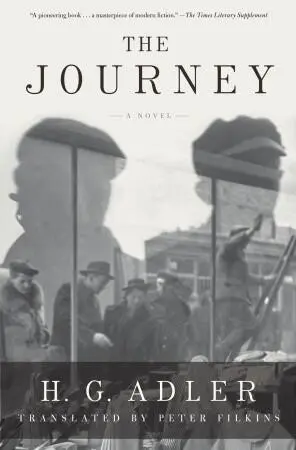
- Название:The Journey
- Автор:
- Издательство:Random House
- Жанр:
- Год:2008
- ISBN:нет данных
- Рейтинг книги:3 / 5. Голосов: 1
-
Избранное:Добавить в избранное
- Отзывы:
-
Ваша оценка:
The Journey: краткое содержание, описание и аннотация
Предлагаем к чтению аннотацию, описание, краткое содержание или предисловие (зависит от того, что написал сам автор книги «The Journey»). Если вы не нашли необходимую информацию о книге — напишите в комментариях, мы постараемся отыскать её.
The story behind the story of
is remarkable in itself: Award-winning translator Peter Filkins discovered an obscure German novel in a Harvard Square bookstore and, reading it, realized that it was a treasure unavailable to English speakers. It was the most powerful book by the late H. G. Adler, a survivor of Theresienstadt and Auschwitz, a writer whose work had been praised by authors from Elias Canetti to Heinrich Böll and yet remained unknown to international audiences.
Written in 1950 after Adler’s emigration to England,
was not released in Germany until 1962. After the war, larger publishing houses stayed away from novels about the Holocaust, feeling that the tragedy could not be fictionalized and that any metaphorical interpretation was obscene. Only a small publisher was in those days willing to take on
.
Yet Filkins found that Adler had depicted the event in a unique, truly modern, and deeply moving way. Avoiding specific mention of country or camps — even of Nazis and Jews—
is a lyrical nightmare of a family’s ordeal and one member’s survival. Led by the doctor patriarch Leopold, the Lustig family finds itself “forbidden” to live, uprooted into a surreal and incomprehensible circumstance of deprivation and death. This cataclysm destroys father, daughter, sister, and wife and leaves only Paul, the son, to live again among those who saved or sacrificed him.
reveals a world beset by an “epidemic of mental illness. . As a result of the epidemic, everyone was crazy, and once they finally recognized what was happening it was too late.”
Linked by its innovative style to the work of James Joyce and Virginia Woolf,
is as much a revelation as other recent discoveries on the subject as the works of W. G. Sebald and Irène Némirovsky’s
. It is a book proving that art can portray the unimaginable and expand people’s perceptions of it, a work anyone interested in recent history and modern literature must read.
The Journey — читать онлайн бесплатно полную книгу (весь текст) целиком
Ниже представлен текст книги, разбитый по страницам. Система сохранения места последней прочитанной страницы, позволяет с удобством читать онлайн бесплатно книгу «The Journey», без необходимости каждый раз заново искать на чём Вы остановились. Поставьте закладку, и сможете в любой момент перейти на страницу, на которой закончили чтение.
Интервал:
Закладка:
Paul goes from door to door, all of them are unlocked. Most of them are to living quarters where there are a lot of things lying about, some of which he can use. A few things are gathered together, for Paul doesn’t want any shortage of things. He’s living in the barracks now in order to avoid further hardship. Out of a bunch of ownerless goods he gathers together an impressive collection. He finds a good knapsack, a blue cap that fits him well, a beautiful silk handkerchief and long gray socks of soft wool. Once Paul’s hands are full, he hurries back to his room and dumps everything. He discovers an office where everything has been turned upside down, a nicely sharpened pencil points to a list of obsolete words, a ream of fresh writing paper awaits dictation, in a drawer there rattles a heap of bent metals, the kind that Captain Dudley collects with such zeal, while books also lie around that teach one how to slaughter, and which are signed with a dedication complete with a snakelike signature, as maps remain heaped up in thick piles, military leaders staring out awkwardly from behind framed glass amid such devastation. Paul does not touch most of it and smiles to himself. Useless, completely useless, nothing but rubbish.
In one room Paul comes upon an old man who has also collected a number of things. The stranger is frightened when Paul appears, but soon he settles down and asks Paul’s pardon for keeping on the lookout for things, since his household has been destroyed by enemy hands and is scattered all about. Paul laughs at this, he can well understand it, not everyone can have come through as easily as did Frau Wildenschwert. He asks if the man is from Unkenburg. — No, he’s not from this city, he has fled here from far off, but he has been lucky, his wife and children had also been saved. Then he asks Paul how things are with him; he must also be a refugee, for no one from Unkenburg looked the way he did. — No, Paul confirms, he is not from Unkenburg, but he has not been so lucky, yet he is still happy that he had neither a wife nor a child to lose. — It’s a huge advantage to be in this mess without anyone depending on you, for then at least you only had yourself to worry about. Paul doesn’t say anything in reply, he has vowed not to speak about his fate, at least for a good while. He recalls his crazy visit with Captain Dudley, thinks about the thoughtless conversation in front of the theater, the hesitant intrusion among strange people in those rooms. Such false steps cannot happen again. Paul says he had drifted here and there, a prisoner who survived it all, something he can’t hide after all, though the hard times are now over.
The man replies that for Paul everything is simple, he will be taken care of, soon he can go home or wherever he wants to go. Whoever attaches himself to the victors will be well taken care of, his worries are over, something that for the man had just begun. This war had lasted so long, and yet it had all come to this! If his people had only been victorious, then everything would be different. The world could have done nothing about it, for nothing could be done against a mighty victor. — Paul should have kept silent, but he doesn’t and instead expresses his own doubts. — Indeed, he should have known. Now he can be happy! Hopefully he is more decent than the many others who, with no reason at all, scream for revenge instead of being grateful they had been so well taken care of. He should be fair and tell the truth back in his country, namely that no one who was imprisoned had to worry about a hair on his head as long as he worked. — Paul promises to never speak anything but the truth. — Then the man is relieved and pleased to find that among the victors a reasonable man still exists.
Paul asks him where he is from. — Oh, a little town that nobody here knows, yet it was a lovely town. Too bad that he can’t show it to him! There he had his own house, a villa with six rooms, in which the victor would be welcome if he ever had a chance to make the trip. Yet it’s all gone, even if the house itself were still standing. It was an old town, much smaller than Unkenburg, but certainly just as beautiful, the countryside lovely around it. Paul hears the name, Leitenberg, an episcopal see, a cathedral, a town hall, old arcades, the guildhalls, and in the middle of the plaza a column dedicated to Saint Rochus. Beside the town there flowed a river, which was deep blue and sometimes looked silver.
Paul asked about the opposite shore, whether there was a town there as well, smaller than Leitenberg and not as pretty. Yes, said the man, there was a town there, quite generously it had been cleared of its native inhabitants, the higher-ups having done so for the prisoners in order to help them. You couldn’t help but appreciate what an act of kindness that was, an entire town for prisoners, such that they could live there undisturbed and provide for themselves, no one to bother them, almost as if they were free, themselves feeling completely at home. The enemy had never done anything that honorable, but today there’s isn’t even a hint of thanks for those who have suffered so much, since all there is now is slander and lies taken as truth. The enemy’s newspapers write what they want, they are unmerciful. — Paul asks if this town was called Ruhenthal, an old fortress, dirty and unhealthy? — Ruhenthal, that’s right, but dirty and unhealthy? That’s not true! Certainly pleasant and simple, yet nice and clean. That the prisoners were not happy there, that could be, for that’s the way prisoners are, they can’t stand living with one another and are often dirty. But that’s their fault. — Had he known any of the people who lived in Ruhenthal? — Yes, he had seen many of them himself; many of them had worked in Leitenberg, a group of them walked leisurely each morning and evening through town, almost as if they were free; handsome men they were, who looked well fed. One noticed how pleased they were that nothing bad had happened to them.
Paul is on the brink of setting the man straight, yet he doesn’t do so. He’d like very much to ask him whether he himself ever went to Ruhenthal, and whether he saw that funeral wagons were provided to the living, but for the dead there were none. And whether he had looked into the narrow rooms and saw the old people, crammed together and helpless, living upon what was left of their possessions? Whether he had seen the sick who were left untended and for whom there was no care available? Whether he had seen the hunger that ravaged faces, wasting away the living, erasing them? There was a lot he’d like to ask about, for Paul could see no end to it, yet he is now so far away from Ruhenthal, such that so much else had come between him and what no amount of questioning could ever touch upon. There is something today that is also omnipresent, something that years ago was only known as corrupt and unjust; now the entire country is a wasteland, and all countries have been laid waste along with it, suffering having broken out among all of those imprisoned, a plunge into the rubbish heap, a lone ark floating above like a wretched home, though it is leaky and gurgles as it sinks in the bubbling mud. Paul doesn’t ask a thing, he wants to leave the man to himself. No one can hear and feel what has happened to another, just as another’s guilt cannot be taken on. Only he who wishes to feel guilty will embrace guilt, yet it cannot be allotted. Perhaps this man from Leitenberg really is innocent and barely reaps expiation, as all men are implicated in the work and deeds of their brothers.
He is a guest in the barracks just like Paul, and so he plunders ownerless goods, which for Paul is loot that he takes from strangers, since they took everything from him, though for the man it feels like robbing his own people in Leitenberg. No, that’s unfair. There is no difference between them: everyone robs his neighbor, whether it’s his friend or foe. No one has anything, that’s why everyone takes something. The man from Leitenberg had to leave behind his belongings, just like Paul. Both of them were now refugees, so there was no distinguishing between them; one leaves because he cannot stay, the other is taken out of his house because he is not allowed to stay, but everyone has to leave. Whoever among those still alive is unwilling to beg has to take something when it lies there ready and in the open. Even the soldiers have to flee the barracks without having enough time to take the pictures of their loved ones down from the walls, the books they were reading from lying open on the table, the plates from which they ate left behind unwashed, knives, forks, spoons, and glasses left unattended, there to save the lives to whom all these goods have been sacrificed. Paul is amazed that more people don’t arrive to take advantage of such a respite. Certainly that will happen soon. Most people in the city are still paralyzed; the inhabitants of Unkenburg move through the destroyed streets and look for their family members and what can be gathered of their goods among the rubble; thus the salvation of rubbish as it becomes goods once again.
Читать дальшеИнтервал:
Закладка:
Похожие книги на «The Journey»
Представляем Вашему вниманию похожие книги на «The Journey» списком для выбора. Мы отобрали схожую по названию и смыслу литературу в надежде предоставить читателям больше вариантов отыскать новые, интересные, ещё непрочитанные произведения.









Обсуждение, отзывы о книге «The Journey» и просто собственные мнения читателей. Оставьте ваши комментарии, напишите, что Вы думаете о произведении, его смысле или главных героях. Укажите что конкретно понравилось, а что нет, и почему Вы так считаете.