H. Adler - The Journey
Здесь есть возможность читать онлайн «H. Adler - The Journey» весь текст электронной книги совершенно бесплатно (целиком полную версию без сокращений). В некоторых случаях можно слушать аудио, скачать через торрент в формате fb2 и присутствует краткое содержание. Год выпуска: 2008, Издательство: Random House, Жанр: Современная проза, на английском языке. Описание произведения, (предисловие) а так же отзывы посетителей доступны на портале библиотеки ЛибКат.
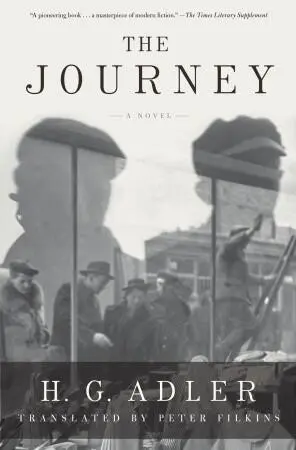
- Название:The Journey
- Автор:
- Издательство:Random House
- Жанр:
- Год:2008
- ISBN:нет данных
- Рейтинг книги:3 / 5. Голосов: 1
-
Избранное:Добавить в избранное
- Отзывы:
-
Ваша оценка:
The Journey: краткое содержание, описание и аннотация
Предлагаем к чтению аннотацию, описание, краткое содержание или предисловие (зависит от того, что написал сам автор книги «The Journey»). Если вы не нашли необходимую информацию о книге — напишите в комментариях, мы постараемся отыскать её.
The story behind the story of
is remarkable in itself: Award-winning translator Peter Filkins discovered an obscure German novel in a Harvard Square bookstore and, reading it, realized that it was a treasure unavailable to English speakers. It was the most powerful book by the late H. G. Adler, a survivor of Theresienstadt and Auschwitz, a writer whose work had been praised by authors from Elias Canetti to Heinrich Böll and yet remained unknown to international audiences.
Written in 1950 after Adler’s emigration to England,
was not released in Germany until 1962. After the war, larger publishing houses stayed away from novels about the Holocaust, feeling that the tragedy could not be fictionalized and that any metaphorical interpretation was obscene. Only a small publisher was in those days willing to take on
.
Yet Filkins found that Adler had depicted the event in a unique, truly modern, and deeply moving way. Avoiding specific mention of country or camps — even of Nazis and Jews—
is a lyrical nightmare of a family’s ordeal and one member’s survival. Led by the doctor patriarch Leopold, the Lustig family finds itself “forbidden” to live, uprooted into a surreal and incomprehensible circumstance of deprivation and death. This cataclysm destroys father, daughter, sister, and wife and leaves only Paul, the son, to live again among those who saved or sacrificed him.
reveals a world beset by an “epidemic of mental illness. . As a result of the epidemic, everyone was crazy, and once they finally recognized what was happening it was too late.”
Linked by its innovative style to the work of James Joyce and Virginia Woolf,
is as much a revelation as other recent discoveries on the subject as the works of W. G. Sebald and Irène Némirovsky’s
. It is a book proving that art can portray the unimaginable and expand people’s perceptions of it, a work anyone interested in recent history and modern literature must read.
The Journey — читать онлайн бесплатно полную книгу (весь текст) целиком
Ниже представлен текст книги, разбитый по страницам. Система сохранения места последней прочитанной страницы, позволяет с удобством читать онлайн бесплатно книгу «The Journey», без необходимости каждый раз заново искать на чём Вы остановились. Поставьте закладку, и сможете в любой момент перейти на страницу, на которой закончили чтение.
Интервал:
Закладка:
Paul is again on the road. Soon there should be the bridge, the ribbon of water, silver and deep blue, then the gate leading onto Bridge Street. It’s all so confusing. There is no corporal to be found, the soldiers have all left. They were taken away so that they could not march anymore. The plague memorial has fallen. How lucky that Paul was no longer nearby. From far off he had heard the muffled thud. The ark has been blown to bits, as well as the entire crematorium. Death sentences can no longer be carried out. The innkeeper’s powder keg has been drunk dry. The spittoon split in two, and Mutsch the cat has eaten all the provisions. Rubble from the plague memorial is in the cellar. It’s the ark’s bunker of ashes. Here everything is preserved by the lice that have been spared in the last bombing. Nurse Dora wants to take care of them, but Frau Lischka will not allow anyone down the steps because the walls could collapse. Hospital Director Zischke waves off all appeals with his hands, no, he has no beds for vermin, though he orders the schoolchildren to collect the bones. The children are excited and obey without any fuss, because it’s all for a better future, and so everyone is happy to pitch in. However, one can’t ask much of old Johann Pietsch. He has retired from service and turned in his broom at the high school.
Paul walks on and no longer feels tired. Bedecked vehicles travel by swiftly, the men on them waving and throwing little gifts to everyone, which tumble in the dust. Paul could bend down for these treasures, yet he worries about his knees being weak, and he wants to keep his balance. It would be too easy to lose his way and have to start all over again from the beginning. He doesn’t want that. Whoever can bend over is welcome to. Many bend down and fall onto the road and begin to gather what they can, taking as much as they can into their mouths and hands, almost dizzy with excitement. They ask Paul why he doesn’t take anything. It doesn’t belong to him. It’s been tossed onto the road, something from which one doesn’t take nourishment. The road should lead to a destination, not provide treats. The innkeeper will lie in poverty in his garden if his wares lie upon the road. He should be given something, he’s the one to whom it’s due. Your goods are only secure if inside a building. Yet many notice how miserable this wanderer is, the one who will not bend down and is in such a hurry because he doesn’t know how to get to his destination and yet wants to get there, a hopeful wanderer, who it was easy to feel sorry for. Meanwhile they hand little bits to him from the ground, which he takes and thanks them for, sticking them in his mouth and pockets, a rich man to whom everything comes effortlessly.
His feet burn, for his shoes are terrible, yet the lazy blood begins to flow. Paul is very healthy and is happy to be on his way. He should take someone’s good boots while yelling at him, for that would be a bit of revenge. In swaying lines the prisoners of war move along the road, themselves forlorn and covered in dust, though wearing good leather boots. You only need to go up to one of them and not even ask any questions but rather just point with the hands imperiously and without feeling. The guy then just bends over and loosens the straps, hands over the shoes, and still has to be grateful that he’s only been stripped of his boots and is at least allowed to lie there. Paul stands before a pale young boy and looks at him imploringly.
“I can’t walk anymore in these shoes and I still have a long way to walk. You’ve had the best shoes available for the longest time, your feet don’t hurt at all. Now you’re almost there and can give me your boots, but I have far to go, very far to go. Come on, why don’t you hand them over? I could just take them like the others do, but I don’t want to just steal them.”
“I won’t hand over a thing that’s on my body. It’s all that I have left. You can get everything you need. Just go to the next armory!”
“Who are you? Where are you from?”
“My name is Robert Budil. I don’t know what’s happened to my parents, or my brother, who is likely dead. The entire regiment was wiped out. My brother was among them. Let me have my shoes!”
“Budil? Are you from Leitenberg?”
“Why? What do you know? Are you from Leitenberg as well?”
“No, I’m not from anywhere. But I know someone named Budil in Leitenberg.”
“Where does he live?”
“On Bridge Street. He had a very strange first name: Ambrose. I always remembered it whenever I walked by his house in my miserable shoes.”
“Ambrose Budil, that’s my father! Is he alive? Is my mother alive? When were you there last?”
“I was there a year ago, actually two years ago. It’s been a long while. I don’t know what happened to your parents. Maybe they’ve since left there. You must know better than I do, Robert Budil. Anyone with an apartment has something, indeed, as well as a lot more, and one can write letters then too.”
“For almost four months I’ve had no mail. Tell me what you know! Don’t torture me! I’ll give you my shoes if you’ll tell me! What’s happened to my parents?”
“Keep your shoes! I have no idea what’s happened.”
“I beg you! How do you know my father’s name if you don’t know him?”
“That’s easy to explain. I was often led by his house. I was imprisoned, yet I had good eyes. That’s how I got to know Leitenberg, or at least as much as it would let a stranger see. Signs large and small. On a house on Bridge Street was a small brass plate.”
Robert Budil is no longer listening; the train of war prisoners had only stopped for a short while to rest. Now all have to move on, the boys moving along weak-kneed, left and … right and … Budil walks with his good shoes, yet Paul also walks on, but in the other direction, persistently onward with his lame feet. He then looks directly at the town before him, and it no longer seems to be destroyed. The tower of the Unkenburg Cathedral looms above, high and proud. It even leans, or at least appears to. It’s been shot up a bit. The monstrances have been damaged and cannot support it. The danger of falling debris forbids entry into the cathedral. There’s no need for a guard before the entrance, for the doorways have shrunk, everywhere there is rubble, nobody can get in.
The bishop catapults over the rooftops, unable to bring the Mass to a close. In the middle of the creed he stops. The airplanes appear out of nowhere, only at the last minute are the sirens sounded, the bishop falling in his robe upon the cathedral square. Bombs rain down right and left, the bishop recites the Dies Irae and bellows it loudly, though there is nobody near him who wants to hear it, the church now empty and shattered, its followers no longer children of God. The bishop continues on in haste, not much time is left him as he dances upon the air and laughs because his work no longer means anything. It’s no longer tied to anything, and so he cannot do anything, rubbish is all there is, the bishop no longer holds a post. He looks around at bodies that cannot take any sacraments because they are not alive and have no grave awaiting them. They have been damned and judged by vengeance, they have been violated to the extreme, they are the devil himself. Then the bishop looks at the other bodies; they are mute and do not want his blessings. They have bowed to him so deeply that they almost fall from the ark into the mud, but the mute are tough and embittered, and because they are dead, they cling to the bloody barbed wire of the creaking ark with gnarled fingers. The bishop flies, the doves fly. They cannot give any more blessings. The useless olive branch of peace falls into the flames, the fire blazes horribly. The dove’s beak is broken, the bishop’s hand has buckled.
Читать дальшеИнтервал:
Закладка:
Похожие книги на «The Journey»
Представляем Вашему вниманию похожие книги на «The Journey» списком для выбора. Мы отобрали схожую по названию и смыслу литературу в надежде предоставить читателям больше вариантов отыскать новые, интересные, ещё непрочитанные произведения.









Обсуждение, отзывы о книге «The Journey» и просто собственные мнения читателей. Оставьте ваши комментарии, напишите, что Вы думаете о произведении, его смысле или главных героях. Укажите что конкретно понравилось, а что нет, и почему Вы так считаете.