H. Adler - The Journey
Здесь есть возможность читать онлайн «H. Adler - The Journey» весь текст электронной книги совершенно бесплатно (целиком полную версию без сокращений). В некоторых случаях можно слушать аудио, скачать через торрент в формате fb2 и присутствует краткое содержание. Год выпуска: 2008, Издательство: Random House, Жанр: Современная проза, на английском языке. Описание произведения, (предисловие) а так же отзывы посетителей доступны на портале библиотеки ЛибКат.
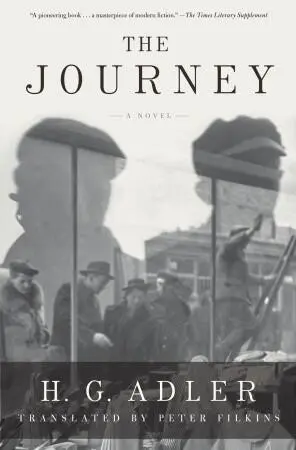
- Название:The Journey
- Автор:
- Издательство:Random House
- Жанр:
- Год:2008
- ISBN:нет данных
- Рейтинг книги:3 / 5. Голосов: 1
-
Избранное:Добавить в избранное
- Отзывы:
-
Ваша оценка:
The Journey: краткое содержание, описание и аннотация
Предлагаем к чтению аннотацию, описание, краткое содержание или предисловие (зависит от того, что написал сам автор книги «The Journey»). Если вы не нашли необходимую информацию о книге — напишите в комментариях, мы постараемся отыскать её.
The story behind the story of
is remarkable in itself: Award-winning translator Peter Filkins discovered an obscure German novel in a Harvard Square bookstore and, reading it, realized that it was a treasure unavailable to English speakers. It was the most powerful book by the late H. G. Adler, a survivor of Theresienstadt and Auschwitz, a writer whose work had been praised by authors from Elias Canetti to Heinrich Böll and yet remained unknown to international audiences.
Written in 1950 after Adler’s emigration to England,
was not released in Germany until 1962. After the war, larger publishing houses stayed away from novels about the Holocaust, feeling that the tragedy could not be fictionalized and that any metaphorical interpretation was obscene. Only a small publisher was in those days willing to take on
.
Yet Filkins found that Adler had depicted the event in a unique, truly modern, and deeply moving way. Avoiding specific mention of country or camps — even of Nazis and Jews—
is a lyrical nightmare of a family’s ordeal and one member’s survival. Led by the doctor patriarch Leopold, the Lustig family finds itself “forbidden” to live, uprooted into a surreal and incomprehensible circumstance of deprivation and death. This cataclysm destroys father, daughter, sister, and wife and leaves only Paul, the son, to live again among those who saved or sacrificed him.
reveals a world beset by an “epidemic of mental illness. . As a result of the epidemic, everyone was crazy, and once they finally recognized what was happening it was too late.”
Linked by its innovative style to the work of James Joyce and Virginia Woolf,
is as much a revelation as other recent discoveries on the subject as the works of W. G. Sebald and Irène Némirovsky’s
. It is a book proving that art can portray the unimaginable and expand people’s perceptions of it, a work anyone interested in recent history and modern literature must read.
The Journey — читать онлайн бесплатно полную книгу (весь текст) целиком
Ниже представлен текст книги, разбитый по страницам. Система сохранения места последней прочитанной страницы, позволяет с удобством читать онлайн бесплатно книгу «The Journey», без необходимости каждый раз заново искать на чём Вы остановились. Поставьте закладку, и сможете в любой момент перейти на страницу, на которой закончили чтение.
Интервал:
Закладка:
The high school principal was so busy running the school that it took a series of long explanations before he understood what the reporter wanted. However, when the principal understood just what he wanted, his interest was sparked by the visit. “How wonderful that you thought of us when it comes to the pride and honor of this town. I can only tell you that our high school is nearly three hundred years old. It’s no surprise that so many young men have graduated from here. You also went here, Herr Schwind. We have inhabited the present buildings some fifty-seven years, a long, lovely time. I’ve been the principal here for some eighteen years and will most likely retire after next year, if the war has been victoriously concluded by then.”
“But the town, dear principal, the town!”
“Yes, of course it’s much older, no doubt of that. But I don’t know much about it. I wasn’t born in Leitenberg, but what I’m referring to are the noble ideals that have turned our young boys into able men, a venerable tradition that can still be found within every single member of the faculty that stands behind me and with whom I share the same unified spirit.”
“Permit me, please, to press a bit further …”
“The town, my young, impatient friend, certainly existed long before the founding of the high school, and I can imagine how poor the education was here before a Latin school was erected.”
Schwind, however, was not allowed to see the bishop. Only a canon received him and explained with professional courtesy that the present leader of the diocese was the seventeenth Bishop of Leitenberg.
Schwind winced at the poor results of what he found out from asking educated professionals, but when he asked the common folk, he encountered equally meager results. The reporter met a portly man of roughly fifty on Bridge Street, who, yawning, had just emerged from his house.
“Forgive me, but I’m from The Leitenberg Daily .”
“Fine, fine, but who cares?”
“I wanted to ask you some questions about our town.”
“I don’t know anything about it.”
“But wait until you hear the questions first! You don’t even know what I want to ask you. What is your name? Your occupation?”
“Are you from the police?”
“No, I’m from The Leitenberg Daily .”
“Then I don’t have to tell you anything. I only have to answer to the police.”
“But I don’t want to interrogate you. I’m a reporter. It will be in the paper! People will read about you! Just imagine, the special edition! It’s supposed to be thirty-two pages. It will be a huge edition. If you could just tell me your address — I assume you live in this beautiful house — then you’ll get three free copies. So what’s your name, please?”
“Ambrose Budil.”
“How old?”
“I was fifty-two in June.”
“Occupation?”
“Accountant for the electric company.”
“Married?”
“Yes.”
“Children?”
“Two sons in the army, somewhere on the eastern front.”
“Very good, Herr Budil, very good! Everything is going to work out fine! The future belongs to us! What do you have to say about the eight-hundredth anniversary?”
“Pardon?”
“The coming celebration. The town is celebrating its eight-hundredth birthday.”
“My gosh, the town is that old? I never would have thought so. The time, it goes so quickly.”
“It’s been written about in The Leitenberg Daily . Aren’t you one of our readers, Herr Budil?”
“Yes, I read it all right, but I didn’t see anything about a birthday. So The Daily covered it, you say.… How interesting! Everything can be found in the paper. In my occupation I hardly see anything. We’re also talking about a long time. I know for sure that my grandfather, whose name was Vincent Budil, no, not Vincent … that was my great-uncle’s name. My grandfather was called … wait a minute, I’ve almost got it, he was called … he was called …”
“That’s perhaps not so important, Herr Budil. Anyway, your grandfather …”
“I’ve got it now, he was indeed called Vincent; my great-uncle was Anton, I’m always mixing them up. Anyway, what was I saying …?”
About your grandfather …”
“I know now. My grandfather was born in Leitenberg in 1824. But his father, or so he always said, came from Ruhenthal, the town that they’ve now closed off. Over there. You know what I mean. He would have been amazed to see that today you’re not allowed to enter it! The times sure have changed. Moreover, what an outrageous scandal, for even though there’s a shortage of apartments everywhere, they’ve turned over an entire town to the civil service and the inmates who have been brought there! Are there no penitentiaries? Or can’t those crooks build barracks for themselves? You need to appreciate the fact, my good sir, that I have to look on every day as these loafers are led by a military honor guard along Bridge Street right past my nose.”
“That’s another matter altogether, Herr Budil. What I want to know is what do you think about the past, present, and future of our town?”
“Me? I don’t have anything to say to that. I have nothing to do with it, I have no say whatsoever. Leitenberg is certainly old and beautiful, but there’s a war on; who knows what tomorrow will bring? I’ve no idea, my good sir, none at all! You’ll have to ask other folks. We all just have to grit our teeth and hope that everything comes out all right. It has to!”
Then Balthazar Schwind spoke to a street sweeper, who, after having just taken a bit of a break, pulled a red handkerchief out of his pocket and blew into it hard. He found it easy to get Johann to talk.
“My goodness, eight hundred years already! That’s almost too many to count! But things have always been good here. We’ll soon see how it all comes out. Then our great-grandchildren can say how it is after yet another eight hundred years.”
With such similar responses the reporter could do very little, it soon becoming obvious that there was little else that could be used as well. Therefore there was nothing left to write about except the flight of Saint Rochus atop the column, who had guarded the town since the plague of 1680. Rochus had also endured the cholera epidemic of 1866, but the people of Leitenberg had not erected any more columns dedicated to saints. Amid the old buildings, Rochus towers upward out of the ruins in lonely fashion. The reporter sits above and cannot take any photographs, and is saddened when he begins to worry whether or not he can develop his pictures. There is still a darkroom, but hardly any more developing fluid, and there most likely won’t be any more anytime soon. Undeveloped rolls of film are like unborn children. All too briefly does light touch them, then they must rest in their dark containers until they are brought to life under the shimmering red, though it still takes a bit longer as the new pictures bathe in the flat pans that are gently rocked back and forth. Then they at last see the light of day. Only hopes and silent wishes accompany them in the urge that they fulfill what today is nothing more than a dark promise.
“Someday it will happen!” Balthazar Schwind said aloud as he grabbed onto the stony nose of the saint and looked down into the rubble and the ruins that proclaimed the end of Leitenberg, something that was certain and unavoidable once there was not a single inhabitant who knew anything about the history of his town.
Captain Küpenreiter, an officer from the Scharnhorst barracks and a foreigner from far-off Unkenburg, could never once say for certain what town he was in, it always being just a place where he was commanded to do his duty. From the drawer he pulled out a strategic map and picked up a compass with which he measured distances on the map. After a heavy sigh, Captain Küpenreiter said with relief:
Читать дальшеИнтервал:
Закладка:
Похожие книги на «The Journey»
Представляем Вашему вниманию похожие книги на «The Journey» списком для выбора. Мы отобрали схожую по названию и смыслу литературу в надежде предоставить читателям больше вариантов отыскать новые, интересные, ещё непрочитанные произведения.










Обсуждение, отзывы о книге «The Journey» и просто собственные мнения читателей. Оставьте ваши комментарии, напишите, что Вы думаете о произведении, его смысле или главных героях. Укажите что конкретно понравилось, а что нет, и почему Вы так считаете.