H. Adler - The Journey
Здесь есть возможность читать онлайн «H. Adler - The Journey» весь текст электронной книги совершенно бесплатно (целиком полную версию без сокращений). В некоторых случаях можно слушать аудио, скачать через торрент в формате fb2 и присутствует краткое содержание. Год выпуска: 2008, Издательство: Random House, Жанр: Современная проза, на английском языке. Описание произведения, (предисловие) а так же отзывы посетителей доступны на портале библиотеки ЛибКат.
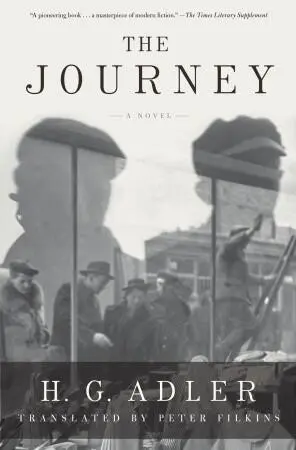
- Название:The Journey
- Автор:
- Издательство:Random House
- Жанр:
- Год:2008
- ISBN:нет данных
- Рейтинг книги:3 / 5. Голосов: 1
-
Избранное:Добавить в избранное
- Отзывы:
-
Ваша оценка:
The Journey: краткое содержание, описание и аннотация
Предлагаем к чтению аннотацию, описание, краткое содержание или предисловие (зависит от того, что написал сам автор книги «The Journey»). Если вы не нашли необходимую информацию о книге — напишите в комментариях, мы постараемся отыскать её.
The story behind the story of
is remarkable in itself: Award-winning translator Peter Filkins discovered an obscure German novel in a Harvard Square bookstore and, reading it, realized that it was a treasure unavailable to English speakers. It was the most powerful book by the late H. G. Adler, a survivor of Theresienstadt and Auschwitz, a writer whose work had been praised by authors from Elias Canetti to Heinrich Böll and yet remained unknown to international audiences.
Written in 1950 after Adler’s emigration to England,
was not released in Germany until 1962. After the war, larger publishing houses stayed away from novels about the Holocaust, feeling that the tragedy could not be fictionalized and that any metaphorical interpretation was obscene. Only a small publisher was in those days willing to take on
.
Yet Filkins found that Adler had depicted the event in a unique, truly modern, and deeply moving way. Avoiding specific mention of country or camps — even of Nazis and Jews—
is a lyrical nightmare of a family’s ordeal and one member’s survival. Led by the doctor patriarch Leopold, the Lustig family finds itself “forbidden” to live, uprooted into a surreal and incomprehensible circumstance of deprivation and death. This cataclysm destroys father, daughter, sister, and wife and leaves only Paul, the son, to live again among those who saved or sacrificed him.
reveals a world beset by an “epidemic of mental illness. . As a result of the epidemic, everyone was crazy, and once they finally recognized what was happening it was too late.”
Linked by its innovative style to the work of James Joyce and Virginia Woolf,
is as much a revelation as other recent discoveries on the subject as the works of W. G. Sebald and Irène Némirovsky’s
. It is a book proving that art can portray the unimaginable and expand people’s perceptions of it, a work anyone interested in recent history and modern literature must read.
The Journey — читать онлайн бесплатно полную книгу (весь текст) целиком
Ниже представлен текст книги, разбитый по страницам. Система сохранения места последней прочитанной страницы, позволяет с удобством читать онлайн бесплатно книгу «The Journey», без необходимости каждый раз заново искать на чём Вы остановились. Поставьте закладку, и сможете в любой момент перейти на страницу, на которой закончили чтение.
Интервал:
Закладка:
Dear Dr. Lustig,
In compliance with the order handed down by the Minister of Health on March 23 of this year in regards to the protective measures concerning the classification of the entire health service as set down in the applicable statutes found in Section 2, Paragraph 1, I am writing to inform you that your right to practice medicine, whether for financial compensation or not, will be officially revoked as of July 1 of the current year.
Failure to comply with the ban outlined in this letter will be subject to the penalties set down in Section 4 of the ordinance quoted above, which we are giving you full notice of here. The right to treat immediate members of your family (as mentioned in Section 6 of the aforementioned ordinance) will remain exempt from the overall ban on further practice.
Because the jurisdiction of the aforementioned ordinance (Section 5, Paragraphs 1–3) clearly applies to you, no recourse to this decision will be possible.
With sincere greetings,
Dr. Kmoch
President of the Medical Board
Leopold had only to see this to understand that the sickness had become much more powerful than he had ever imagined. There was no recourse against this condition; the sickness had spread so wide, leaving behind weakened tissues, metastasis, and a radical condition whose prognosis was no longer even within reach. Caroline had to ask Frau Lischka to have Herr Lischka take down the sign next to the door of the building, for there was no more Dr. Lustig the moment his license had been revoked, the patients heading off down the street without having been tended to because the medical board had ordered it so. Leopold, however, packed up the instruments that would soon be confiscated, though of course he was given a receipt for them, all of it taken care of officially, followed out to the letter, indeed everything carried out the door in proper fashion, perhaps carried off to the medical board, perhaps to Dr. Kmoch’s apartment, the examination couch the only thing left behind, since it was probably too old and wasn’t worth anything, and oh yes, of course, they also didn’t take the washstand, it remained behind, though it was no longer filled with water. For who was there left who could do that since Emmy had been let go, something that the ministry itself had ordered. Meanwhile, eighteen months later Leopold began his journey to Ruhenthal, the city of prisoners.
It was then that Leopold said to Zerlina, “You know, child, I will be needed there. Prisoners also get sick and have illnesses like normal people. They’ll be happy to have an experienced doctor and a former surgeon major among them.”
But when Leopold arrived, they laughed at the old man as he repeatedly and stubbornly insisted, “My dear sirs, I am a doctor! I have practiced medicine for forty years. I’m healthy and can be of help to you.”
“We already have plenty of young doctors here who are of no use to us. We could plaster the walls with them. There’s already too many!”
“But I’m experienced! I’m a good doctor! Perhaps you might even find some former patients of mine who will attest to how I have helped them in the past.”
“Ridiculous! You’re no doctor to us, you’re just an old man who has seen his better days and is used up and done for! Go ahead, rest on your laurels!”
“Even when they’re old many realize their greatest accomplishments!”
“That doesn’t matter to us. First of all, we’ve already told you that we don’t need you, and second, no one here who is older than sixty is allowed to practice medicine. Do you understand?”
Leopold, however, understood nothing, though he heard every word. It hurt him deeply that no one wanted anything to do with him. Clearly the people here were also afflicted with this unknown sickness that forbid a doctor to be a doctor. When there’s a sickness that prevents doctors from practicing, then medicine is useless, it having collapsed and become nothing more than a fable from the good old days when there were still doctors who studied, graduated, and did their residencies, after which they set up their own practices, placed a sign next to the front door, and then worked for as many years as it pleased them or their health allowed. No one could revoke their right to practice as long as they took their work seriously and practiced it in a knowledgeable manner. Only criminals and frauds were expelled from this noble profession amid scandal and shame, but this seldom occurred, because fortunately there were only a few certain individuals who grossly insulted the honor of the profession. Standing in front of the Ruhenthal officials, Leopold pointed silently to the stethoscope he had saved and managed to carry with him through all his travels, pointing to it proudly and boldly, as if challenging the officials, though they looked on keenly and laughed loudly as one of them grabbed hold of the stethoscope.
“You don’t need that here, Doctor. Still, our doctors will be glad to have it, for we’re running short of stethoscopes.”
Leopold stood there looking pale, a tear falling from his eye. When the official saw that, he responded in mock compassion.
“Hey now, take it easy! It’s easy to get sick here, because people much younger than you get sick, and then a young, talented doctor will show up to take care of you. He’ll hold your stethoscope in his hands and will be able to tell right away what sounds your heart and lungs are making. Here it’s important that one gets a good diagnosis, for there’s hardly any medicine, and we have to save what we have. But at least we know what people need and what’s causing them to die.”
“I can listen without a stethoscope, young man, but you have to have medicines available. You have to! Otherwise nothing can be done!”
“We don’t have any, or at least hardly any, Doctor, and yet we manage.”
“You mean to say you heal people here only through diet, bed rest, and physical therapy?”
“Diet and bed rest? What are you thinking of? And you want to be a doctor! Here it’s death that does the healing when nature isn’t able to help on its own.”
Still laughing, the officials left, Leopold surrounded by laughter all around him, Caroline laughing as well, just like everyone. Only Leopold remained serious and rigid and stared hard through the murky room.
“Do none of you have a clue, or are you all mad? Diet is important, but that’s not enough on its own!”
Leopold should not have had to work, for normally someone his age was freed of such responsibility, yet in return the old ones were expected to give part of their rations to the other prisoners. This was what was simply expected of them, though there was no interest in hearing what they had to say about it, they were expected to just accept these measures. The authorities in Ruhenthal had given the order: more for the young, because they will live, and less for the old, because they will die! This was the normal run of things in Ruhenthal. Human wisdom confronted natural law and sped up its course. Die, Doctor, die, you are not needed! There’s hardly any bread, and so one doles out a few hard crumbs, which don’t harm the digestion. Also the long overdue return of justice is helped by such clever distractions, for the day-to-day boredom of life simply won’t allow itself to continue. The state has a stranglehold on the people and like a leg they fall asleep. Die, Doctor, die, and lie down on the rotten straw! Everywhere the human race has secured a victory with hardly a struggle. A new age of inventions is here, die, die, the state has tightened its bandage around you! The destruction and care of the Earth has been handed over to mankind, the compress in place, the state thrice blessed, dear Leopold! So die, for the stethoscope is broken and your hearing has failed!
Читать дальшеИнтервал:
Закладка:
Похожие книги на «The Journey»
Представляем Вашему вниманию похожие книги на «The Journey» списком для выбора. Мы отобрали схожую по названию и смыслу литературу в надежде предоставить читателям больше вариантов отыскать новые, интересные, ещё непрочитанные произведения.





Обсуждение, отзывы о книге «The Journey» и просто собственные мнения читателей. Оставьте ваши комментарии, напишите, что Вы думаете о произведении, его смысле или главных героях. Укажите что конкретно понравилось, а что нет, и почему Вы так считаете.