H. Adler - The Journey
Здесь есть возможность читать онлайн «H. Adler - The Journey» весь текст электронной книги совершенно бесплатно (целиком полную версию без сокращений). В некоторых случаях можно слушать аудио, скачать через торрент в формате fb2 и присутствует краткое содержание. Год выпуска: 2008, Издательство: Random House, Жанр: Современная проза, на английском языке. Описание произведения, (предисловие) а так же отзывы посетителей доступны на портале библиотеки ЛибКат.
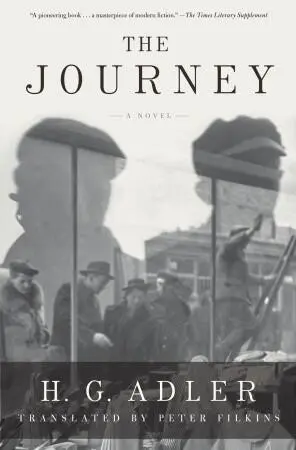
- Название:The Journey
- Автор:
- Издательство:Random House
- Жанр:
- Год:2008
- ISBN:нет данных
- Рейтинг книги:3 / 5. Голосов: 1
-
Избранное:Добавить в избранное
- Отзывы:
-
Ваша оценка:
The Journey: краткое содержание, описание и аннотация
Предлагаем к чтению аннотацию, описание, краткое содержание или предисловие (зависит от того, что написал сам автор книги «The Journey»). Если вы не нашли необходимую информацию о книге — напишите в комментариях, мы постараемся отыскать её.
The story behind the story of
is remarkable in itself: Award-winning translator Peter Filkins discovered an obscure German novel in a Harvard Square bookstore and, reading it, realized that it was a treasure unavailable to English speakers. It was the most powerful book by the late H. G. Adler, a survivor of Theresienstadt and Auschwitz, a writer whose work had been praised by authors from Elias Canetti to Heinrich Böll and yet remained unknown to international audiences.
Written in 1950 after Adler’s emigration to England,
was not released in Germany until 1962. After the war, larger publishing houses stayed away from novels about the Holocaust, feeling that the tragedy could not be fictionalized and that any metaphorical interpretation was obscene. Only a small publisher was in those days willing to take on
.
Yet Filkins found that Adler had depicted the event in a unique, truly modern, and deeply moving way. Avoiding specific mention of country or camps — even of Nazis and Jews—
is a lyrical nightmare of a family’s ordeal and one member’s survival. Led by the doctor patriarch Leopold, the Lustig family finds itself “forbidden” to live, uprooted into a surreal and incomprehensible circumstance of deprivation and death. This cataclysm destroys father, daughter, sister, and wife and leaves only Paul, the son, to live again among those who saved or sacrificed him.
reveals a world beset by an “epidemic of mental illness. . As a result of the epidemic, everyone was crazy, and once they finally recognized what was happening it was too late.”
Linked by its innovative style to the work of James Joyce and Virginia Woolf,
is as much a revelation as other recent discoveries on the subject as the works of W. G. Sebald and Irène Némirovsky’s
. It is a book proving that art can portray the unimaginable and expand people’s perceptions of it, a work anyone interested in recent history and modern literature must read.
The Journey — читать онлайн бесплатно полную книгу (весь текст) целиком
Ниже представлен текст книги, разбитый по страницам. Система сохранения места последней прочитанной страницы, позволяет с удобством читать онлайн бесплатно книгу «The Journey», без необходимости каждый раз заново искать на чём Вы остановились. Поставьте закладку, и сможете в любой момент перейти на страницу, на которой закончили чтение.
Интервал:
Закладка:
As soon as Caroline hears these familiar sounds in the foyer, she comes out of a room or the kitchen to ask, “When can we expect you, Leopold? When should I have lunch ready?”
“Caroline, how many times have I told you, a doctor never knows when he’ll be back. The patients need me. Between one and three. I’ll be here as soon as I can. You can keep the food warm. Take care!”
With dignity the doctor leaves the apartment, hurrying on his way to his many patients, all of whom are waiting for the good doctor. He examines them thoroughly and considers each condition seriously, giving the proper diagnosis and writing prescriptions so that everything is well again soon. Leopold struggles against illness, and being a doctor is for him a sacred occupation, one that he chose because he wanted to help people, which is why he must take care never to underestimate the severity of an illness. That’s why it’s also necessary that the patients do exactly what the doctor tells them. He cannot stand objections, it being nothing but a waste of time, though who would dare try it? One glance and the patients shut up or nod their heads in understanding. If they don’t want to do what they’re told, Leopold scolds them by reminding them of all the possible complications and dangers that can threaten one’s life. If they don’t want to listen then he simply says, That’s it, you had better find a different doctor, or, Sorry, but I have to be at the hospital. But it rarely ever comes to this, because no one ever wants to leave the good Dr. Lustig.
Then usually everything goes well and the convalescents or the healed come to the office to thank Leopold and praise his care of them. At the end of it all they ask what the bill is, but the doctor is quite generous and the patients soon breathe a sigh of relief, after which comes more thank-yous, as they feel blessed and close the door behind them as fast as politeness allows. Leopold doesn’t earn much, nor is there much left over for savings. In the Lustig house the budget is tight, as things have gotten ever more expensive, when the doctor stops to consider. However, he has no idea of the value of money and never asks what is needed to run the house, or what Caroline and the children must live on. As a result, every couple of months Caroline has to sit him down, but he doesn’t quite understand what’s being asked of him; he works the entire day and complains that he can’t just steal money like a common thief.
“I can’t charge as much for my services as can a dress designer for a fancy dress. No, Caroline, I can’t do that. Forgive me. People also need money and they take no pleasure in being sick. They have to be helped. It’s enough that they have to pay for expensive medicines. Illness is a misfortune off of which I don’t want to get rich. I won’t have anything to do with something so unjust and would rather be poor, that’s certain.”
“And the poverty of the doctor and his family is also a misfortune.…”
“You talk too much. Have we not always had plenty of bread and butter? Have we not had a good life for ourselves?”
“It didn’t come from your earnings, my dear Leopold.”
“Where from then? I’ve given you everything, almost everything!”
“You always gave it, Leopold, but it was always too little. Do you hear? Too little!”
Leopold keeps on talking, but Caroline doesn’t pay any attention and leaves the room, thinking that she will never get through to the man because his head is always in the clouds; reality doesn’t exist for him. All he thinks about is his work, not about others, not even his wife or his children, nor in thirty years of marriage has he ever had a notion of what really goes on in his house. No, he knows nothing other than his medicine and his patients, both of which he lives for and sacrifices himself. He has never been hard to please, all he needs is his own comfort, meaning good food, his clothes cleaned and ironed, and a well-tended office. How hard is it to fill these desires, how much could it possibly cost? Yes, but the family also has its own desires and wants to be taken care of, and that all costs money, my dear Leopold. Where are we supposed to get that if the father of the house doesn’t take care of it himself? What the children earn hardly amounts to anything. How is Caroline supposed to earn extra money even if she does have certain skills? No woman should have to work for pay, thinks Leopold. But how would we manage if Ida didn’t help her sister out? No one should accept money from others, not even from a sister who is herself a sickly widow. The family shouldn’t rely on her. Meanwhile, so many patients are so grateful that they are not satisfied with just paying their bills. At the end of the year they send some wine or other valuable gifts. Yet how expensive they are! As a housewife, Caroline knows the price of things and should figure out what such things are worth. But it never occurs to her to do so.
And now Leopold is no longer a doctor. The world into which he came with all of his industry and thoroughness slowly grew ill and died. It had to do with an affliction that the doctor at first did not notice and then later never completely understood. Above all he did not see that this sickness had to be fought off with powerful medicines, for there was nothing about it in his thick medical books, nothing in his journals. Indeed it was a different kind of infirmity, against which no amount of rest, no diet, no radiation worked, not even the healing powers of the almost forgotten and yet so comforting mustard plaster. No, this was no case for that part of medicine that Leopold knew well, namely general practice, which involved internal ailments that one had to carefully tap and listen to, or childhood illnesses that Leopold recognized at a glance. Instead, it was an affliction without cause, undetectable by eye or ear, though the affliction was nonetheless there, overpowering and quickly spreading, a part of psychology, something for which Leopold had never had much use. You couldn’t do much for someone suffering from mental illness except to secure the environment in which he was isolated and give him sedatives to keep him calm whenever he became a danger to himself or his keepers.
The sickness had crept out of nowhere without a sign to alert the medical world before suddenly everyone fell sick. It was the first epidemic of mental illness, but no one recognized it as such, neither the patients nor the doctors. No one told anyone he was sick, for as a result of the epidemic everyone was crazy, and once they finally recognized what was happening it was too late. Therefore the afflicted neither came to Dr. Lustig’s office nor asked him to visit them. He would have given them a talking to, yes, he would have, yes indeed.… But also the psychiatrists, these charlatans who were of no use, because they knew nothing about medicine and were only considered doctors out of a sense of tolerance he could not understand. “When you’re not capable of anything, that’s when you become a psychiatrist!” Leopold often said. Indeed, if only the condition had made itself known then they could have warned others about it and continued to publish information about ongoing case histories, but all sense of duty was abandoned, the spread of the epidemic was not thwarted, appeals to the authorities went unanswered, no warnings came from the medical associations, even the professors of the medical schools remained silent. Nobody had a clue, not even the public health officials of the Ministry of Health had done the least thing to try to stop the spread of this threatening disease.
Once the unknown epidemic spread throughout the country it was too late. Now people noticed something was wrong, yet they still didn’t grasp what it was, not even Leopold, for no one had allowed him to examine or treat them, which would have allowed him to report on the type and nature of the illness. “Totally crazy is what they are!” But that is not a clinical diagnosis, rather layman’s terms that undermine the authority of serious medicine, and sadly the hand lets the stethoscope fall, no sounds are heard, only twanging sounds, the patients perhaps having no lungs or heart. What Leopold had accomplished as a doctor suddenly meant nothing. That’s why Leopold took it especially hard when he was stripped of his right to practice. Sadly he read through the decision of the medical board, though he understood completely what it meant.
Читать дальшеИнтервал:
Закладка:
Похожие книги на «The Journey»
Представляем Вашему вниманию похожие книги на «The Journey» списком для выбора. Мы отобрали схожую по названию и смыслу литературу в надежде предоставить читателям больше вариантов отыскать новые, интересные, ещё непрочитанные произведения.









Обсуждение, отзывы о книге «The Journey» и просто собственные мнения читателей. Оставьте ваши комментарии, напишите, что Вы думаете о произведении, его смысле или главных героях. Укажите что конкретно понравилось, а что нет, и почему Вы так считаете.