Nasser Amjad - Land of No Rain
Здесь есть возможность читать онлайн «Nasser Amjad - Land of No Rain» весь текст электронной книги совершенно бесплатно (целиком полную версию без сокращений). В некоторых случаях можно слушать аудио, скачать через торрент в формате fb2 и присутствует краткое содержание. Год выпуска: 2014, Издательство: Bloomsbury Qatar Foundation Publishing, Жанр: Современная проза, на английском языке. Описание произведения, (предисловие) а так же отзывы посетителей доступны на портале библиотеки ЛибКат.
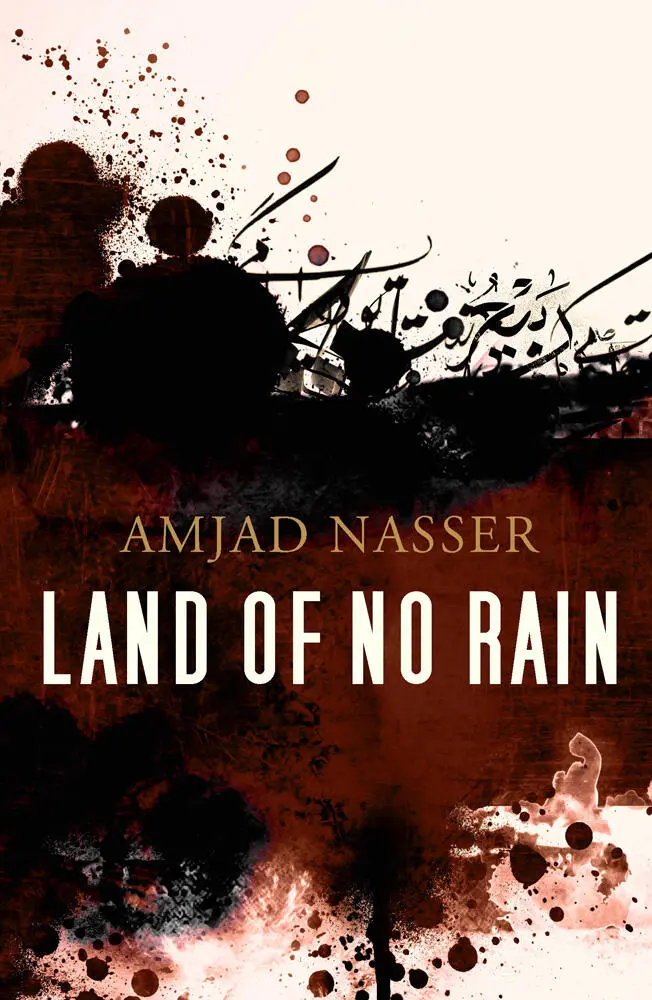
- Название:Land of No Rain
- Автор:
- Издательство:Bloomsbury Qatar Foundation Publishing
- Жанр:
- Год:2014
- ISBN:нет данных
- Рейтинг книги:4 / 5. Голосов: 1
-
Избранное:Добавить в избранное
- Отзывы:
-
Ваша оценка:
Land of No Rain: краткое содержание, описание и аннотация
Предлагаем к чтению аннотацию, описание, краткое содержание или предисловие (зависит от того, что написал сам автор книги «Land of No Rain»). Если вы не нашли необходимую информацию о книге — напишите в комментариях, мы постараемся отыскать её.
Land of No Rain — читать онлайн бесплатно полную книгу (весь текст) целиком
Ниже представлен текст книги, разбитый по страницам. Система сохранения места последней прочитанной страницы, позволяет с удобством читать онлайн бесплатно книгу «Land of No Rain», без необходимости каждый раз заново искать на чём Вы остановились. Поставьте закладку, и сможете в любой момент перейти на страницу, на которой закончили чтение.
Интервал:
Закладка:
* * *
He had to visit the house where he found his feet as a child, the house where he left his family when he took flight into the unknown. On the great journey from which people, if they return at all, do not return as they were. Everyone expected him to visit the house. He didn’t take anyone with him on the tour of inspection of his old haunts. He went alone. He came back dripping with sweat and stifling constant bouts of coughing with his handkerchief. He closed the door of his room and did not come out for the rest of the day. He didn’t tell his brother Shihab about the trip, but everyone knew he had gone. In one of our lengthy exchanges on the balcony of our house, he told me in surprise how he found the old banned books, the ones that many people were once punished for possessing, on display at the pavement bookstalls in the commercial centre, covered in dust, next to books on cooking and interior design. He told me he couldn’t understand how the books were on display like that, in broad daylight, while other books that used to be on display on the pavements, and that no one read, were now deemed more dangerous than drugs. He said time had a strange cycle, and ideas had even stranger cycles. He recalled the proverb that says that every age has its dynasty and its heroes, to which he added his own observation: ‘and its ideas too’. Because how was it that a book such as The State and Revolution , which had left an indelible scar on his stomach, could be displayed in the middle of the pavement, next to the feet of passers-by, while books such as Governance is God’s, The Hejab is a Sharia Requirement, Sacred Jihad and other books that used to be on sale openly were now more dangerous than heroin? He wasn’t unaware of the changes that had taken place here, but he was surprised by the dramatic transformation of the Grandson’s allies into dangerous enemies. Enemies who had once held an honoured place in the alliance against poisonous imported ideas but who had now descended into dark cellars where they turn the bodies of their young men into bombs. Because in the days when people like him were being hunted down and thrown in jail, the former allies of the Grandson had been preoccupied with fatwas about sexual intercourse and with debating what would invalidate their Ramadan fast or their ritual ablutions before prayer. ‘Praise be to the One Who brings about change,’ he said, as if someone other than himself was uttering the words.
* * *
Two or three days after he arrived, a luxury car stopped in front of the house. A young man wearing a suit and a large tie got out. The man asked for him, and he came out to meet him. The young man was one of Mahmoud Abu Tawila’s staff. He wanted to take him to meet his old comrade. He declined, saying he wasn’t able to go. He asked him to tell his boss he would see him as soon as he was done with his various engagements. Clearly he didn’t want to meet his old comrade, at least not in the first few days after returning. The next day the same car stopped in front of the house again. A tall man got out, well-dressed with a trimmed black moustache and short jet-black hair. It was Mahmoud Abu Tawila. It was no longer possible to avoid meeting him. He didn’t go off with him, but invited him into the same diwan where his old comrade had previously attended some of the evening salons. Mahmoud Abu Tawila seemed humbled when he saw the picture of the father. He stood a while in front of the calligraphies hanging on the walls. He said things about how the country had lost a rare talent. ‘May God have mercy on his soul,’ he added. In a tone that may or may not have been sincere, he said, ‘The time has come for our country to embrace creativity, not drive it away!’ As with many things, he couldn’t be sure of his former comrade’s feelings towards his father. There was that constant ambiguity in the tone of his voice and in the way he spoke, the effortless way he patched together common sayings, maxims, proverbs and his own linguistic innovations to create what sounded like a model page from a textbook, though not one that was circulated widely. I gathered that Mahmoud offered him work in the cultural or media departments, as with other former opposition people. He added a new refrain to what he had said about change from within when they had met by chance in the City of Red and Grey. He told him the whole country was now at a crossroads, that the map of the region was being redrawn and they had to preserve the country’s identity and unity. He said the new commander did not have the experience or even the charisma of the Grandson, so it was essential to strengthen the national institutions that guaranteed the unity of the country and its survival in the face of the coming storm. He understood that his friend Mahmoud really was worried that a fragmentation of Hamiya’s nucleus, under pressure from the changes in the region, would lead to the wholesale disintegration of the country. Mahmoud told him that the country was at the centre of a tug-of-war between two camps, which political circles called the old guard and the new guard. Although he rejected the terminology, he was inclined towards those described as the old guard and said the label did not offend him. They were the ones, he said, who could be relied on to defend the identity and unity of the country. He told him that labels don’t usually mean much but in this case they did. The label was pejorative, as he put it, intended to give the impression, especially abroad, that this camp was reactionary and that its leading members were lured by the medals and other decorations that covered the Grandson’s chest, but in fact those known as the ‘new guard’ were just a bunch of political buffoons suddenly parachuted into the country by murky financiers. They weren’t very different from a group whose name might ring a bell with him, compradors , and that was what they were now being called by local radicals of the kind that exist in every age, even at this moment of major turbulence that was sweeping away ideas and ideologies. He didn’t comment on what his old friend said. It struck him as remote from his immediate concerns, as if Mahmoud were talking about things that were happening on another planet. Inside, he was surprised at how emotionally detached he was from what was happening in his country, if it really was happening, that is. He realised that history had its decisive moments and that this was doubtless one of them. So how was it that everyone remained indifferent to the bleak picture his old friend painted of the country’s future? He didn’t want to say anything. This probably stemmed from his inability to respond, not from an aversion to speaking or because he rejected what he was hearing from his old friend, who had preserved his extraordinary inner energy. He was familiar with those nihilistic moments when he felt indifferent towards things, when moving was the same as staying still, when speaking was the same as silence, right the same as wrong. That internal paralysis that a psychiatrist he often went to in the City of Red and Grey had linked to chronic depression.
Is that what he had?
He politely ignored Mahmoud’s offer. But Mahmoud didn’t give up. He wasn’t that type. He asked him to think it over and said he understood his circumstances after everything he’d been through. He told him the country needed him now more than ever. He, personally, needed his advice. But he avoided a candid response to Mahmoud’s request and said he wanted to be free at last to write. He had many postponed projects and needed time to finish them off. His old friend noticed that he wasn’t in good shape. He didn’t look like the person he had met again in the City of Red and Grey ten years after they had parted. Mahmoud knew what had happened in that city. He knew what had happened to his wife. As he hinted to his friend who had returned, he also knew that he had been the ‘guest’ of the National Security Agency. He told him they had nothing against him now because circumstances had changed, the old files had been closed, and the agency now had other priorities. But the returnee was somewhere else, in body and in spirit. He had a plan of action from which he would not deviate. In our lengthy exchanges, he admitted to me that he still harboured some affection for his old friend, who had long competed with him in everything. Because there are some things that can’t be wiped out easily, feelings that don’t completely dissipate or turn into their opposites. There’s a sediment that settles in the heart. There’s something that lingers in the depths, resisting complete obliteration.
Читать дальшеИнтервал:
Закладка:
Похожие книги на «Land of No Rain»
Представляем Вашему вниманию похожие книги на «Land of No Rain» списком для выбора. Мы отобрали схожую по названию и смыслу литературу в надежде предоставить читателям больше вариантов отыскать новые, интересные, ещё непрочитанные произведения.





Обсуждение, отзывы о книге «Land of No Rain» и просто собственные мнения читателей. Оставьте ваши комментарии, напишите, что Вы думаете о произведении, его смысле или главных героях. Укажите что конкретно понравилось, а что нет, и почему Вы так считаете.