Alix Ohlin - Signs and Wonders
Здесь есть возможность читать онлайн «Alix Ohlin - Signs and Wonders» весь текст электронной книги совершенно бесплатно (целиком полную версию без сокращений). В некоторых случаях можно слушать аудио, скачать через торрент в формате fb2 и присутствует краткое содержание. Год выпуска: 2012, ISBN: 2012, Издательство: Random House, Inc., Жанр: Современная проза, на английском языке. Описание произведения, (предисловие) а так же отзывы посетителей доступны на портале библиотеки ЛибКат.
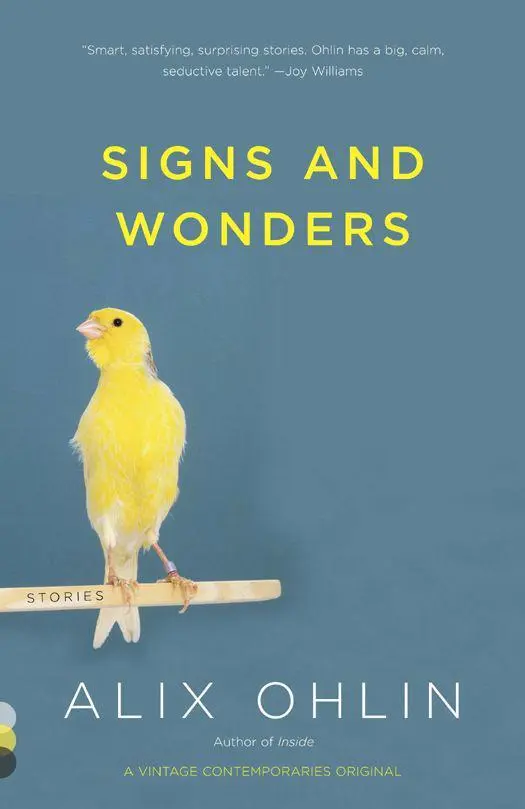
- Название:Signs and Wonders
- Автор:
- Издательство:Random House, Inc.
- Жанр:
- Год:2012
- ISBN:9780307948649
- Рейтинг книги:3 / 5. Голосов: 1
-
Избранное:Добавить в избранное
- Отзывы:
-
Ваша оценка:
Signs and Wonders: краткое содержание, описание и аннотация
Предлагаем к чтению аннотацию, описание, краткое содержание или предисловие (зависит от того, что написал сам автор книги «Signs and Wonders»). Если вы не нашли необходимую информацию о книге — напишите в комментариях, мы постараемся отыскать её.
Signs and Wonders — читать онлайн бесплатно полную книгу (весь текст) целиком
Ниже представлен текст книги, разбитый по страницам. Система сохранения места последней прочитанной страницы, позволяет с удобством читать онлайн бесплатно книгу «Signs and Wonders», без необходимости каждый раз заново искать на чём Вы остановились. Поставьте закладку, и сможете в любой момент перейти на страницу, на которой закончили чтение.
Интервал:
Закладка:
Rebecca is thinking about how something drained out of her in the doctor’s office, some part of herself that believed in change and possibility, in all the and/or flowchart branches of a long and storied life. She thinks about how she hated Gabriel then, and blamed him, and wrote that letter to his long-suffering wife. But the truth was that in spite of it all she did love him; she didn’t idealize him or anything, she simply loved him, and that love was pure and true and strong even though its circumstances were sordid and trivial and absurd.
· · ·
The bus stops at the other end of the park. Coming out of the rec center, snapping her gum (which seems to lose its tensile strength in the cold, and she wonders, briefly, why), the day-care attendant notices a man in a gray wool coat get off and start across the park in the direction of her charges. The only reason she notices him is to think that her boyfriend is better-looking and taller and more muscular, and she can’t wait until she sees him tonight. She’s got a one-track mind, that attendant.
A child runs up to Rebecca and doesn’t say anything, just stands in front of her, a strand of blond hair leaking out from underneath a fleece cap. Crouching down, Rebecca can see it’s a girl, who removes her hand from the pocket of her snowsuit and shows it to her, shyly, like an injury of which she is ashamed. Their eyes meet.
“It’s okay,” Rebecca says mechanically, and the child nods. “Come here.”
She fits the mitten over her small, white hand and tugs it up over her wrist, the girl so close that Rebecca can smell the sour yet wholesome scent of her skin. The two of them look at each other, the child still holding up her mittened hand as if Rebecca isn’t finished yet. What’s left to do? A kiss on the forehead, a “You’re dismissed”? What’s the protocol? Then she realizes she put the mitten on wrong, that the girl’s thumb isn’t fitting into its slot. So she has to pull the mitten off and start over again, the child staring all the while. Rebecca’s starting to wonder if something’s wrong with the kid, with the whole lot of them, and that’s why they’ve been abandoned in the park to play by themselves.
Tori, meanwhile, is standing next to her, standing there in her red coat, her long blond hair snaking down her back. From the back, of course, she looks just like Rebecca. Only one thought exists in her mind: Frank.
The man coming toward them, the gun warm in his hand, could be Gabriel or Frank or even Tommy, escaped from rehab. But not all of them; only one. As it turns out, it’s Gabriel. It’s the sad-eyed ones you have to watch out for — another piece of advice that could usefully have been given to Rebecca, but which she would probably have ignored.
You can see where this is going, right? With the red coats and the blond hair? There are no surprises for you here.
From a distance of ten yards Gabriel sees only Tori’s back, and he is so blinded by his belief that it’s Rebecca — the woman who wrote a letter to his long-suffering wife — that he doesn’t notice the other form crouched down next to her. If he did, he might think it is a bundled coat or a child on a sled; his focus is that intense, the world outside it merely peripheral.
The day-care attendant puts away her cell phone, wonders who all these adults are, then sees him pull out a gun and fire. A woman in a red coat falls to the ground, lightly, almost casually, as if in jest.
The attendant starts to run. Children are screaming, some of them running away. Rebecca drops the mitten and stands up and turns around. She thinks of cars: backfires, accidents. She doesn’t take a gunshot into account. Then, seeing Gabriel, she thinks he has come for her, to make a life with her, that he has finally left his wife. All this crosses her mind with certainty in the second before she notices the gun. Once she does, she sees the woman on the ground beside her, crouches again, and turns her over, feeling for a pulse. There is none. The woman still looks alive — that is, exactly like she did only moments earlier — but she is dead.
“Oh,” Rebecca says. “Oh. Oh.” The little girl runs away.
You knew that the gun was going to go off, and that it was going to kill a woman in a red coat. It was only a question of which woman, and when. And of course why. This isn’t some kind of mystery. It’s not even a story about the murder, really, or police and jail and a trial. It’s about the moment after the murder, when Rebecca looks Gabriel in the eye and he looks back. The bitter, burnt smell of gun smoke is in the air between them. Here’s the thing: in that instant, Gabriel knows that he’s killed the wrong woman, that his Rebecca — the love of his life, notwithstanding the long-suffering wife, whom he couldn’t bear to have hurt — is still alive, and he’s so grateful and happy that he smiles. And Rebecca, who with one part of her brain knows he must have come to kill her, with another part of it registers this happiness and smiles back, out of instinct, acknowledgment, and love.
And meanwhile Tori is gone and, somewhere in the world, Tommy and Frank do not know it yet.
Soon, of course, there will be police, jail, a trial. There will be repercussions, grief, and pain of enormous proportions, with consequences radiating out from each of the three people in this park, toward friends and families and coworkers and neighbors and childhood acquaintances they haven’t spoken to in years but in whose minds they nonetheless appear and flit around, moth-like, unexplained, from time to time.
You think this is a story about coincidence and/or injustice and/or fate, about the extraordinarily wrong actions of ordinary people. But you’re wrong. This is about the moment when one of them realizes he has killed the wrong person, and the two of them, these lovers, very nearly run to each other and embrace. They almost kiss over the dead body of the woman who is not her. It’s about the moment in which hope leaps in his heart. The moment in which she vows never to let him go again.
The Only Child
It all started when Sophie came home from college, between her sophomore and junior years. She wasn’t happy to be back. She’d grown to love Boston, the depressing, blustery winters, the intricate one-ways and roundabouts, and felt she’d outgrown California and its sunny, childlike weather. Worst of all was her mother. Sophie was an only child, and her mother had always clung to her. She tiptoed into her room at night to watch her sleep. As a child Sophie hadn’t noticed, but now that she was older she usually wasn’t asleep yet when her mother came in, and she’d look up from her book and say, “ What are you looking at?”
Which only made her mother smile affectionately and back out of the room. By late June Sophie couldn’t take it anymore; she went over to her friend Beena’s house and they called up Trevor, their high-school drug connection, and got a dime bag and some Ecstasy, and suddenly it was four in the morning and Sophie drove home at breakneck speed only to find her parents still up, waiting.
“You guys,” she said, “you’re driving me crazy.”
Her mother was crying.
“It’s not that bad,” Sophie said. “I was just out late. At school I do this all the time. I mean, not all the time. But you know what I mean.”
“We have to tell you something,” her father said. “We should’ve told you a long time ago.” He was a serious man, her father, prone to ominous pronouncements about issues he had no ability to affect. “This real-estate bubble will burst very soon,” he’d say while barbecuing chicken. Or: “Gas prices will go up much farther before they ever go down.”
Читать дальшеИнтервал:
Закладка:
Похожие книги на «Signs and Wonders»
Представляем Вашему вниманию похожие книги на «Signs and Wonders» списком для выбора. Мы отобрали схожую по названию и смыслу литературу в надежде предоставить читателям больше вариантов отыскать новые, интересные, ещё непрочитанные произведения.







Обсуждение, отзывы о книге «Signs and Wonders» и просто собственные мнения читателей. Оставьте ваши комментарии, напишите, что Вы думаете о произведении, его смысле или главных героях. Укажите что конкретно понравилось, а что нет, и почему Вы так считаете.