Alix Ohlin - Signs and Wonders
Здесь есть возможность читать онлайн «Alix Ohlin - Signs and Wonders» весь текст электронной книги совершенно бесплатно (целиком полную версию без сокращений). В некоторых случаях можно слушать аудио, скачать через торрент в формате fb2 и присутствует краткое содержание. Год выпуска: 2012, ISBN: 2012, Издательство: Random House, Inc., Жанр: Современная проза, на английском языке. Описание произведения, (предисловие) а так же отзывы посетителей доступны на портале библиотеки ЛибКат.
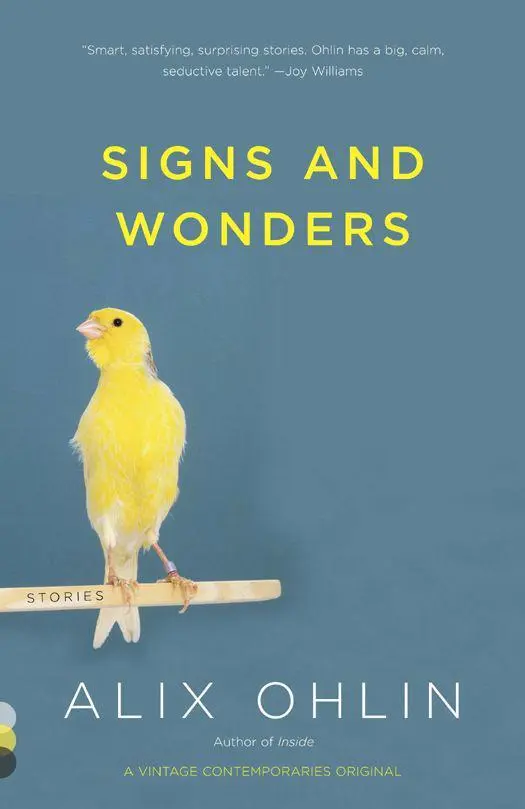
- Название:Signs and Wonders
- Автор:
- Издательство:Random House, Inc.
- Жанр:
- Год:2012
- ISBN:9780307948649
- Рейтинг книги:3 / 5. Голосов: 1
-
Избранное:Добавить в избранное
- Отзывы:
-
Ваша оценка:
Signs and Wonders: краткое содержание, описание и аннотация
Предлагаем к чтению аннотацию, описание, краткое содержание или предисловие (зависит от того, что написал сам автор книги «Signs and Wonders»). Если вы не нашли необходимую информацию о книге — напишите в комментариях, мы постараемся отыскать её.
Signs and Wonders — читать онлайн бесплатно полную книгу (весь текст) целиком
Ниже представлен текст книги, разбитый по страницам. Система сохранения места последней прочитанной страницы, позволяет с удобством читать онлайн бесплатно книгу «Signs and Wonders», без необходимости каждый раз заново искать на чём Вы остановились. Поставьте закладку, и сможете в любой момент перейти на страницу, на которой закончили чтение.
Интервал:
Закладка:
It was the first time anyone had mentioned the weirdness of the situation to her. Everybody else, her parents, her new brother, seemed intent on making it seem ordinary, which it manifestly wasn’t. At this onslaught of honesty Sophie felt grateful, even close to tears.
“It’s incredibly strange,” she said.
“Must be,” Fiona said. “But also good, right? I mean, here you have somebody else who’s part of your family. Somebody else to care for you.”
Sophie hadn’t considered it that way at all. “I guess I’m still getting used to it,” she said.
At eight, she and Fiona went out to a French restaurant. Her brother arrived twenty minutes late, trailing a briefcase and apologies, then insisted on ordering for her.
“Have you had oysters?” he asked. “What about snails? Have you had steak tartare, ever, in your life? I bet you didn’t have snails growing up in California.”
She hadn’t, and didn’t want them now, but felt it would be rude to refuse. She thought he was testing her. She didn’t realize that he felt he had something to prove, that his entire life — what he’d been given, what he’d become — was under scrutiny. Fiona sat back and didn’t talk much, just smiled at both of them. Philip ordered the snails and a bottle of Bordeaux and Fiona pushed her glass over to Sophie, letting her drink most of it. Philip kept asking her questions. What was their house like, what kind of after-school activities did she do, what did she think of her high school, what did she get on her SATs? It felt like a job interview.
“You must be smart, you got into a good college,” he said. “What are you going to do after you graduate? If you moved to New York, I could help you. I have some connections. The world’s about connections, you know. That’s something I didn’t realize in college, but it’s totally true.”
“I was thinking maybe grad school?” Sophie said. She didn’t want to let go of the life she’d only just discovered. It was the first time she’d ever felt like an adult, and she couldn’t imagine that there would be other places she might feel that way, other ways she could grow up.
Philip laughed. “Everybody here’s either dropping out of grad school or just about to go back. You’ll fit in perfectly.”
He ordered dessert for the table but didn’t have any himself. Sophie and Fiona shared it, their spoons digging into the meringue. Close enough to smell Fiona’s perfume, she noticed the diamond engagement ring on her left hand.
The next day, Fiona offered her a menu of activities: the Guggenheim, MoMA, the Met. “We don’t have to do anything big and touristy,” Sophie said. “Just walking around is good.”
Philip nodded, and Fiona smiled. “That’s such a smart thing to say. It’s so true that you see more of a city that way.” Sophie felt that she’d done well. “Let’s go to Chinatown and then we can have some pasta in Little Italy, maybe walk around SoHo. How does that sound?”
“Perfect,” Sophie said.
They took a cab downtown. The streets in Chinatown were mobbed. While holding hands with Philip, Fiona pointed things out to Sophie: Chanel knockoff purses, an art-supply store, the ducks hanging in shop windows. Next they moved over to Little Italy, where they had lunch. All the talk was about what it was like to live in New York, the various difficulties and advantages, the rents, the stresses. It was an urban version of her parents’ friends sitting around talking about their houses and yards. Having this revelation made Sophie feel wise. She thought that this was maturity, the ability to see through people. Only later did she find out that anyone could see through people, and the hard thing was not to try.
After lunch Fiona said she was tired, so they went back to the apartment. Before taking a nap, she suggested that Sophie and Philip call California.
It was one in the afternoon there, and Sophie’s mother was outside gardening. “Are you having a good time?” she asked, sounding a little breathless.
“Of course,” Sophie said, knowing that this was what she wanted to hear, yet unable to bring herself to rave or brim over with stories.
“Put him on?” her mother said.
Sophie handed the phone to her brother, who stood with the receiver pressed to his ear, smiling politely. Was he good-looking? Sophie couldn’t say. His face was long, like hers; his nose had a bump in it. If without knowing anything she’d passed him on the street, would she have noticed him, or somehow felt a connection?
“Soph,” he said, still smiling, but now holding out the phone.
When she put it to her ear she could hear her mother crying. “Are you okay?”
“I’m great,” her mother said, the worst liar ever. “I’m just so happy.”
In the background she could hear her father’s voice but not the specific words. Whatever they were, she knew he was trying to comfort her. In the future, after he retired, this tendency would grow even stronger. He’d start cooking for her, three meals a day, even after she got sick, and he’d shadow her from room to room, just as Sophie’s mother had once done to her. Her mother, irritable from pain, would complain about this to Sophie while he was in the kitchen straining broth into homemade soup. Once she died, of liver cancer, Sophie expected him to fade into the shadows himself, to lose his purpose, or to move into her own home. By then she was living with her second husband, sharing custody of Sara with Lars and of Mark’s son, Henry, with his ex-wife, a rotating parade of children and schedules that had to be carefully regulated and updated on wall calendars lest total chaos ensue. But her father seemed happy in his own routine, walking two miles every day and scrupulously following the news. Not until then did she realize he was the most self-sufficient person she’d ever known, and that her mother, the doter, the worrier, the maker of phone calls, had been the most in need of care.
“It’s okay, Mom,” Sophie said now. “We’re having a nice time.”
“Please remember everything,” her mother said, “and be sure to tell me later.”
“I’ll try,” Sophie said. She hung up and looked for Philip — wanting to commiserate, for a glance to pass between them — but he was in the kitchen already, talking to Fiona and pouring himself a glass of wine.
They were supposed to go out to dinner again, but after two glasses of wine Philip said he was tired, wanted to order in Chinese and stay home. This sounded fine to Sophie, but Fiona didn’t like the idea.
“Sophie’s only in town for the weekend,” she said. “We should be taking her to the Russian Tea Room or something.”
“The Tea Room’s closed, babe,” he said, with a touch of irritation.
“I said or something. ”
“Anyway, she’s cool with it. Right?”
Sophie nodded slightly, afraid of overcommitting to his side of the disagreement. When her parents fought, they did so in their bedroom, at night, keeping their voices down and the door closed. She was thirteen before she figured out that they ever argued about anything, although this, she now knew, was the least of their secrets.
“Of course she’s cool with it ,” Fiona said. She was standing with her arms folded in front of her, and Sophie couldn’t be sure but it seemed like tears were glimmering in her eyes. “She doesn’t know what the other options are. That’s why we should come up with something. You always want to do the least difficult thing.”
“And that’s wrong?” Philip said. Then he poured himself another glass of wine, clearly an act of defiance. There was a kind of electrical current in the room, like just before a thunderstorm.
Fiona started to cry.
Читать дальшеИнтервал:
Закладка:
Похожие книги на «Signs and Wonders»
Представляем Вашему вниманию похожие книги на «Signs and Wonders» списком для выбора. Мы отобрали схожую по названию и смыслу литературу в надежде предоставить читателям больше вариантов отыскать новые, интересные, ещё непрочитанные произведения.












Обсуждение, отзывы о книге «Signs and Wonders» и просто собственные мнения читателей. Оставьте ваши комментарии, напишите, что Вы думаете о произведении, его смысле или главных героях. Укажите что конкретно понравилось, а что нет, и почему Вы так считаете.