Alix Ohlin - Signs and Wonders
Здесь есть возможность читать онлайн «Alix Ohlin - Signs and Wonders» весь текст электронной книги совершенно бесплатно (целиком полную версию без сокращений). В некоторых случаях можно слушать аудио, скачать через торрент в формате fb2 и присутствует краткое содержание. Год выпуска: 2012, ISBN: 2012, Издательство: Random House, Inc., Жанр: Современная проза, на английском языке. Описание произведения, (предисловие) а так же отзывы посетителей доступны на портале библиотеки ЛибКат.
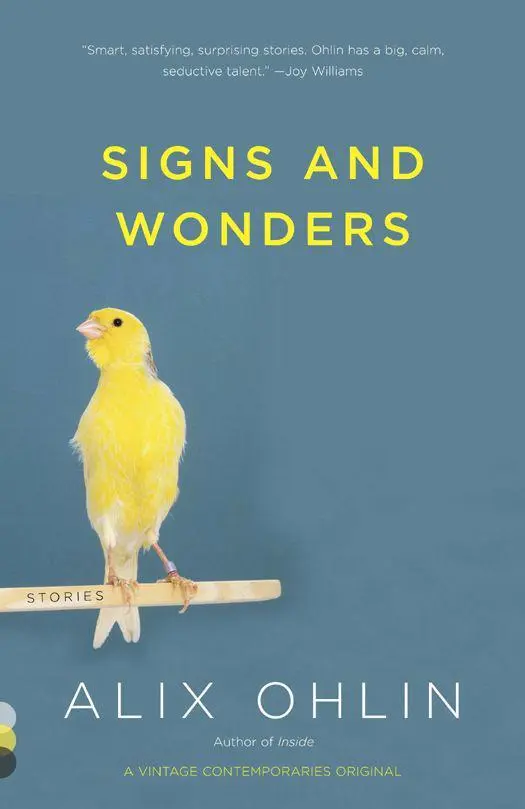
- Название:Signs and Wonders
- Автор:
- Издательство:Random House, Inc.
- Жанр:
- Год:2012
- ISBN:9780307948649
- Рейтинг книги:3 / 5. Голосов: 1
-
Избранное:Добавить в избранное
- Отзывы:
-
Ваша оценка:
Signs and Wonders: краткое содержание, описание и аннотация
Предлагаем к чтению аннотацию, описание, краткое содержание или предисловие (зависит от того, что написал сам автор книги «Signs and Wonders»). Если вы не нашли необходимую информацию о книге — напишите в комментариях, мы постараемся отыскать её.
Signs and Wonders — читать онлайн бесплатно полную книгу (весь текст) целиком
Ниже представлен текст книги, разбитый по страницам. Система сохранения места последней прочитанной страницы, позволяет с удобством читать онлайн бесплатно книгу «Signs and Wonders», без необходимости каждый раз заново искать на чём Вы остановились. Поставьте закладку, и сможете в любой момент перейти на страницу, на которой закончили чтение.
Интервал:
Закладка:
“My wife and I were saving it,” he said, “but I don’t need it. Take it and go back to New Hampshire. Go back to school and be a teacher. Meet a nice man and have children.” His voice was cracking. The bartender was looking at him, but he didn’t care. “Start a new life.”
Jane pushed the envelope back at him and stood up. “Is that what you think I want from you? Fuck you.” Her voice rose to a shout. “Seriously, Martin. Fuck you.” She got up and rushed out, her high heels clicking spastically.
The bartender shrugged. “Women,” he said.
Doug picked up the envelope and went home. While he was taking a shower, the phone rang. Jane, he thought, I’ll never get away from her. After he got dressed, he saw there was a message, so he poured himself a drink and steeled himself to listen to it.
But it wasn’t Jane. It was Debbie, Carol’s best friend, the one who’d been driving on the night of the accident. She’d called him every few months since the crash, but he’d never called her back. It wasn’t that he hated her; he just couldn’t stand the sound of her voice.
“Douggie,” she said, in her high, squeaky voice, and immediately he was back in the hospital, back in the embrace of her awful bandaged paws. “I know we haven’t really talked since … Well, maybe you don’t want to hear from me. But I was watching the news about that guy and how he’s going to jail forever now, and I was thinking about you.” Her voice trailed off and he guessed she was drinking, or on the verge of crying, or both. “I was …” She hung up.
Debbie was divorced and lived by herself, ten minutes away, in a condo development called Lantern Hills. Every time she told people where she lived she’d say, “We do have some lanterns, but the land’s actually flat,” and laugh. He’d always found her annoying, but now, all of a sudden, he felt like he’d missed her.
He rang the doorbell and she answered the door in jeans and a college T-shirt — no bra it looked like — and bare feet. Her hair was down, uncombed.
“I got your message,” he told her.
“Come in,” she said.
She brought him a beer and they sat down on the couch. She looked strange holding the bottle, and two of her fingers didn’t bend. There were scars on the backs of her hands.
She waved her stiff hands at him, almost apologetically. “They’re full of pins,” she said.
“That guy,” Doug said, “the one who killed his wife and kids. Carol would have said, Too bad we don’t have the death penalty in Rhode Island. ”
Debbie nodded. “That’s true, that’s so exactly what she would have said.”
There was a silence.
“I met this girl,” Doug told her. “She was a hooker. But she wanted to be a teacher.”
“What?”
He told her everything, from start to finish, though he left out the part at the very end where Jane said she didn’t want the money. He just talked about giving her the envelope and telling her to start over, and Debbie nodded and listened with her scarred hands awkwardly semifolded in her lap. With the ludicrous, almost lurid story hanging there between them, he felt closer to her than he had to anyone in a very long time. He felt a tenderness gurgle inside him and gasp for air, and as he spoke and gestured he let his hand brush over hers.
Vigo Park

There’s a gun at the beginning of this story, placed here so that you know it’s going to go off by the end. That’s just the way it is; you’ve been warned. Call it fate, call it destiny, call it the inevitable consequence of certain destructive but all-too-common human behaviors. There’s no changing the ending, however dramatic and/or ugly and/or contrived and/or sad it might seem to you. Better accept it now.
The gun (an ancient Walther looted from some German soldier in World War II, not that this ultimately matters) is in the coat pocket of a man on the 24 bus, which is heading to Vigo Park. It’s winter, and he’s hunched over, with his hands meeting across his lap, like someone protecting himself from the cold. Underneath his coat, though, he has taken off both his gloves and is touching the gun — which his father, a responsible man, kept unloaded and locked in a cabinet in his house until he died — with his bare fingers. The ring on his left hand makes a clinking sound against the barrel, but nobody on the bus hears it. Despite all that’s happened he hasn’t been able to bring himself to take it off. Whenever he starts to slide the ring off he sees his wife in his mind’s eye, crying on their wedding day when she put it on his finger, tears of pure, liquid happiness. To take it off would be to acknowledge all the ways he has hurt her, and that is more than he can stand to do.
A fat man in a sheepskin jacket sits down next to him at this point, and so he stops touching the gun, which has made him feel kind of masturbatory anyway, sliding his hands up and down the length of it beneath his coat. The bus begins the uphill chug toward the park. People get on; others get off. The day is gray. Earlier there was sleet and later there will be snow; but right now the sky holds itself in dark abeyance above the salt-streaked roads and cars of the city. Even the clothing seems to have darkened in the wintry light: brown and black and navy-blue wool coats trudge up and down the streets, relieved only occasionally by a patterned hat or scarf. Why, he wonders, does winter have to take all the color from the world? The bus turns a corner, and through the dirty window he can just make out his destination.
In the park a woman in a red coat sits watching a child play. It’s not her child. She has no child. This, to her, is a source of enormous grief. She had a chance, several years ago, but was talked out of keeping it. Sometimes, when she sees a child the age her own would be, she thinks about kidnapping it, or doing other, even crazier things.
“Life is what you make it,” her sister often tells her, and this is just one reason among many they seldom speak. Her sister, who is happy, believes this is of her own devising. She doesn’t believe in luck. She tells Rebecca to change the things in her life that make her unhappy, and then she’ll be happy. “It’s like making coffee,” she explains. “Is it too strong? Add more water next time. Learn from the mistakes of the past.” These words fall on Rebecca like wet snow: white and substantial one moment, dissolved by the next. “I drink tea,” she tells her sister, who sighs heavily and informs her that she’s missing the point.
This is where things might get a little hard to believe for some people. Basically the situation is that on the other side of the playground is another woman in a red coat. Like Rebecca, she has long blond hair in a ponytail, and like Rebecca, she is alone. In fact, it’s the same make and model of coat, bought from the same department store during the same January sale. It was even bought for the same reason, because most winter coats are dark blue or black or brown and both women thought they might cheer themselves up by relieving the gray color scheme of winter with a flash of red. This not-especially-brilliant bit of fashion psychology has infected hundreds, maybe thousands, of women, and the red coats are flying off the racks; it’s the one must-have item of the season — you know how women are, they get these ideas into their heads, these cravings that must be satisfied — and Tori has come to regret her purchase, since seeing it on so many other women has made her feel generic in her thoughts and emotions, frankly, the last thing she needs right about now. Looking across the park she thinks, Oh, great, another one. Why do I even bother? Which is a question she’s asking herself more and more often these days. This other woman seems to be waiting for someone, as she herself is. Automatically she compares the other woman’s looks to her own — maybe ten years older, and thinner, too thin, really, a stick — and decides, after some thought, that the coat looks better on her, Tori. Knowing this victory is shallow doesn’t mean she isn’t still satisfied. Frank always tells her, after sex, that she’s beautiful, in a tone of wonderment and joy she has to believe is genuine. In life you have to believe some things are real or you just die. You die, even if you stay alive.
Читать дальшеИнтервал:
Закладка:
Похожие книги на «Signs and Wonders»
Представляем Вашему вниманию похожие книги на «Signs and Wonders» списком для выбора. Мы отобрали схожую по названию и смыслу литературу в надежде предоставить читателям больше вариантов отыскать новые, интересные, ещё непрочитанные произведения.








Обсуждение, отзывы о книге «Signs and Wonders» и просто собственные мнения читателей. Оставьте ваши комментарии, напишите, что Вы думаете о произведении, его смысле или главных героях. Укажите что конкретно понравилось, а что нет, и почему Вы так считаете.