Richard House - The Kills
Здесь есть возможность читать онлайн «Richard House - The Kills» весь текст электронной книги совершенно бесплатно (целиком полную версию без сокращений). В некоторых случаях можно слушать аудио, скачать через торрент в формате fb2 и присутствует краткое содержание. Год выпуска: 2013, Издательство: Picador, Жанр: Современная проза, на английском языке. Описание произведения, (предисловие) а так же отзывы посетителей доступны на портале библиотеки ЛибКат.
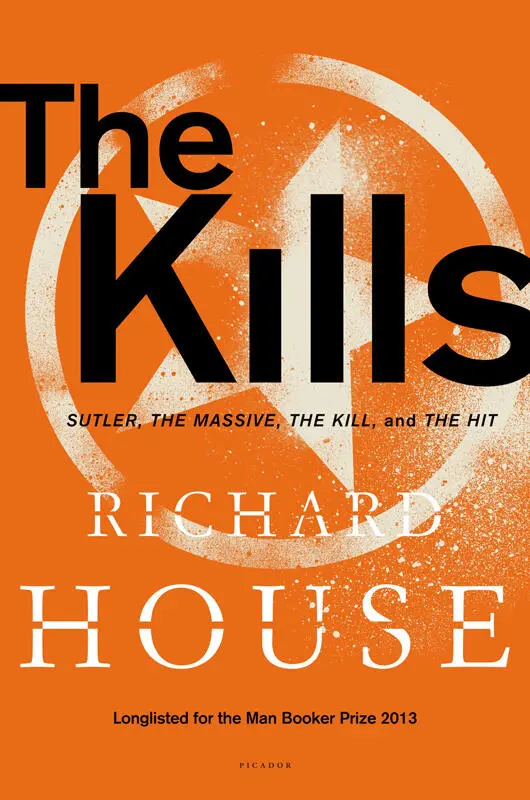
- Название:The Kills
- Автор:
- Издательство:Picador
- Жанр:
- Год:2013
- ISBN:нет данных
- Рейтинг книги:3 / 5. Голосов: 1
-
Избранное:Добавить в избранное
- Отзывы:
-
Ваша оценка:
The Kills: краткое содержание, описание и аннотация
Предлагаем к чтению аннотацию, описание, краткое содержание или предисловие (зависит от того, что написал сам автор книги «The Kills»). Если вы не нашли необходимую информацию о книге — напишите в комментариях, мы постараемся отыскать её.
The Kills — читать онлайн бесплатно полную книгу (весь текст) целиком
Ниже представлен текст книги, разбитый по страницам. Система сохранения места последней прочитанной страницы, позволяет с удобством читать онлайн бесплатно книгу «The Kills», без необходимости каждый раз заново искать на чём Вы остановились. Поставьте закладку, и сможете в любой момент перейти на страницу, на которой закончили чтение.
Интервал:
Закладка:
‘Take the Citroën,’ English Tony insisted. If something happened he could clean it. Just take a little care and fill it up. It’s only shirts, right? This is what she does, she stitches shirts?
Marek drove back through piazza Garibaldi, passed by every kind of police imaginable, municipal, state, carabinieri, finance, firemen and paramedics, you name it. Every one of them idling at the piazza.
Back in the basement he waited at the door, dressed slowly in the white suit, the slip-on booties, the hairnet, the goggles, the latex gloves, stared at the door, a heavy door like something from a ship, painted and repainted so the surface had a roundness, a way of appearing smooth when in reality it was deeply scratched and picked. He couldn’t enter the room, couldn’t make himself touch the door handle, and found himself stuck.
One week ago — was it? — the argument with Paola, a joke of hers about him being gullible. It wasn’t that he was stupid, that wasn’t what she was trying to say. Maybe it was the military training, or something, but he always did what she told him, always. She just had to speak in a certain way and he’d jump to it. He couldn’t remember the comment but she’d said it was almost the same thing — doing what you’re told and being stupid. Almost the same.
How could he not have thought of this?
A room covered in plastic.
How could it not occur to him?
He made the decision, physically leaned into the door until he had no choice but to step forward and touch it. Once inside he walked about the perimeter, his nose and mouth buried in the crook of his arm as he tugged the plastic sheets free from the walls. He shielded his face as the plastic slipped down, and trod carefully, because whatever this was, it wasn’t only blood. Although he had carefully covered the walls and double taped the seams, the sheeting had separated on the floor and a large pool of blood had settled underneath, and there were bare footprints, already dry, tracked across the concrete. Marek attempted to fold the sheets without coming into contact with the blood. With only one side torn down, he looked about the room and understood that what he was doing was unwise.
Behind the door, set beside what remained of the roll of plastic, he uncovered a shoulder-bag. Under the bag, placed tidily next to the wall, he found a pair of brown trainers and socks, left side by side as if someone had undressed there. None of this seemed fake to him, the hairs caught in the tape strapping, the pattern and pooling of the blood, the hanging tether — but he told himself that none of this was real.
He packed the plastic into six black disposal bags, slopped bleach onto the floor and left it as it was.
Back on the street he found Cecco leaning nonchalantly against a parked car, happy with himself. Marek checked the street and when he saw that it was clear, he came out with two of the bags. Cecco watched, then offered to help him load them into the car. Marek signalled a gracious no.
‘If you need a hand,’ Cecco offered, ‘I could drive.’
Marek opened the car door and began to load the bags onto the back seat, and wedged them behind the seats with his foot. Straightening as he backed out of the car, he smiled back at the boy and wished that he would leave. It was the car he was after. This is what held his interest.
* * *
Marek parked the car on via Consolo. He washed his arms and neck in a fountain in a piazzetta with boys playing football around him who knew better than to pay attention. He rinsed out his shirt then he checked himself in a shop window and was surprised by his expression, stern, sober, and pale. Inside the shop the owner sat in a chair fanning herself and avoiding eye contact.
Out on Corso Garibaldi the police attended to the traffic. A cat-call of sirens, close and threatening, ran down Corso Emanuele. Marek walked the long way round to via Capasso avoiding the groups of police, mindful not to appear suspicious; he had never seen so many police before, but realized that he must have, he’d just never had a reason to fear them.
* * *
He waited in his apartment, certain the police would come, told Paola that he was still feeling unwell. He waited curled on the bed, arms wrapped tight about his chest, and stared hard at the wall, convinced that the police were playing a game. His fingerprints would be all over the room, all over the car, and he didn’t doubt that they would soon come after him. The police would trace the car, contact Tony, then they would come for him.
After midnight he began to feel hopeful. It was possible, just possible, that they hadn’t discovered the car. Parked alongside other cars one road away from the palazzo it would not be so obvious. What was there to notice? Even if they did find the car, how would they know to come to him? Fingerprints would take a while to process, by which time he would be out of the city. No. A new problem struck him. The car and its contents combined were less of a worry than Peña. The woman was so stupid that if the police came to speak to her information would pour out of her, unstoppable, and she would tell them everything about the bag, about Marek preparing the room, and once they associated Marek with the room, they would quickly piece together what they needed. And Salvatore? What was the deal with Salvatore?
* * *
At two o’clock Marek decided to return to the car. He came carefully down the stairs and checked the courtyard to see if there were police in the building, and was surprised to see the entrance as it usually was at night, the hefty wood doors closed, windows and shutters open on the upper floors, only one or two lights showing in the front of the building.
The car was still on the bridge, undisturbed. He walked by it, not looking at the car, but looking up the street for any sign that something was not right. Satisfied, he turned about, and hurried back with the keys in his hand.
The late afternoon heat had drawn out a fatty stench from the clothes. Marek wound the window down. The car started on the third attempt with a rough choke. Marek drove with his head toward what draught there was, a buffet of hot air with the soft feel of cloth.
He took the smaller roads following the coast south toward Ercolano and sensed, for the first time, the possibility of success. The headlights broke across concrete walls and glasshouses, on one side were simple townhouses and workshops, on another a broken line of warehouses which appeared largely abandoned. Turning a narrow corner he was forced to an abrupt stop, in the middle of the road an abandoned dumpster, so solid, he thought of it at first as some kind of creature, something ancient. Marek laughed, tension broken, he turned left and headed inland and soon he was back among housing. He drove now with the lights off, aware that the car would draw attention to itself. He turned again and headed for an unlit area and found himself on a pumice track with stark concrete high-rises on either side. The road came to a halt at a dry sloping scrubby field.
Marek stopped the car, turned on the headlights: from what he could see he was far enough away from the housing estate and into a wasteland. He could burn the clothes and bags here. This, he thought, was too easy, as if he had some natural talent. The idea disturbed him.
Under the plastic bags he found a litre can of engine oil. He threw the clothes into the field and when he returned to the car he thought he heard a cough, a definite cough. Marek stopped and listened and squinted up the track. It was nothing, he was certain, but nevertheless he needed to hurry. As he reached for the shoulder-bag he thought he heard the sound again. Not a cough this time but someone walking, the crisp break of dry grass underfoot. Marek paused and again stared hard into the night, and again discovered nothing. He swung the shoulder-bag out into the field, then, following the light cast by the headlamps he walked after them opening the can of oil. It wasn’t a cough this time but a huff — Marek stood over the clothes, he doused them with oil and was surprised that the clothes would not ignite. He attempted to light them with a handful of dried grasses, but again it wouldn’t catch. He plucked more grass, wound the strands into a knot and tried again. This time the grass caught, but the flames died as quickly as they had started. Behind him the first handful he’d thrown aside quickly caught fire — and just as swiftly died. If he couldn’t burn the clothes he would bury them. Unable to see where he had thrown the bag he searched the field and stepped carefully through the grass — and there, again, a rustle. This time he was certain he heard someone approaching.
Читать дальшеИнтервал:
Закладка:
Похожие книги на «The Kills»
Представляем Вашему вниманию похожие книги на «The Kills» списком для выбора. Мы отобрали схожую по названию и смыслу литературу в надежде предоставить читателям больше вариантов отыскать новые, интересные, ещё непрочитанные произведения.



Обсуждение, отзывы о книге «The Kills» и просто собственные мнения читателей. Оставьте ваши комментарии, напишите, что Вы думаете о произведении, его смысле или главных героях. Укажите что конкретно понравилось, а что нет, и почему Вы так считаете.