Richard House - The Kills
Здесь есть возможность читать онлайн «Richard House - The Kills» весь текст электронной книги совершенно бесплатно (целиком полную версию без сокращений). В некоторых случаях можно слушать аудио, скачать через торрент в формате fb2 и присутствует краткое содержание. Год выпуска: 2013, Издательство: Picador, Жанр: Современная проза, на английском языке. Описание произведения, (предисловие) а так же отзывы посетителей доступны на портале библиотеки ЛибКат.
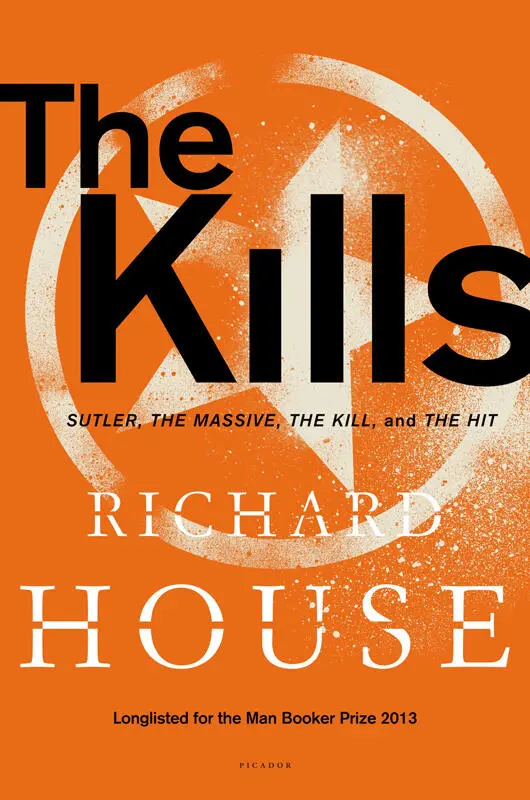
- Название:The Kills
- Автор:
- Издательство:Picador
- Жанр:
- Год:2013
- ISBN:нет данных
- Рейтинг книги:3 / 5. Голосов: 1
-
Избранное:Добавить в избранное
- Отзывы:
-
Ваша оценка:
The Kills: краткое содержание, описание и аннотация
Предлагаем к чтению аннотацию, описание, краткое содержание или предисловие (зависит от того, что написал сам автор книги «The Kills»). Если вы не нашли необходимую информацию о книге — напишите в комментариях, мы постараемся отыскать её.
The Kills — читать онлайн бесплатно полную книгу (весь текст) целиком
Ниже представлен текст книги, разбитый по страницам. Система сохранения места последней прочитанной страницы, позволяет с удобством читать онлайн бесплатно книгу «The Kills», без необходимости каждый раз заново искать на чём Вы остановились. Поставьте закладку, и сможете в любой момент перейти на страницу, на которой закончили чтение.
Интервал:
Закладка:
When the door finally opened Peña stepped away in a doped slowness and slipped back to the whitewashed wall.
Paola pushed through, and used her overnight bag as a block between her and the supervisor. She gave Marek a look as if Peña was drunk, as if this really was all too much.
‘I’m going up.’
She was sorry, Peña said, hardly acknowledging Paola as she walked away. She reached vaguely to Marek, feebly caught his arm, her voice fragile and diminishing, and whispered, sorry. So sorry.
Impatient with these apologies Marek asked what was she sorry about. What was this exactly? What did she want?
Peña pointed to courtyard, to the basement door, to a white plastic shopping bag. Even at this distance, Marek could see the blue lettering that served as a logo for Salvatore Alimentari. The bag looked fat, the sides folded over as if tucked, as if waiting to be collected, the sides scuffed with muck.
Marek walked directly to the bag and gruffly pulled it toward him and was surprised at the weight. Inside, he found a hammer and a saw-tooth blade, a pair of pliers, some shorts, and a T-shirt sopped with something like oil, sticky and dirty. He opened the T-shirt with his fingertips, still not thinking, a little repelled at the feel of the material, but just not thinking, and out skittered two teeth, two human teeth, with long white double roots. At the base of the bag a piece of meat, impossible — a tongue. He dropped the clothes. ‘What is this?’ Wiped his hands down his shirt, looked to Peña and said he didn’t understand. What was this? Blood? Real blood. Teeth. A tongue?
Peña held out the keys and said that he should go to the basement, she would not go, and Marek said she was crazy, why had she waited, this was a matter for the police?
* * *
Except.
It wasn’t a matter for the police.
Not at all.
When he returned to the courtyard Marek came quickly out through the service entrance onto via Tribunali. Certain that he was going to be sick, he leaned forward and regulated his breathing. The room’s heavy stink followed him out, and the effort not to retch brought tears to his eyes. Marek curled up in the doorway and hugged himself hard.
It was impossible that this could happen. Impossible to accept what he had seen, a room fouled with thick gouts of blood, a pool of it misshapen with skids and slides, the colour bright-edged and black-centred, wet and crusting.
He had bought the plastic.
He had prepared the room, painted it, left it white, layered with plastic, not draped, but taped and nailed and dressed, and what he returned to was far beyond his understanding, a room so thick with blood that someone had dragged and swum through it, soaked themselves and left their imprint.
Plenty of people would have seen him coming and going over the past week.
He called the brothers, could hardly hold the phone with shaking, but let it ring and found no answer. He called again, and again, and thought he heard a sound from the bag — and there, in fact, was the phone, set to vibrate, beside the tongue.
Outside, distant, he could hear sirens and car horns. The traffic on via Duomo stopped and began to stall along via Capasso.
Sensing Peña behind him he spat on the pavement.
Had she called the police?
She could not remember.
‘You must remember. Have you called the police? Have you spoken with anyone else?’
Peña shook her head, no she had not called anyone else.
‘Nobody has seen this?’ He pointed to the bag. ‘And the room? Has anyone seen the room?’ A T-shirt with a star.
Again Peña shook her head.
Marek shook his head. ‘You haven’t been down there?’
Peña gave another quick shake. No, no she hadn’t looked. What was down there?
‘Nothing.’ Marek shook his head. ‘Nothing.’
They shook their heads together, willing this to be true.
‘There’s nothing down there.’ He held up the keys. ‘Let me keep these for now.’
Peña nodded, eager to be rid of any responsibility.
‘Has anyone come in or out? Anyone from the palazzo? Has anyone seen or looked into the bag?’
Once more she shook her head, and Marek again felt hopeful.
‘Did you see anyone go down into the basement this weekend? What about the brothers? Has anyone seen Marc or Paul?’
She didn’t understand him. She hadn’t met the men.
‘The men who rented the room? You haven’t met them?’
‘Salvatore,’ she said, but according to his sons he had returned to Bari, for his health. They knew nothing about a basement room, and nothing about two businessmen.
Lanzetti. Marek decided he should speak with Lanzetti.
What was he going to do about the bag? Peña pointed back to the courtyard. Marek followed after. He picked up the T-shirt, returned it to the bag and again took note of the pattern, badly stained: a white star in a white circle.
One of the brothers had killed the other, he was certain of it. He pinched the keys hard into his fist. A white star. A white circle. The same star and circle as the bakery. The bakery and the language school. A far worse idea occurred to him. They had murdered the Japanese girl. This was why they had asked him to find someone. This was why they had paid him so well. The clothes in the bag were not clothes likely to be worn by either of the brothers, but neither were they women’s clothes.
Marek had painted the room. Bought the materials. Dressed the room in plastic. He’d helped them search for a woman. He began to understand his part in this, the realization yawned open, the bleach, the gloves, the package at the hotel. An expectation that he would clean up. And the tongue? An emphatic demand that he should shut his mouth.
He told Peña that it was a joke. The tongue, the blood, were fake. The clothes were real enough, of course, but everything else was some kind of elaborate joke. Peña appeared to accept the answer, although the idea produced no change in how she appeared.
* * *
Paola, seated at the sewing machine, leaned through and gave a hi, as if the weekend had not been awkward, as if nothing had happened, which was in many ways the problem. Nothing had happened: no arguments, but no agreements either. She’d tolerated the weekend, suffered through it as if this were something he’d especially wanted to do, and just this one time they’d do it, right, but it wouldn’t become a habit, OK, it wouldn’t be anything she’d care to repeat. Paola leaned from her chair, hands holding a T-shirt steady under the needle, to peep into the room with an apologetic hi, as if she realized now just how childish she could be sometimes. ‘What’s that on your shirt?’
Marek answered paint. He’d wiped his hands down his shirtfront. Two smears that looked nothing like paint.
Paola slipped back into work, and left him alone while he sat at the toilet, tried to control his breathing, tried to hold down his retching or keep it to the moments when she was sewing, when the machine peckered through the material and the sound stammered through the walls. His eyes were watering from the effort to regulate his breathing, he didn’t know if he was crying.
She asked if he was OK, what was keeping him?
‘I think, I don’t know, maybe I’ve picked up something. The steam room.’
‘The chicken,’ she said, ‘undercooked. Oh god, we both had it. I’m feeling a little that way too.’
Читать дальшеИнтервал:
Закладка:
Похожие книги на «The Kills»
Представляем Вашему вниманию похожие книги на «The Kills» списком для выбора. Мы отобрали схожую по названию и смыслу литературу в надежде предоставить читателям больше вариантов отыскать новые, интересные, ещё непрочитанные произведения.







Обсуждение, отзывы о книге «The Kills» и просто собственные мнения читателей. Оставьте ваши комментарии, напишите, что Вы думаете о произведении, его смысле или главных героях. Укажите что конкретно понравилось, а что нет, и почему Вы так считаете.