Richard House - The Kills
Здесь есть возможность читать онлайн «Richard House - The Kills» весь текст электронной книги совершенно бесплатно (целиком полную версию без сокращений). В некоторых случаях можно слушать аудио, скачать через торрент в формате fb2 и присутствует краткое содержание. Год выпуска: 2013, Издательство: Picador, Жанр: Современная проза, на английском языке. Описание произведения, (предисловие) а так же отзывы посетителей доступны на портале библиотеки ЛибКат.
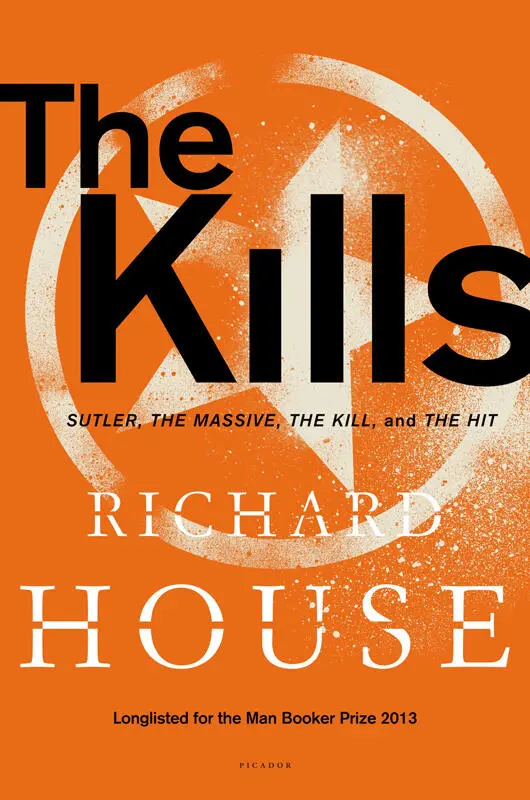
- Название:The Kills
- Автор:
- Издательство:Picador
- Жанр:
- Год:2013
- ISBN:нет данных
- Рейтинг книги:3 / 5. Голосов: 1
-
Избранное:Добавить в избранное
- Отзывы:
-
Ваша оценка:
The Kills: краткое содержание, описание и аннотация
Предлагаем к чтению аннотацию, описание, краткое содержание или предисловие (зависит от того, что написал сам автор книги «The Kills»). Если вы не нашли необходимую информацию о книге — напишите в комментариях, мы постараемся отыскать её.
The Kills — читать онлайн бесплатно полную книгу (весь текст) целиком
Ниже представлен текст книги, разбитый по страницам. Система сохранения места последней прочитанной страницы, позволяет с удобством читать онлайн бесплатно книгу «The Kills», без необходимости каждый раз заново искать на чём Вы остановились. Поставьте закладку, и сможете в любой момент перейти на страницу, на которой закончили чтение.
Интервал:
Закладка:
The door opened directly onto the street, he watched a woman come out and manhandle a wheelchair onto the road. The chair was cumbersome, and strapped into it was a young boy, one arm on his lap the other held up to his chest, crooked, his head slightly twisted. The traffic could not see her, and came fast round the turn, coming dangerously close to the wheelchair. The woman lumbered the chair out onto the road, and once it was on even ground it seemed to move by itself. The woman, the child’s mother or aunt, walked beside the boy to protect him from the traffic. She walked with a little difficulty, a slight twist in her hips, an awkward gait, a plastic shopping bag hitched into her elbow that flew over her hands as the traffic passed close by them.
Marek considered returning to Naples.
The house sounded busy. Children upstairs, shouts coming from the kitchen, full of people who could not be seen. As no one answered the door Marek came timidly into the hall and then into the kitchen. Two women worked together, busy, preparing food, and they didn’t immediately notice him. When they did they sent him back down the hall and said he should go into the room on his left. Behind the building, through the open kitchen door, was a small courtyard, and he could see parts of cars and scooters parked up beside stacks of salvaged wood.
Nenella was younger than he expected, not much older, by appearance, than Marek himself. She wore jeans and a shirt with an embroidered design across the shoulder. Her hair was short and dyed a deep chestnut; she had none of the airs that he associated with faith healers and readers. There were newspapers spread out across the floor to either cover or collect, and at the back of the room, dark because of the drawn shutters, a fat old dog with rheumy eyes stretched out. Nenella appeared momentarily unsettled, surprised by Marek.
Disappointed that the woman appeared so ordinary, and a little ashamed to be explaining his doubts and troubles to a stranger, Marek began to stammer. Starting with the accident he described the difficulties and indifference that had settled upon him. Now anxious about what he was saying Marek began to sweat, and admitted that he did not know what he was doing.
After five minutes Nenella stopped him. There was nothing she could do. There was nothing to fix. She sent him away saying that she would not read for him. He would not conceive, she said, because he should have died that day. Every day after the accident came from a new life. He was a baby, she said, new-born, and there was no business between them.
* * *
He called Paola as he drove back and said that his mother was not well. He gave no details and used the tired language of those who don’t have time to explain. She’d taken a turn for the worse. She was seeing a specialist, he didn’t know when exactly, but it looked like they were running out of options. As far as he knew there were no further treatments possible. Lemi was coming from Frankfurt, they would stay at his cousin’s then drive to his mother’s house in Lvov. He didn’t know how long this would take. He hoped to be back in a week.
He returned to the palazzo one last time, collected his passport, left what money he could on the table. Just as he was about to leave he heard a key in the lock, and Paola came into the apartment on her own. He waited in the bedroom and said nothing as she crossed through to the bathroom. He wouldn’t normally be in the apartment at this time. So it was strange to him that she locked the bathroom door after herself, a piece of information he would not have guessed. He crept out of the bedroom and came slowly up the hall not wanting to make any noise, and not wanting to alarm or alert her. He thought of her without him, how his absence without an explanation would be cruel, and would hold her unnaturally to one place, where ordinarily, if they simply parted, she would be able to continue. She would understand the shape of such a departure. She would stay in the apartment, he could be certain of this. It wasn’t easy finding a place as good as this to live, certainly not at the rate she paid. He would stay with her, while apart, for long enough to ensure that he could hear about the palazzo. If anything happened, if the police started to make enquiries he would need to know. For the interim he would stay at his brother’s. He would wait, bide time until he could feel confident.
Then he would disappear. This much he had decided. Without Paola, without his mother, he would be untethered, and while this felt like a necessity, he realized that he had expected more with Paola, that while they weren’t perfect, they fitted, and that — he’d never thought of it so clearly before — he had expected to grow old with her.
The last details: the edge of parquet meeting the marble floor at the main entrance. The marble yellow and cracked at the wall, but bleached where it had been cleaned over many years. The weight of the door, and how, slow to draw shut, it became easier mid-swing. How the key needed to be turned twice to get the latch to properly cross the gap. These details would stay with him longer than the physical memory of Paola, how she lay beside him on their final night, her hand curved to the small of his back, how she muttered in her sleep when she slept on her side, small whispers, the subject: he could never guess.
WEDNESDAY: DAY K
Early on Wednesday evening Niccolò Scafuti, a security guard for the Persano-Mecuri chemical dye plant in Ercolano, reported the discovery of bloodstained clothes and a small black cloth shoulder-bag a few metres from the road on scrubland behind his apartment.
Built in the early nineteen-seventies, the Rione Ini estate dominated the south-eastern boundary of Ercolano. Poorly constructed of pre-cast concrete sections, the buildings overshadowed the surrounding wasteland. Only four of the planned twelve high-rise apartments were completed, although the foundations, drains and sewers were laid for the entire complex. The land about the estate remained tracked and broken, levelled in the spring and summer by a sloped field of grasses busy with red, papery poppies.
Niccolò sat out on the balcony and waited for his sister to return. At five o’clock the incinerator on via Tre Marzo burnt paper waste and sent up a plume of white, feathery ash. In the late afternoon a cool breeze blew in from the sea, and the heat rose off the concrete and caused the falling ash to momentarily pause, hover, then rise.
At six o’clock Niccolò took a plastic sack and slingshot and headed directly for the wasteland. As he walked through the scrub he followed a path running parallel to the road, his eye open for small pea-sized stones. The day had been frustrating, much of it spent manually raising and lowering a barrier as the new security passes would not work. The drivers coming into the compound waited for his service but did not acknowledge him. When they did talk they’d look at him, take a moment, then deliberately slow down.
Beside the track, partly hidden by the tall grasses, lay a brown shoulder-bag. Further to his left, in a one-metre-wide clearing, he discovered a small rubbery hump of clothes, as brown as the bag, which appeared to be dug out of the ground from a small scratched hole. He cautiously inspected the clothes, busy with ants, set hard and coated in sandy dirt. It was only when he opened out the T-shirt, saw the cuts, a series of small slashes, and noticed how the heavy stains stiffened the cloth that he realized they were stained with blood.
Niccolò looked back along the path to see what else he had walked by. Close to the road the grass was scorched in a wide path, and he guessed that an attempt had been made to burn the clothes and the bag. Alarmed at what else he might find, he checked carefully to see if there were other areas burned or flattened in the field — then he returned to the bag when he was sure that he was alone.
Читать дальшеИнтервал:
Закладка:
Похожие книги на «The Kills»
Представляем Вашему вниманию похожие книги на «The Kills» списком для выбора. Мы отобрали схожую по названию и смыслу литературу в надежде предоставить читателям больше вариантов отыскать новые, интересные, ещё непрочитанные произведения.






Обсуждение, отзывы о книге «The Kills» и просто собственные мнения читателей. Оставьте ваши комментарии, напишите, что Вы думаете о произведении, его смысле или главных героях. Укажите что конкретно понравилось, а что нет, и почему Вы так считаете.