Peter Buwalda - Bonita Avenue
Здесь есть возможность читать онлайн «Peter Buwalda - Bonita Avenue» весь текст электронной книги совершенно бесплатно (целиком полную версию без сокращений). В некоторых случаях можно слушать аудио, скачать через торрент в формате fb2 и присутствует краткое содержание. Год выпуска: 2015, ISBN: 2015, Издательство: Crown Publishing Group, Жанр: Современная проза, на английском языке. Описание произведения, (предисловие) а так же отзывы посетителей доступны на портале библиотеки ЛибКат.
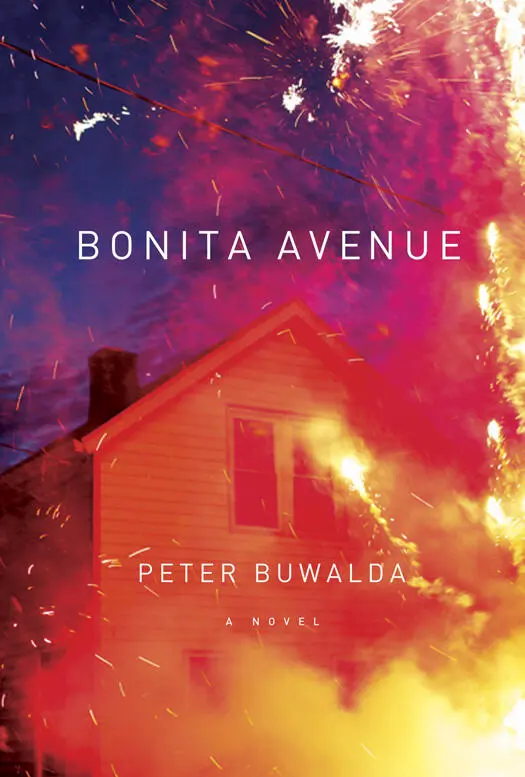
- Название:Bonita Avenue
- Автор:
- Издательство:Crown Publishing Group
- Жанр:
- Год:2015
- ISBN:978-0-553-41786-9
- Рейтинг книги:4 / 5. Голосов: 1
-
Избранное:Добавить в избранное
- Отзывы:
-
Ваша оценка:
Bonita Avenue: краткое содержание, описание и аннотация
Предлагаем к чтению аннотацию, описание, краткое содержание или предисловие (зависит от того, что написал сам автор книги «Bonita Avenue»). Если вы не нашли необходимую информацию о книге — напишите в комментариях, мы постараемся отыскать её.
A riveting portrait of a family in crisis and the ways that even the smallest twists of fate can forever change our lives,
is an incendiary, unpredictable debut of relationships torn asunder by lies, and minds destroyed by madness.
Bonita Avenue — читать онлайн бесплатно полную книгу (весь текст) целиком
Ниже представлен текст книги, разбитый по страницам. Система сохранения места последней прочитанной страницы, позволяет с удобством читать онлайн бесплатно книгу «Bonita Avenue», без необходимости каждый раз заново искать на чём Вы остановились. Поставьте закладку, и сможете в любой момент перейти на страницу, на которой закончили чтение.
Интервал:
Закладка:
The man kicked some guinea pig droppings out of the way, producing a high-pitched rolling sound. The woman raised her painted eyebrows and looked around. He hurriedly removed a stack of pizza boxes from the armchair next to the curtain. “Take a seat,” he said, gesturing toward the purple sofa, the only unoccupied place in the room because he himself was not lying on it. He set the boxes on the coffee table, on top of a brickwork of books, and sat down on the freed-up armchair. The container of pasta he’d been eating from was lying on its side next to the woman’s right foot, a congealed tongue of beige-colored sauce oozing out.
“You’re the boyfriend of Mr. Sigerius’s stepdaughter, is that right?” asked the man. He sat on the sofa like it was a gas station toilet. “According to our information, you and Mr. Sigerius are well acquainted.” He pointed to the badminton racket that stuck out from under a pile of boxes. “You work out together and are close friends.”
“That’s right.” He saw no reason whatsoever to go into the situation in detail. How would he explain it? That everything was ruined was none of their business.
“We’re interested in Sigerius’s son,” the fellow said. “His only biological child.”
Aaron nodded. The division of duties was clear: the woman sat with a notebook on her lap, poised to write down everything he said. He noticed her looking interestedly at the fence post. It was leaning like Gulliver’s toothpick against the emptied bookcase.
“Not so much in the son himself,” said the man, “but in his relationship with Mr. Sigerius. What can you tell us about that?”
The man’s tone switched between formality and familiarity like a traffic light. He simmered with aggression. In his own office, deep in the sub-basement of some concrete complex with endless corridors and security portals, a bright, monochromatic lamp dangled above the table.
“No contact,” Aaron said. “Zero. As you’re perhaps aware, he’s a bit of a, um … how can I put it nicely? A strange guy.”
The man nodded earnestly, but the woman, reacting to his last words, emitted a brief chuckle, which she tried to disguise with her hand. Seeing that he was on to her, she asked: “What is that pole doing there?”
“I need it during my expeditions,” he said, too eagerly and too earnestly — he regretted it immediately, and as he did not elucidate further, they all sat staring at the muddy fence post he had unearthed in a park on one of his trips to the supermarket. At the top, where a steel cable had once been threaded through the nails, he had tied a length of rope.
“Expeditions?” the man asked. He enunciated the word as if it did not have a scientific connotation, but a menacing one, a threat to national security, which he moreover seemed to take personally.
Aaron nodded. “If we just wait for government agencies,” he answered as truthfully as possible, “we’ll never get to the bottom of the fireworks disaster. That’s why I’m devoting my free time to investigating the underlying explanation of things.”
The guy locked his gaze onto him, red-hot steel that Aaron had to let loose. “In the eschatological sense,” he explained, looking at the woman. She smiled at him as though he were lying in a crib. “And what does that pole have to do with it?”
Everything. Was he supposed to tell them that sometimes, when his neighbor’s lights were out, he would drag his fence post to a stretch of painted fencing across from the Rijksmuseum, prop it against the partition, climb up onto it and pull himself onto the top rail? Then he’d hoist the pole up by the rope and jump down into pitch-black ruins. A few times, he wandered around, sneezing from the ashes his feet kicked up, shining his flashlight on chunks of rubble. Agonizing about the meaning of it all, the myriad consequences, all of them causal, he poked around the colossal vehicles that clean-up crews drove around during the day, studied the foundations of demolished houses like a dentist. When he became exhausted, or frightened by the din in his head, he went to the crater where the SE Fireworks bunkers once stood, now a sandpit cordoned off with plastic barrier tape. And then lay down on his back, stared up from his observatory at the stars, allowed himself to be trampled by the stampede in his brain. It was a scary place. Was it wise to tell these cops about it? The fear in the focal point of his sooty enclave. In the distance, a halo from the unwitting city.
“Nothing,” he said.
“Do you recall any conflicts between Sigerius and his son?” the man asked. Eschatology didn’t seem to interest him one iota.
“Oh yes,” he replied. “They fought about everything. Even about a glass of Coke.”
“You just said they had no contact.”
“Did I? They don’t; haven’t for a long time. It’s not something I’d say lightly.”
The guy fired a barrage of insinuating questions at him, fishing for signs of problems between Wilbert and his father; he was after something. As though what he’d most like to have heard was that Sigerius and Wilbert had had fisticuffs right here in this room and smashed, the two of them, through the sliding door. Meanwhile some details came to mind. I could blab, he thought, I could tell them what I know about the court case against the kid, and the deceitful role Sigerius played. For now he let the man talk, heard himself give evasive answers, and was surprised to notice himself flagging, almost nodding off. Or were those in fact his waking moments? He wondered other things too, like who Sjöwall and Wahlöo reported to, and would Sigerius find the transcript of this interview on his desk in the morning? The he-man had guaranteed him anonymity at first, it was a routine screening, he claimed, but the secret service often kept things from you.
“Who’s calling themselves the secret service?” he asked.
“How about if we ask the questions,” said the woman. The secret agent got up with a sigh, squashing pizza boxes with his Italian shoes. Shivering from the cold, he walked alongside the bookshelves. “This is nothing,” Aaron said. “It’s supposed to freeze tonight.”
“You moving or something?” the guy asked, his chin pointing like a urinal toward the stacks of books piled here and there. No, he wasn’t moving, but he just couldn’t stand it anymore, the thousands of spines staring at him from the shelves.
“Maybe,” he answered. He used to like to stare back, but these days it only depressed him, even now that his broad-shouldered friend stood at them, rubbing his hands, his back squarely in his jacket, on the verge of instigating one of his forays: crouched down, on the balls of his feet, asking questions, a steady stream of questions. Had he read them all? What did he think of that Vestdijk? Had he read this ? What’re they worth, all these books? Why didn’t he lend them out? How did he keep them alphabetized? What was the point of a first edition? And Naipaul, was he worth reading? And bam, there was Sigerius again, holding up one of the thousands of novels he had dragged off to his nest in the years after his Utrecht debacle, a mountain of never-to-be-read books that had exerted such an attraction on Sigerius. Why did he think this or that author was so good? And this one, isn’t he overestimated? So I should read him? What do I have to read before I die? — limitless interest, Aaron at first wondering whether it was genuine, or if Sigerius was just returning the favor for his own boundless curiosity about jazz.
The fact that Sigerius kept coming back proved he really meant it. He apparently missed their exchanges. And yes, he did have some catching up to do. Literature was his blind spot, he was ignorant about the oddest things. The man who’d stared at his books and now turned to look at him thought Dostoyevsky was a composer. Grew up among sailors and construction workers. Faulkner? No idea. In his speeches at the opening of an academic year, Sigerius never skimped on quotes, Ibsen, Isherwood, Irving, Ishiguro — everything with the I for Important, but decorative and discretionary. Suddenly he felt like commenting on it, a strange virulence washed over him. “You’ve read so little,” he said. “Practically nothing.”
Читать дальшеИнтервал:
Закладка:
Похожие книги на «Bonita Avenue»
Представляем Вашему вниманию похожие книги на «Bonita Avenue» списком для выбора. Мы отобрали схожую по названию и смыслу литературу в надежде предоставить читателям больше вариантов отыскать новые, интересные, ещё непрочитанные произведения.




Обсуждение, отзывы о книге «Bonita Avenue» и просто собственные мнения читателей. Оставьте ваши комментарии, напишите, что Вы думаете о произведении, его смысле или главных героях. Укажите что конкретно понравилось, а что нет, и почему Вы так считаете.